
- AI impact on new college graduate jobs: What data shows
- What the AI impact on new college graduate jobs data actually measures
- Why the AI job market for recent graduates may look different
- Are new graduates losing jobs to AI, or are other forces involved?
- A practical checklist for AI-exposed occupations for college graduates
- What the evidence means for a recent graduate
AI impact on new college graduate jobs: What data shows
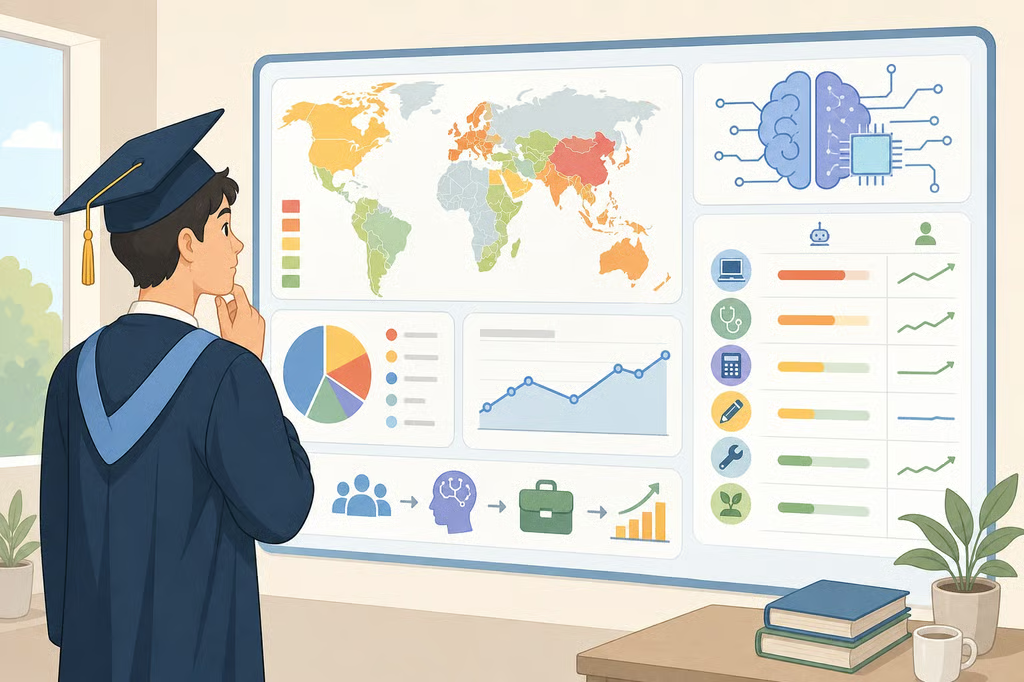
The AI impact on new college graduate jobs is difficult to measure directly because the newest studies track age, occupation, industry, and employment outcomes rather than college-graduate status. The evidence still matters for recent graduates entering the workforce, especially those targeting occupations with tasks that generative AI may substitute for or reorganize.
A Stanford analysis found that employment for workers ages 22 to 25 in highly AI-exposed occupations stood about 19% below where it would have been if it had kept pace with similarly aged workers in less-exposed occupations by June 2026. That is a comparison with a peer group, not a count of jobs lost to AI. Stanford Digital Economy Lab also found no evidence of widespread, economy-wide job displacement from generative AI.
A separate Census Bureau working paper identified a related pattern among early-career workers ages 22 to 24. In the most AI-exposed industry-state cells, regression-adjusted employment declined 12% over the 10 quarters following ChatGPT’s introduction. That figure is not a national estimate for all recent graduates. It describes a particular group, geography, and exposure measure. U.S. Census Bureau researchers also caution that earlier employment trends and other economic changes complicate the causal picture.
The useful question, then, is narrower than “Is AI taking jobs?” It is whether young and early-career workers are encountering weaker hiring conditions in certain occupations, what the data actually measures, and how a job seeker can evaluate a field without treating one statistic as a personal forecast.
What the AI impact on new college graduate jobs data actually measures
The Stanford findings come from the Canaries Dashboard, a collaboration between ADP Research and Stanford’s Digital Economy Lab. The dashboard uses anonymized ADP payroll data to track labor-market outcomes monthly across millions of U.S. workers. Stanford’s AI Economic Indicators announcement describes the dashboard as a near-real-time way to examine hiring, wages, and employment patterns.
That speed is useful, but it does not eliminate the limits of the data. The dashboard measures workers and occupations, not whether a worker recently earned a degree. A 22-year-old in an AI-exposed occupation may be a college graduate, but may also have entered the field through another route. Likewise, a 25-year-old may have several years of experience. The findings should therefore be read as evidence about young workers, with direct relevance to recent graduates who compete for the same early-career roles.
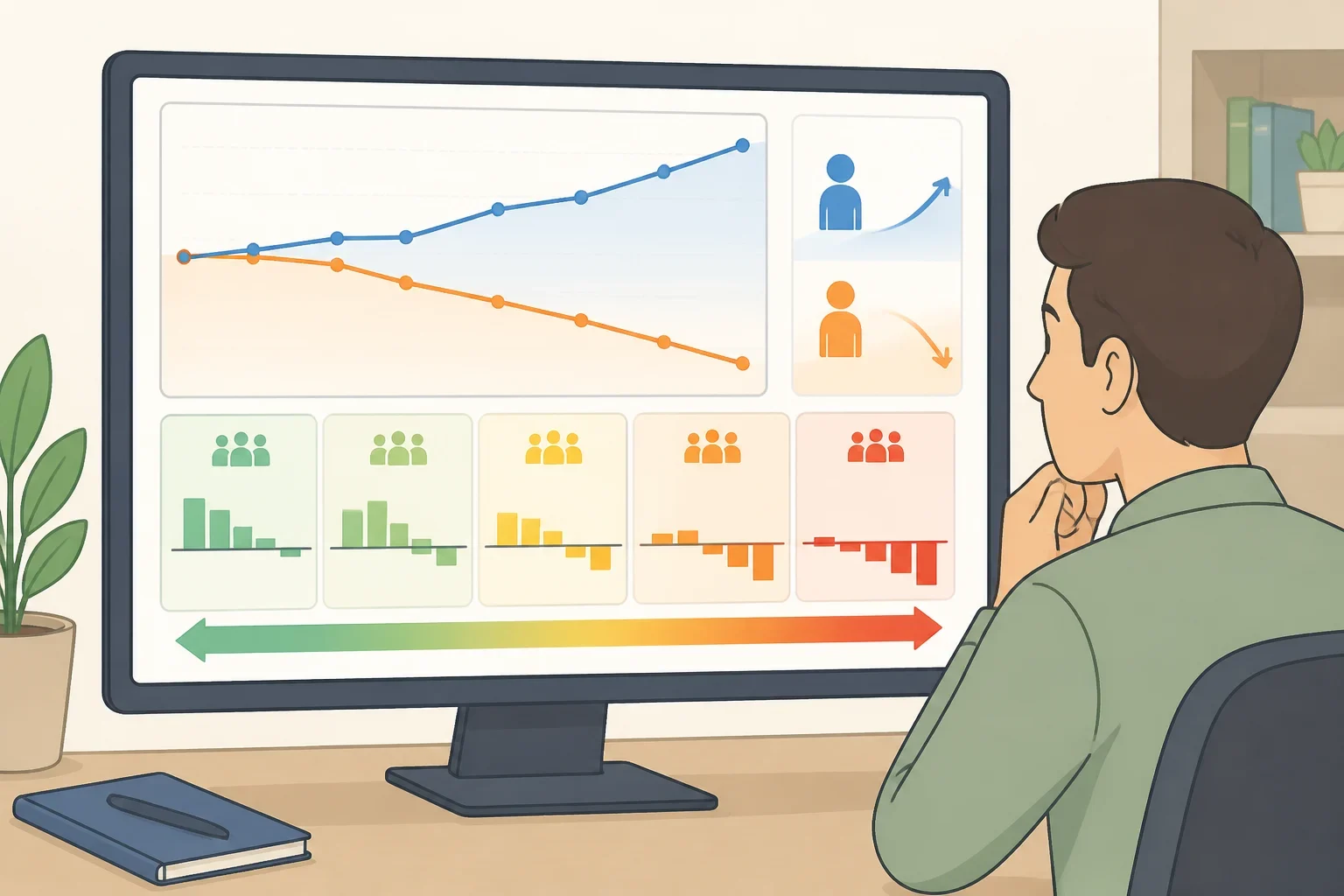
Stanford divides occupations into five exposure groups, or quintiles. A quintile is one-fifth of the occupation sample, ordered from lower to higher exposure. In the comparison cited above, the two most-exposed quintiles are grouped together and measured against the three least-exposed quintiles.
The difference is substantial in the underlying employment levels. Between November 2022 and June 2026, employment among 22-to-25-year-olds in the two most-exposed quintiles fell about 11%, while employment for the same age group in the three least-exposed quintiles grew about 10%, according to Stanford’s August update. These figures describe changes within the study’s groups. They do not show that every occupation in either group moved in the same way.
The Census study offers a different lens. It uses matched employer-employee administrative records and examines industry-state cells, rather than the occupation-level payroll comparisons used by Stanford. Its 12% figure applies to early-career workers ages 22 to 24 in the most AI-exposed cells over the 10 quarters after ChatGPT’s introduction. The two sources show broadly consistent raw patterns by age and industry, but their samples, age ranges, units of analysis, and methods differ. That makes the Census results useful corroboration, not a full replication of the Stanford estimate.
“AI-exposed occupation” also needs a careful definition. It is a technical classification based on the tasks and activities associated with an occupation. It does not mean an employer has decided to replace every worker in that role. Two people with the same job title may perform different work, and one employer may use AI to reduce routine tasks while another uses it to expand what junior employees can produce.
For a recent graduate, the relevant question is not simply whether a job title appears on an exposure list. It is which entry-level tasks are central to the role, whether those tasks are being automated, and whether the employer is redesigning the job around human review, judgment, communication, or client responsibility.
Why the AI job market for recent graduates may look different
The evidence points most clearly to hiring and entry, not to a broad wave of separations among established workers. Stanford reports that the employment divergence operates primarily through reduced hiring of young workers rather than increased separations. Experienced workers in the same occupations show no comparable employment gap in that analysis. Stanford’s research summary describes the adjustment as occurring through employment rather than base compensation.
Base compensation means base pay, excluding bonuses, equity, and other variable pay. That distinction matters. The finding does not establish that total compensation has remained unchanged, nor does it show that experienced workers face no risk. It says that the measured adjustment has appeared more strongly in employment outcomes than in base pay.
The Census paper similarly identifies a sharp decline in early-career hiring around ChatGPT’s introduction and reports that the fall in hires was the primary contributor to the subsequent employment decline in the most exposed cells. The paper also reports that the hiring rate had largely recovered by early 2025, a change attributed to a smaller employment base. That does not mean the entry-level market had returned to its earlier position. A similar hiring rate applied to a smaller group can coexist with fewer young workers employed overall.
This distinction changes the practical problem for a new graduate. The immediate challenge may be getting the first opportunity rather than losing an established position. A tighter pool of entry-level openings can make applications more competitive, but the supplied research does not establish how long an individual search will take or predict the outcome for a particular field.
It also affects how a graduate interprets a rejection. “AI caused my unemployment” claims more certainty than the evidence allows. A more accurate description might be that the target occupation has experienced an employment and hiring pattern associated with higher AI exposure, alongside other factors that may affect demand.
The pattern is not limited to technology. The Census paper reports an association between higher AI exposure, reduced early-career employment, and fewer hires across most sectors of the economy. That means graduates in fields outside software should examine the tasks in their target roles rather than assuming that generative AI and entry-level jobs are only a technology-sector issue.
Are new graduates losing jobs to AI, or are other forces involved?
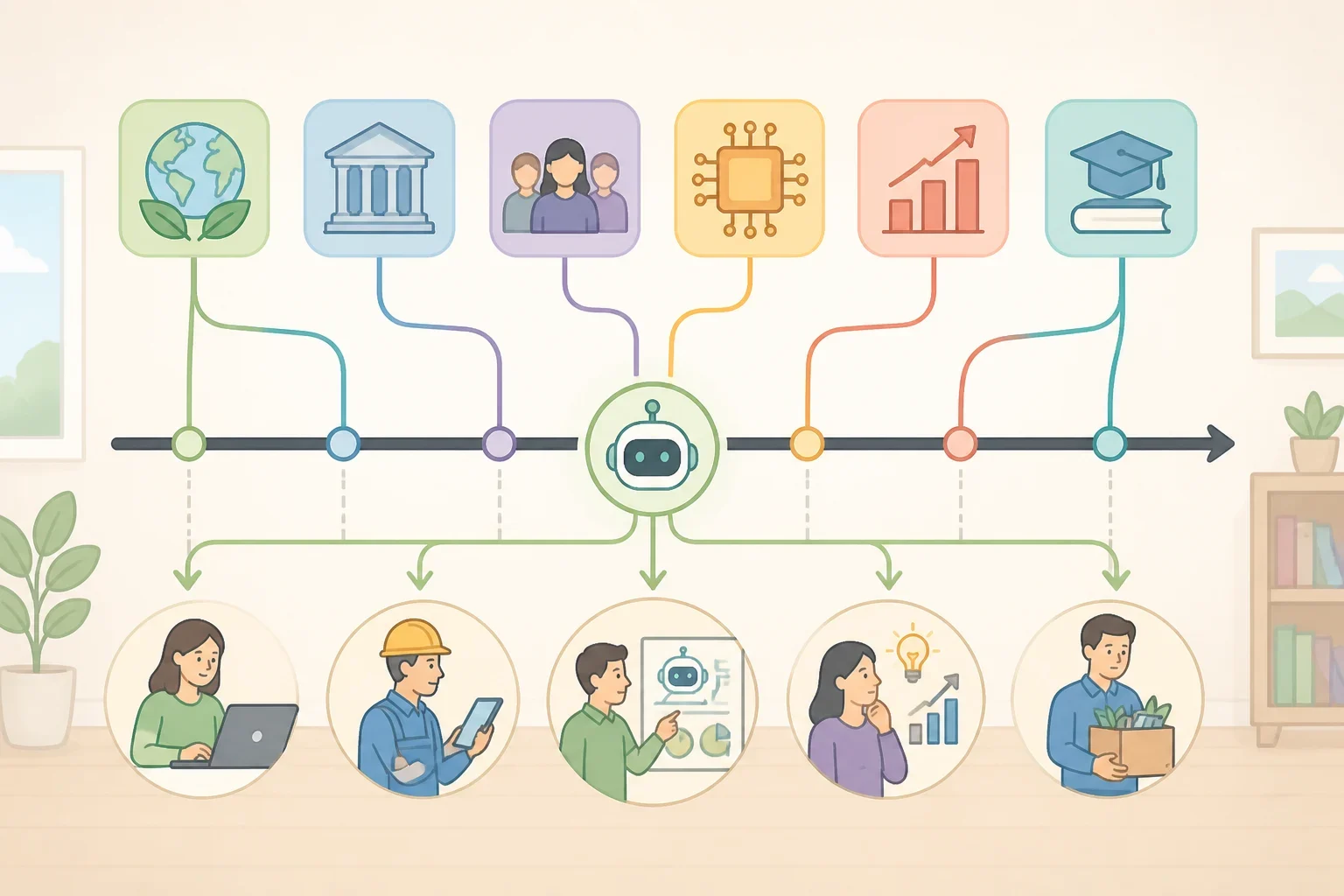
The studies provide evidence of an association, but they do not create an experiment comparing a labor market with AI to an identical labor market without it. Stanford researchers have explicitly warned against treating AI as the sole determinant of employment. Their February analysis says the researchers cannot be certain about causality from this type of analysis. Stanford’s February analysis also finds that the relationship becomes more notable in 2024 after applying a stricter model with firm-time fixed effects. Earlier declines may partly reflect other forces.
That timing is important. A change visible after the widespread adoption of generative AI is consistent with an AI-related effect, but it does not prove that AI explains the entire change. Both research efforts identify differential trends that began before widespread generative AI use. The Census paper discusses the COVID-19 pandemic, increased remote work, and rising educational attainment among workers in AI-exposed occupations as possible parts of the background.
Interest rates provide another test. Stanford reports that existing evidence does not suggest interest rates are a good explanation for the disproportionate decline in entry-level hiring in AI-exposed occupations. The occupations most exposed to AI are not the same as those most sensitive to interest rates. The Census analysis reaches a more qualified conclusion: monetary-policy shocks may account for up to one-quarter of relative early-career employment declines through the second quarter of 2025, but they do not explain the rapid decline in hires at the most AI-exposed firms compared with others.
Those findings can coexist. Interest rates may have affected the broader employment picture without explaining the specific hiring pattern associated with AI exposure. Treating the research as a competition between one single cause and another would oversimplify what the studies actually show.
Education adds another layer. Stanford reports that the gaps between more- and less-exposed young workers shrink when education is taken into account. That suggests education and occupational sorting are related to who appears in the affected groups, but it does not establish that a degree protects a worker from AI-related hiring changes. A credential may help a graduate qualify for certain roles, while also concentrating that graduate in occupations with particular task profiles.
For job seekers, causal uncertainty is not a reason to ignore the data. It is a reason to use it carefully. The evidence supports saying that higher AI exposure is associated with fewer early-career hires and weaker employment outcomes in the studied groups. It does not support telling an individual that AI caused a rejection, that a specific occupation will disappear, or that established workers are secure.
A practical checklist for AI-exposed occupations for college graduates
The research cannot determine which applicant will be hired. It can help a graduate ask better questions about a target occupation.
Identify the occupation and its actual entry-level work
Start with the specific occupation, not a broad major or industry. Read several current job postings and list the duties that appear repeatedly. Separate routine production tasks from responsibilities involving judgment, client communication, quality control, research, or decisions that require context.
For example, a marketing applicant might see that entry-level work includes drafting campaign copy, organizing performance data, checking brand standards, and explaining recommendations. An analyst might be expected to clean data, maintain spreadsheets, investigate unusual results, and present findings. A junior developer may write code, test generated code, document changes, and troubleshoot issues that automated tools do not resolve.
This exercise does not prove that a task will be automated. It shows where to investigate.
Compare automation with redesign
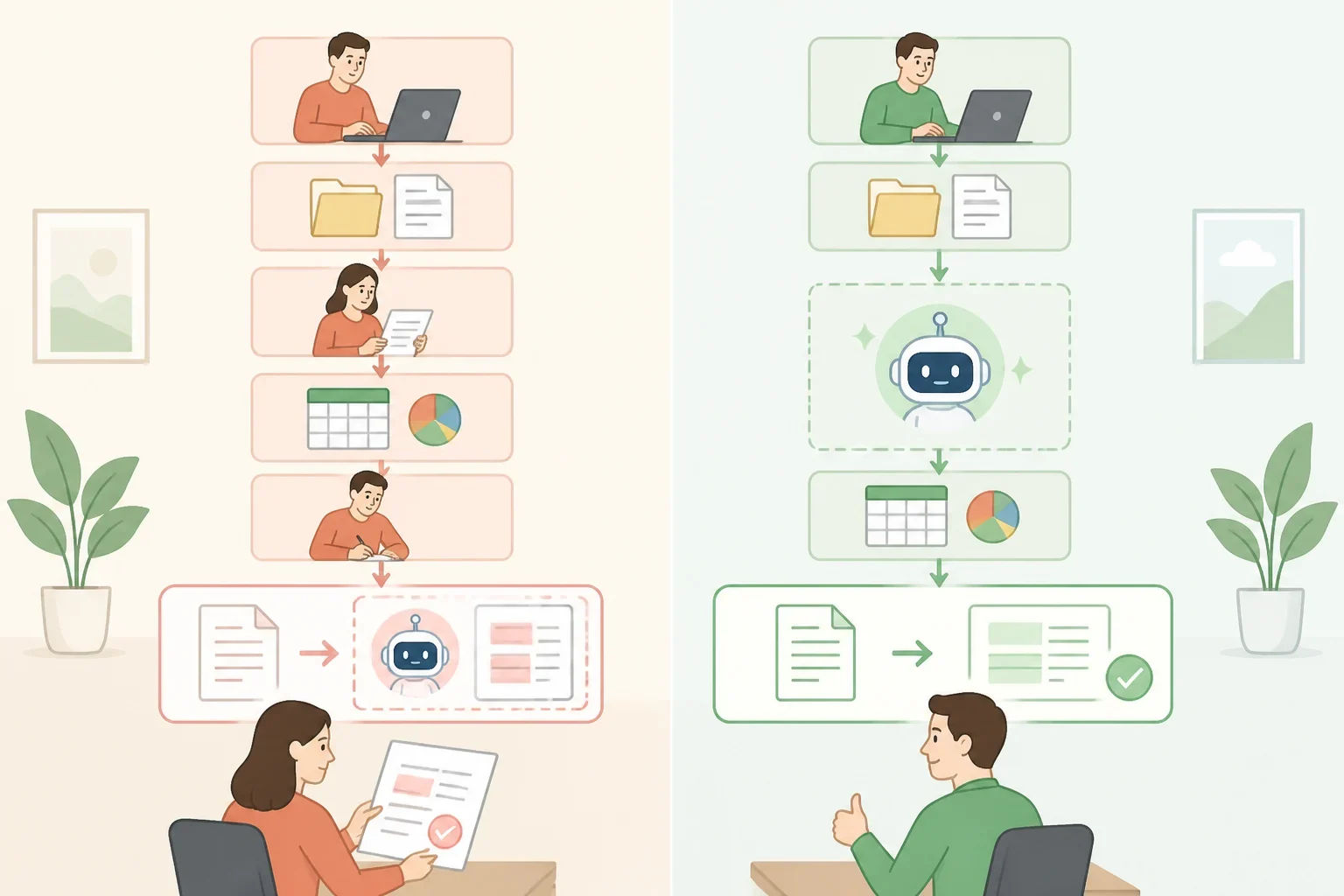
Ask whether AI is being used to remove a task or to change who performs it. If a tool produces a first draft, the remaining work may include verifying accuracy, correcting errors, protecting confidential information, and adapting the result to a customer or business need.
That distinction should shape a work sample. A marketing applicant could show a draft created with assistance alongside the verification process, revisions, and reasoning behind the final version. An analyst could document how spreadsheet formulas or AI-generated calculations were checked against source data. A developer could explain how generated code was tested, reviewed for security or reliability, and revised.
These examples demonstrate a process, not generic familiarity with an AI tool. Tool familiarity alone does not guarantee employment.
Build evidence that fits the field
Choose one small project that reflects the target role. The project should make clear:
- what problem the work addressed
- which tools were used
- how accuracy or quality was checked
- what decisions required human judgment
- what the final result contributed
A graduate does not need to claim expertise in every AI system. A clearer application might say that a candidate can review generated copy for factual and brand issues, audit AI-assisted spreadsheet work, or test and document generated code. The useful skill is tied to the occupation and its standards.
Ask targeted interview questions

Interview questions can reveal whether a team is replacing junior tasks, adding AI to existing work, or expecting new hires to learn a changed process. Candidates can ask:
- Which AI tools, if any, does the team use in this role?
- What work is still completed and reviewed by junior employees?
- How are new hires trained to check AI-assisted output?
- What rules apply to confidential or customer information?
- How is performance evaluated when tools change the amount of routine work?
- Which responsibilities require independent judgment?
The answers may also show whether the employer has a structured training process. That information helps a candidate compare roles, not simply decide whether a job is “AI-proof,” a promise the available evidence cannot support.
Compare more than one entry route
When direct entry-level hiring is limited, internships, apprenticeships, referrals, and contract roles can provide additional ways to demonstrate relevant work. These are strategies, not findings from the Stanford or Census studies, and they will not fit every occupation or personal situation.
The comparison should be practical. An internship may offer supervised experience and a work sample. An apprenticeship may connect training with a defined occupation. A contract assignment may provide a project that can be discussed in later applications, but its terms and stability need careful review. A referral can help an application receive attention, but it does not replace evidence that the candidate can perform the work.
What the evidence means for a recent graduate
The data supports a targeted story about young workers in AI-exposed occupations, not a claim of economy-wide displacement. Stanford’s June 2026 estimate, the 11% and 10% group changes, and the Census paper’s 12% result all describe relative or study-specific outcomes. They are not counts of jobs lost by college graduates.
The evidence is also more direct about hiring and entry than about what happens to every worker after being hired. That distinction should guide career planning. A graduate evaluating an AI-exposed field should examine task changes, build a role-specific work sample, compare training and entry routes, and ask employers how junior work is supervised.
For ongoing monitoring, Stanford’s AI Economic Indicators platform provides regularly updated dashboards at indicators.stanford.edu. Use it to watch broad labor-market patterns, not to predict one occupation or one application outcome. The next useful step is to pair that broader view with current job postings and direct questions about the work a particular employer actually needs done.
