

How AI is affecting the US job market by occupation
Payroll employment fell by 23,000 in July while unemployment held at 4.1%. That points to a labor market that has cooled, but it does not show that artificial intelligence caused the decline. Monthly payroll data show where employment changed by industry. They do not identify whether a lost position was replaced by software, affected by demand, or eliminated through another business decision.
That distinction is the starting point for understanding how AI is affecting the US job market. Current labor data provide a snapshot of employment. BLS projections offer a forward-looking estimate of which occupations may gain or lose jobs as technology changes productivity and employer demand. For job seekers, career changers, and workers in administrative, customer-service, financial, legal, or technology-related roles, the practical question is not whether a job has an AI label. It is how the work is changing, and which skills employers are asking for alongside AI tools.
What current US labor market data show
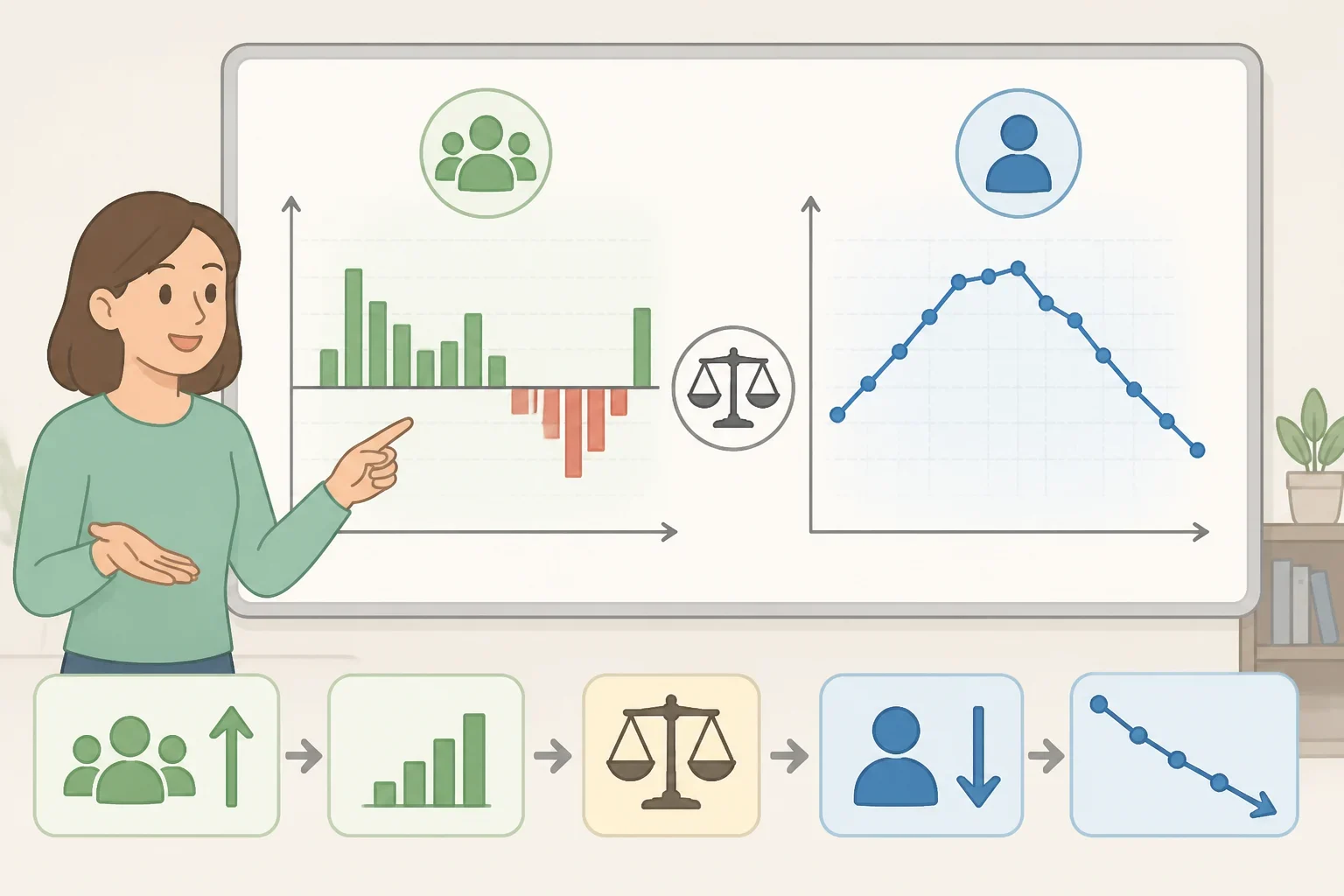
The July employment figures, reported ten days ago, showed little change overall. Payroll employment declined by 23,000, after averaging 34,000 monthly gains over the preceding 12 months, while the unemployment rate remained 4.1%, according to BLS. That is a clear slowdown from the prior pace, but the data do not establish AI as its cause.
The revisions make the labor market look softer than earlier estimates suggested. May’s payroll gain was revised from 129,000 to 63,000, and June’s from 57,000 to 20,000. Together, those revisions reduced the previously reported employment gain for the two months by 103,000, BLS reported ten days ago.
The July losses were concentrated in particular areas. Local government education employment fell by 50,000, retail trade lost 19,000 jobs, and financial activities declined by 14,000. Financial activities employment was 121,000 below its recent peak in May 2025, with losses in credit intermediation and insurance, according to BLS, which reported the July results about five weeks ago.
Those figures are consistent with a slower labor market. They are not a count of AI-related layoffs. The establishment survey measures nonfarm employment, hours, and earnings by industry, rather than asking whether a position was eliminated because of automation. A decline in finance, retail, or education could reflect several business conditions, and the available data do not separate those causes.
Other indicators describe the labor market without resolving the question. The number of people on temporary layoff increased by 153,000 to 921,000 in July, while the number of permanent job losers remained at 1.7 million, BLS reported about five weeks ago. Those measures may help readers understand the broader employment environment, but they do not show how many workers were displaced by AI.
For someone deciding whether to retrain, that limitation matters. A headline about falling employment in finance or retail cannot answer whether a specific occupation is becoming less viable. That requires a closer look at the occupation, its recurring tasks, and the qualifications appearing in current job postings.
Which jobs are most affected by AI?
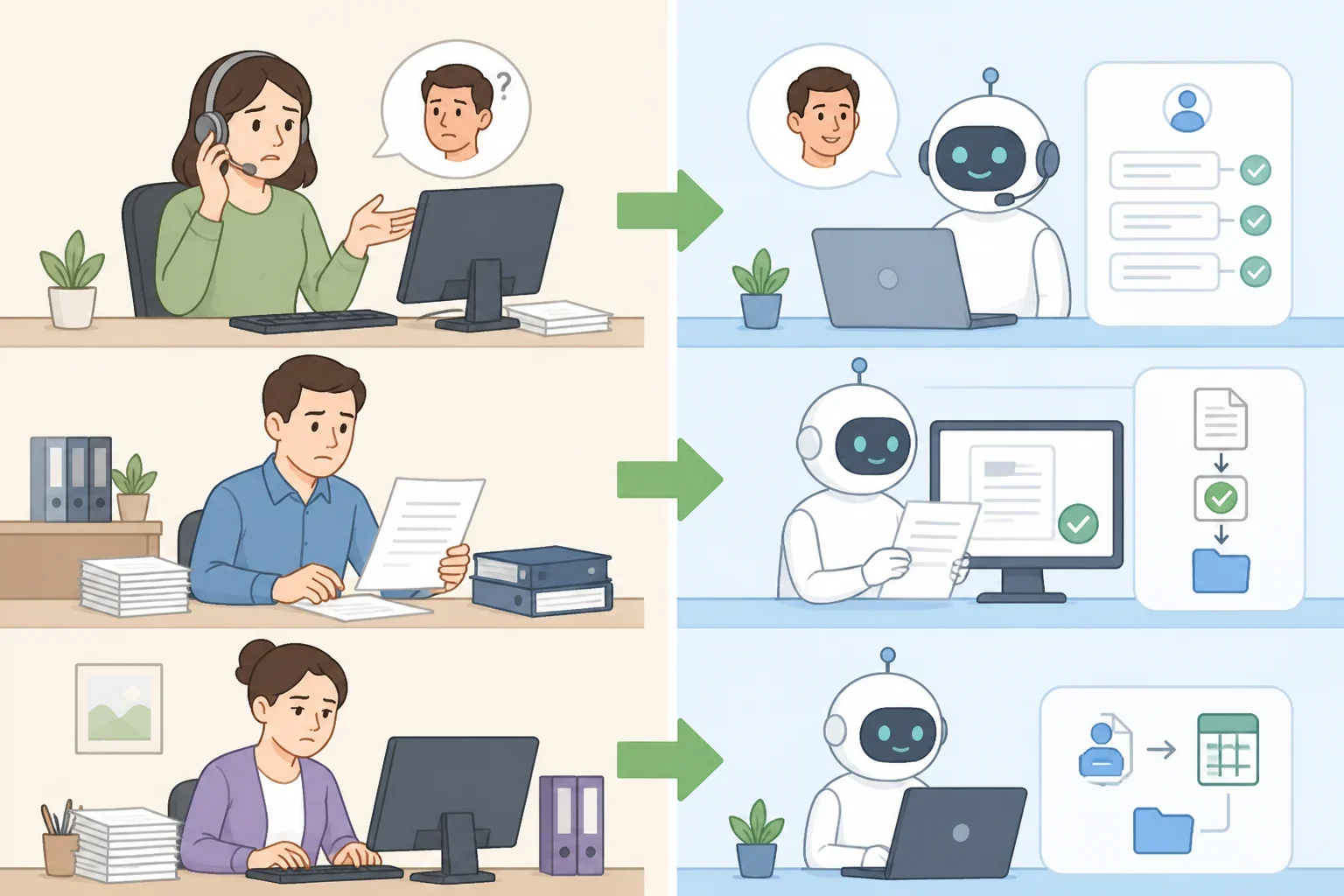
The jobs most affected by AI are not necessarily entire industries. They are often occupations with a large share of repeatable information-processing work. BLS says increasing use of information technology, including AI, is expected to raise demand in some occupations while reducing employment in others over the 2024-34 period, according to an analysis published about two months ago BLS.
Customer service representatives are projected to decline by 5.5%, or 153,700 jobs, between 2024 and 2034. Procurement clerks are projected to decline by 8.7%, or 5,400 jobs. Legal secretaries and administrative assistants are projected to decline by 5.8%, or 9,000 jobs, while claims adjusters, examiners, and investigators are projected to decline by 5.1%, or 18,200 jobs, BLS reported about two months ago.
BLS connects these declines partly to AI adoption, productivity gains, and the integration of technology into workplace processes. The broader office and administrative support group is projected to decline by 4.0% and lose 752,100 jobs from 2025 to 2035, the largest numerical decline among major occupational groups in that projection, according to BLS, published three weeks ago.
That does not mean every worker in these roles will lose a job. It means employers may need fewer workers for some routine activities as systems handle more of the process. A customer-service position built mainly around scripted calls and chats may face a different outlook from one involving complex troubleshooting, relationship management, or responsibility for a difficult outcome.
The same distinction appears in sales. BLS says the integration of AI into routine calls, chats, and sales analysis is expected to limit demand for many sales workers, while e-commerce is also expected to affect the occupation, according to BLS three weeks ago. Workers should therefore examine the actual work behind a title rather than treating “sales” or “customer service” as a single category.
A useful starting point is a task audit:
- Which duties involve repeatable data entry, document processing, scripted communication, or standardized review?
- Which duties require judgment, explanation, customer relationships, or responsibility for an outcome?
- Are employers adding workflow software, automated chat, or AI tools to the role?
- Do current postings request analysis, quality control, systems knowledge, or technical communication in addition to traditional duties?
That review is more useful than labeling a job “safe” or “at risk.” It can show where a worker’s current experience transfers and where an additional skill may be needed.
Where AI is creating demand

AI can reduce demand for some tasks while increasing demand for workers who build, maintain, interpret, or apply technology. Data scientist employment is projected to grow 33.5% from 2024 to 2034, and software developer employment is projected to grow 15.8%, an increase of 267,700 jobs, according to BLS about two months ago.
Computer and mathematical occupations are projected to grow 10.1% from 2025 to 2035, more than three times the 3.1% projected growth for total employment. Professional, scientific, and technical services are projected to grow 7.5%, while information is projected to grow 6.5%. BLS links those projections partly to demand for AI-based systems, data processing, software development, research, and related consulting services, in projections published three weeks ago BLS.
Those figures point to areas worth researching, not guaranteed job offers. A person considering a technology-related path should examine postings for the exact role. One employer may prioritize data analysis, another software development, and another database work, systems maintenance, or technical communication.
AI may also change the work of people who use it rather than build it. A BLS analysis published last year says software developers can use AI to develop, test, and document code, improve data quality, and create user stories. That analysis projects software developer employment to grow 17.9% from 2023 to 2033, according to BLS last year.
The practical implication for current workers is narrower than “learn to code.” Learn how technology is used in the occupation, then strengthen the parts of the job that involve checking, explaining, applying, or taking responsibility for the result. The right skill should come from real job postings and workplace needs, not from a general assumption that every worker needs the same training.
AI exposure does not always mean job disappearance

Some occupations face direct competition from AI and still show projected employment growth. Personal financial advisors have begun facing competition from automated robo-advisors, yet BLS projects employment in the occupation to grow 17.1% from 2023 to 2033, according to BLS last year.
Legal work presents a similar distinction. AI can reduce the time lawyers and paralegals spend on some document-review tasks. At the same time, lawyer employment is projected to grow 5.2% through 2033, while paralegal and legal assistant employment is projected to grow 1.2%, BLS reported last year.
These projections do not prove that AI will improve employment prospects in either field. They show why “AI-exposed” should not be treated as a synonym for “disappearing.” An occupation can lose demand for particular tasks while retaining work that involves client relationships, professional judgment, communication, oversight, or accountability.
The projections also have limits. BLS says it uses a technology-progress scenario grounded in historical patterns rather than making highly speculative adjustments for the possibility of faster AI adoption, according to BLS three weeks ago. The estimates are useful baselines, but they do not settle how quickly employers will adopt new systems or how a particular workplace will reorganize jobs.
Industry growth does not protect every occupation
Healthcare shows why industry labels are not enough. Healthcare and social assistance is projected to have the largest job growth and be the fastest-growing industry sector, at 8.4% from 2025 to 2035, according to BLS three weeks ago. Healthcare employment also rose by 22,000 in July, including an 18,000 increase in ambulatory healthcare services, BLS reported about five weeks ago.
Within that growing sector, occupations can move in different directions. Medical secretaries and administrative assistants are projected to grow 4.2%, or 35,300 jobs, from 2024 to 2034, while medical transcriptionists are projected to decline 4.9%, or 2,200 jobs, according to BLS about two months ago.
The same reasoning applies to finance, technology, and professional services. A strong industry forecast does not tell a worker whether a particular occupation is expanding, contracting, or being redesigned. Check the occupational title and its duties before drawing a conclusion from an industry headline.
How to assess personal exposure to AI
Use BLS projections alongside a practical review:
- List the recurring tasks. Separate routine calls, chats, document review, data handling, and standardized processing from work requiring judgment, explanation, relationships, or responsibility.
- Compare several current postings. Look for repeated requests involving AI tools, workflow systems, analysis, quality control, customer retention, compliance, or technical communication.
- Check the exact BLS occupation. Confirm the projection period before comparing figures. The 2024-34 occupation estimates and the 2025-35 occupational-group estimates are not interchangeable.
- Test one adjacent skill before paying for training. Practice a skill that appears repeatedly in relevant postings through a project, current work, or structured learning. Then reassess whether it opens a realistic next role.
A customer-service worker might compare postings for technical support or customer success and note whether employers seek troubleshooting, product knowledge, or account-management skills. An administrative worker might compare operations or reporting roles and identify the spreadsheet, database, or process skills employers request.
The evidence points to a task-by-task assessment rather than a broad prediction of mass displacement. Current payroll data show a soft July labor market, but they do not establish AI as the cause. Longer-range projections point to pressure in routine administrative and customer-facing work, growth in occupations tied to AI and data, and continued demand in some fields where technology changes tasks without eliminating the occupation.
Before making a career move, save several postings for the role being considered, check the matching BLS occupation and projection period, and identify one skill that appears across those postings. That process gives a worker something more useful than an AI headline: a current view of the work, the requirements, and the next step worth testing.
