
- Has technology caused unemployment? AI and automation evidence
- What is technological unemployment?
- Does technology cause unemployment at the company level?
- How are labor shortages different from unemployment?
- What does the unemployment framework tell us?
- How to assess your own occupation
- What the evidence means for job security
Has technology caused unemployment? AI and automation evidence
Has technology caused unemployment? In some occupations and tasks, yes. But the evidence available as of September 2026 does not show broad economy-wide job loss from AI. For workers, job seekers, and career changers, the more useful question is narrower: which tasks are changing, whether the employer is growing or shrinking, and what skills could help someone move into work that still needs human judgment and interaction.
That distinction matters when headlines describe AI as either a job-destroying force or an automatic productivity boost. A Brookings analysis from last year links AI investment with firm growth and increased employment, while also documenting displacement in selected occupations. An OECD report from two months ago cautions that a poorly managed transition can still displace workers, with effects differing by sector, region, city, and skill level.
What is technological unemployment?
Technological unemployment occurs when a machine, software system, or AI tool performs work that previously required human labor, reducing the number of people needed for that activity. The affected activity may be a complete job, but it may also be only one part of a job.
Think of a customer-service representative who once searched a knowledge base, drafted routine replies, and summarized interactions manually. An AI tool may help that employee complete those tasks faster. The employer could then handle more requests with the same staff, reduce hiring for that function, redesign the role, or move employees toward escalations and relationship-based work.
The outcome depends on what the employer does with the productivity gain. A tool can reduce labor demand for a task without reducing total employment at the company. That is why task displacement, firm-level employment, and economy-wide unemployment need to be examined separately.
The Brookings review explains that AI can automate some cognitive tasks or raise productivity enough to reduce the number of workers needed. It also cites research by Brynjolfsson and colleagues finding that AI tools made customer-service workers much more efficient. In another example, research by Fedyk and colleagues found that audit firms using AI reduced their audit workforce, according to the same Brookings review.
So, does automation lead to job loss? It can, especially when software performs repeatable tasks. Evidence of reduced staffing in one occupation does not establish that every employer, industry, or worker will experience the same result.
A practical first step is to examine a job by task rather than by title. List the work completed each week, then mark activities involving routine information processing, drafting, classification, scheduling, or standard responses. That list gives a more useful starting point than asking whether an entire occupation is “safe” or “at risk.”
Does technology cause unemployment at the company level?
After a company adopts AI, the technology may be used to cut labor costs. It may also help the company develop products, serve more customers, or expand into work that was previously too expensive.
The Brookings analysis reports that a one-standard-deviation difference in AI investment was associated with approximately 20% higher sales growth over a decade. That amounted to roughly 2% additional sales growth per year, according to the same source. The finding describes an association, not proof that AI investment alone caused the growth.
Timing matters as well. Sales effects generally appeared about two to three years after firms invested in AI, and employment growth followed a similar pattern, according to Brookings. In the analysis, firms that invested more in AI increased total employee headcount, with employment growth of approximately 2% per year per one-standard-deviation increase in AI investment.
That does not cancel out individual risk. A company can add employees in product development or sales while reducing positions in auditing, customer support, or another function affected by automation. Some workers may be able to move into the new roles. Others may not have the required experience, location, or training.
At the industry level, Brookings found no displacement effect in its sample of publicly traded Compustat firms. Both sales and employment increased alongside AI use in that sample. The result is useful evidence about the firms studied, not a guarantee for small businesses, private employers, every occupation, or every local labor market.
For a job seeker evaluating an AI-adopting employer, a hiring pause should not automatically be read as proof of permanent decline. It should not be dismissed either. Check whether the employer is investing in new products, changing the duties in current postings, or hiring for adjacent roles. Compare several job postings over time, review company information when available, and ask recruiters how the role is expected to change.
How are labor shortages different from unemployment?
A reduction in labor shortages is not the same as a rise in unemployment. A labor shortage occurs when employers want more workers than they can readily find. If technology helps firms complete the same work with fewer employees, employers may advertise fewer openings without every displaced worker becoming unemployed.
Labor-market tightness describes the balance between employers’ demand and the available supply of workers. A tighter market generally makes roles harder to fill. A less tight market may bring fewer vacancies, slower hiring, or more competition among applicants. None of those conditions, by itself, identifies how many workers lost jobs because of technology.
An OECD analysis from nine months ago examined AI and digital technology diffusion, the green transition, globalization, and population aging across 26 OECD countries and 34 sectors. It found that digitalization and decarbonization increased labor-market tightness, while population aging had that effect over a longer period. The analysis also found that import competition and labor-substituting AI diffusion reduced shortages.
Those findings are not necessarily contradictory. Technology can increase demand for some skills and reduce demand for others. It can also change the mix of work inside an occupation. An employer may need fewer people for routine processing but more people who can check outputs, handle unusual cases, understand a regulated process, or work directly with customers.
The OECD report on skills in the AI age likewise states that employment effects differ across sectors, regions, cities, and skill levels. A national headline may tell a worker very little about a specific occupation in a specific city.
Before deciding that technology is affecting a career, compare:
- the tasks employers are automating or redesigning
- the skills appearing in current postings for the same occupation
- whether nearby employers are adding related roles or reducing openings
This comparison is more useful than relying on a national claim that AI is either eliminating jobs or creating them.
What does the unemployment framework tell us?
Unemployment has several possible causes, so assigning every job loss to technology is risky. A worker may be between jobs, affected by a business-cycle downturn, mismatched with available openings, or displaced by a structural change such as automation. Those categories can overlap.
The U.S. Bureau of Labor Statistics defines full employment as an economy in which the unemployment rate equals the nonaccelerating inflation rate of unemployment, no cyclical unemployment exists, and gross domestic product is at potential given available resources. The framework allows analysts to focus on structural changes rather than cyclical movements in the business cycle.
That explanation does not diagnose current technology-related unemployment, and it does not show that technology has caused no job loss. Its value is narrower: economy-wide unemployment figures cannot, by themselves, identify the role of AI. Analysts must separate cyclical conditions from longer-term changes in the structure of work.
For workers, that means a weak hiring market should not automatically be treated as evidence that an occupation has been automated. Check whether the problem appears in the work itself, in the local economy, or in the employer’s broader business conditions.
How to assess your own occupation
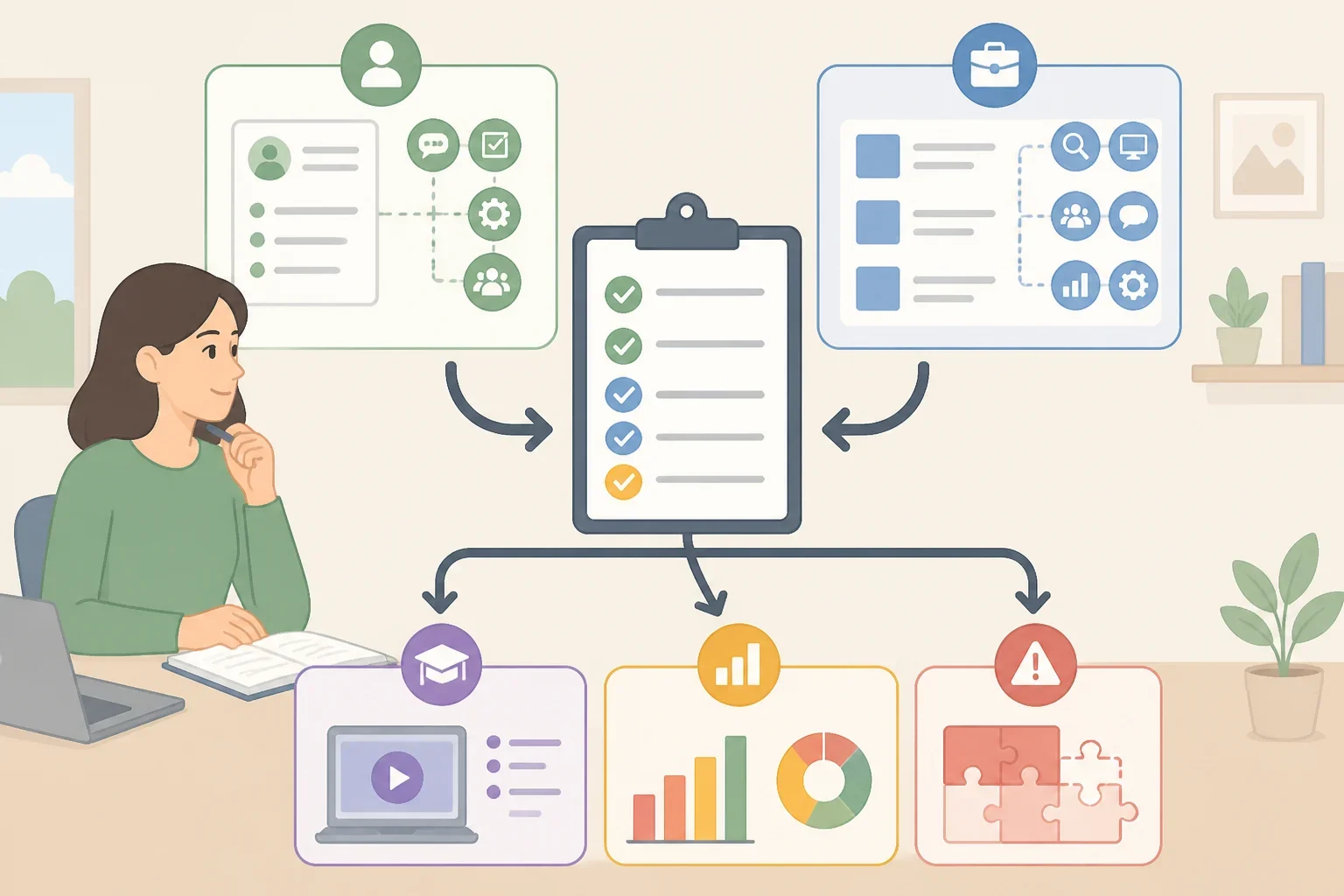
No source can promise that a job will remain unchanged. A better evaluation combines national occupational information with local evidence.
Start with the Occupational Outlook Handbook. Use it to review an occupation’s typical duties, education expectations, work environment, and broader outlook. National information provides context, but it may not capture a rapid change in a particular city, employer, or specialty.
Then use O*NET to examine the occupation’s tasks, skills, knowledge areas, and work activities. Treat that information as a way to organize the role, not as a definitive automation-risk score unless a specific feature and method establish that measure.
Next, review current job postings from several employers. Look for changes such as:
- routine duties being automated or handled through software
- increased demand for quality control, client communication, analysis, or domain knowledge
- AI-assisted workflow experience listed as preferred rather than required
- adjacent roles combining subject knowledge with technology skills
Finally, examine the training options connected to the target role. An employer may offer training, a community college may have programs connected to local hiring, and a state workforce agency may identify in-demand roles. These options do not guarantee a new job, but they can turn general concern into a specific comparison of skills, time, cost, and job duties.
The most useful skill-building choice is usually tied to a target role, not to AI literacy in the abstract. If the goal is to remain in the same field, practice the tools employers actually mention while strengthening judgment, communication, quality review, and subject knowledge. If a career change is under consideration, compare the current task list with two or three adjacent occupations and identify the smallest realistic training step.
What the evidence means for job security
Has technology caused unemployment? It has reduced labor demand for some tasks and occupations. The Brookings evidence also finds that AI use has been associated with firm growth and increased employment, with no widespread job loss in the evidence reviewed. Both findings can be true because a task, a firm, and an economy are different levels of analysis.
The OECD adds an important qualification. AI could raise productivity, support growth, and create new opportunities, but a poorly managed transition can still displace workers. The results vary by sector, location, and skill level.
Workers do not need to predict the entire future of AI to make a sound next move. Examine the tasks in the target occupation, compare them with current postings, review the Occupational Outlook Handbook and O*NET, and investigate employer or state training options. Then choose one concrete skill or adjacent role to research this quarter. That process gives a career decision more substance than either reassurance or fear.
