
- Job search strategies for college graduates in 2026: a pivot guide
- Why the Class of 2026 job market looks tougher than the headline number
- AI impact on entry-level jobs: what the research actually shows
- Why AI fluency alone won't set you apart in an entry-level job search
- Job search strategies for college graduates in 2026: build a role-comparison worksheet
- Some early-career churn is normal, but verify it against your own search
- Rewrite your resume and interview answers around what your application should show
Job search strategies for college graduates in 2026: a pivot guide
Workers ages 22 to 25 in the most AI-exposed occupations are now employed at a level 19% below where they would be if they had kept pace with similarly aged peers in less-exposed fields, according to Stanford Digital Economy Lab research published last week. That gap has widened from 15% a year earlier, and Stanford's researchers say it kept growing through mid-2026. For anyone mapping out job search strategies for college graduates in 2026, that widening gap is the number to understand before writing a single resume bullet.
This isn't a story about mass layoffs. Stanford traces the gap to employers hiring fewer young workers, not firing people already on staff. A Census Bureau working paper released earlier this year, still preliminary and not yet peer reviewed, reached a related but distinct finding: early-career hiring fell in the industry-state combinations most exposed to AI, again driven mainly by reduced hiring rather than separations. Meanwhile, U.S. payrolls fell by 23,000 in July, and May and June figures were revised down by a combined 103,000 jobs, according to the Bureau of Labor Statistics.
For graduates finishing school this year, the useful question isn't whether AI is broadly erasing entry-level jobs. Stanford's researchers say they don't see widespread, economy-wide displacement tied to AI. The narrower question is whether your target occupation, function, or sector is one where junior hiring is actually shrinking, and what a smarter search looks like if it is.
Why the Class of 2026 job market looks tougher than the headline number
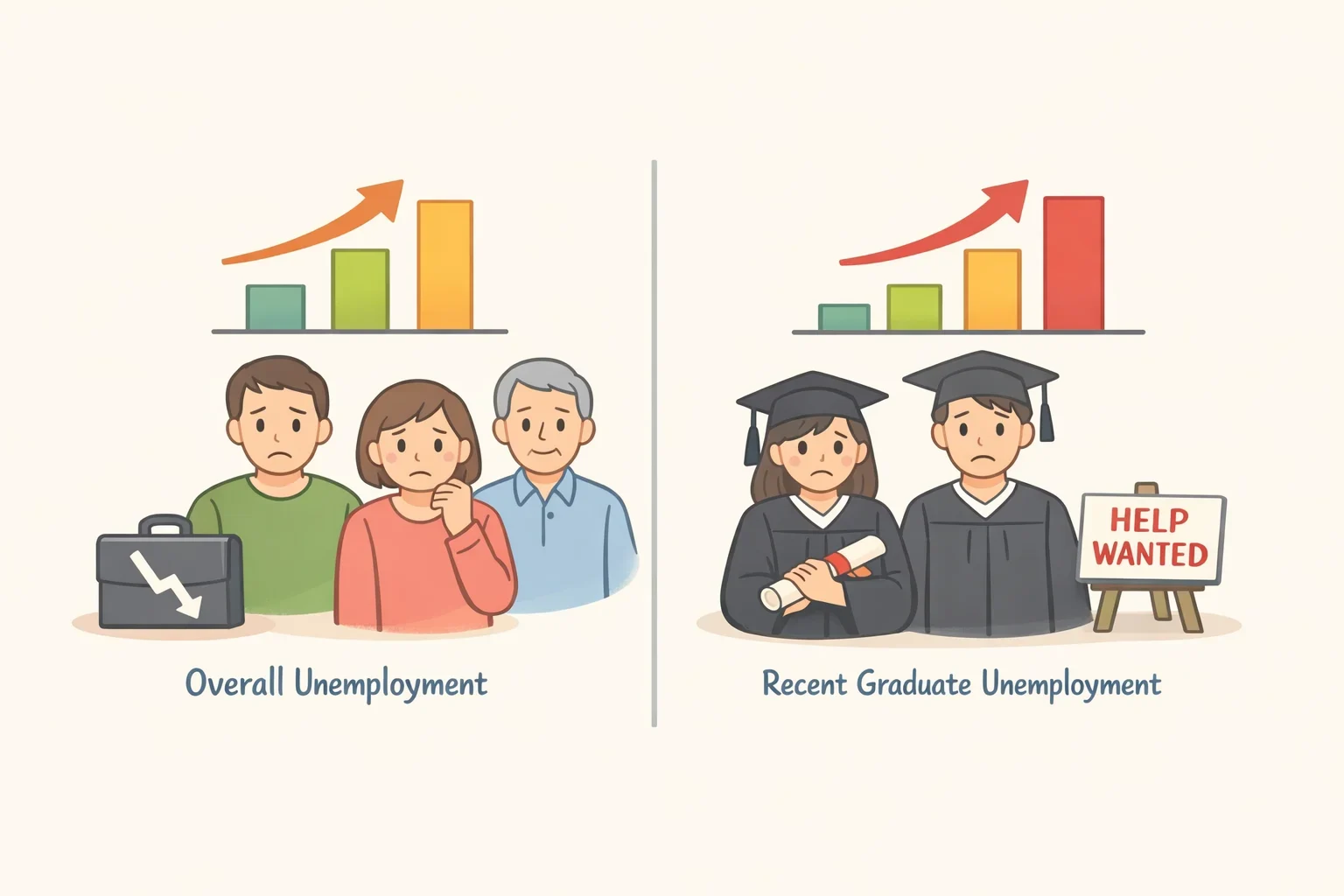
The national unemployment rate held at 4.1% in July, a figure that reads as fairly mild. But that number describes the whole labor force, not new entrants. Recent college graduates faced 5.6% unemployment in early 2026, up 1.6 percentage points from three years earlier, according to a Stanford SIEPR policy brief published last month.
Cohort-specific data and national data tell different stories. Weigh the former more heavily than a headline unemployment figure when judging your own odds.
Hiring has cooled overall, too. Total nonfarm payrolls dropped 23,000 in July after averaging monthly gains of 34,000 over the prior year, per BLS data released earlier this month. Sector performance underneath that topline number is uneven. Health care was among the sectors adding jobs in July, up 22,000, while local government education lost 50,000 positions and retail trade shed 19,000. Financial activities employment fell another 14,000 in July and has dropped a cumulative 121,000 since a peak in May 2025.
A cooling overall market and an AI-linked squeeze on junior hiring are two separate, overlapping pressures. Check current job postings and BLS industry data for your specific target sector rather than treating the national unemployment rate as a stand-in for your own market.
AI impact on entry-level jobs: what the research actually shows
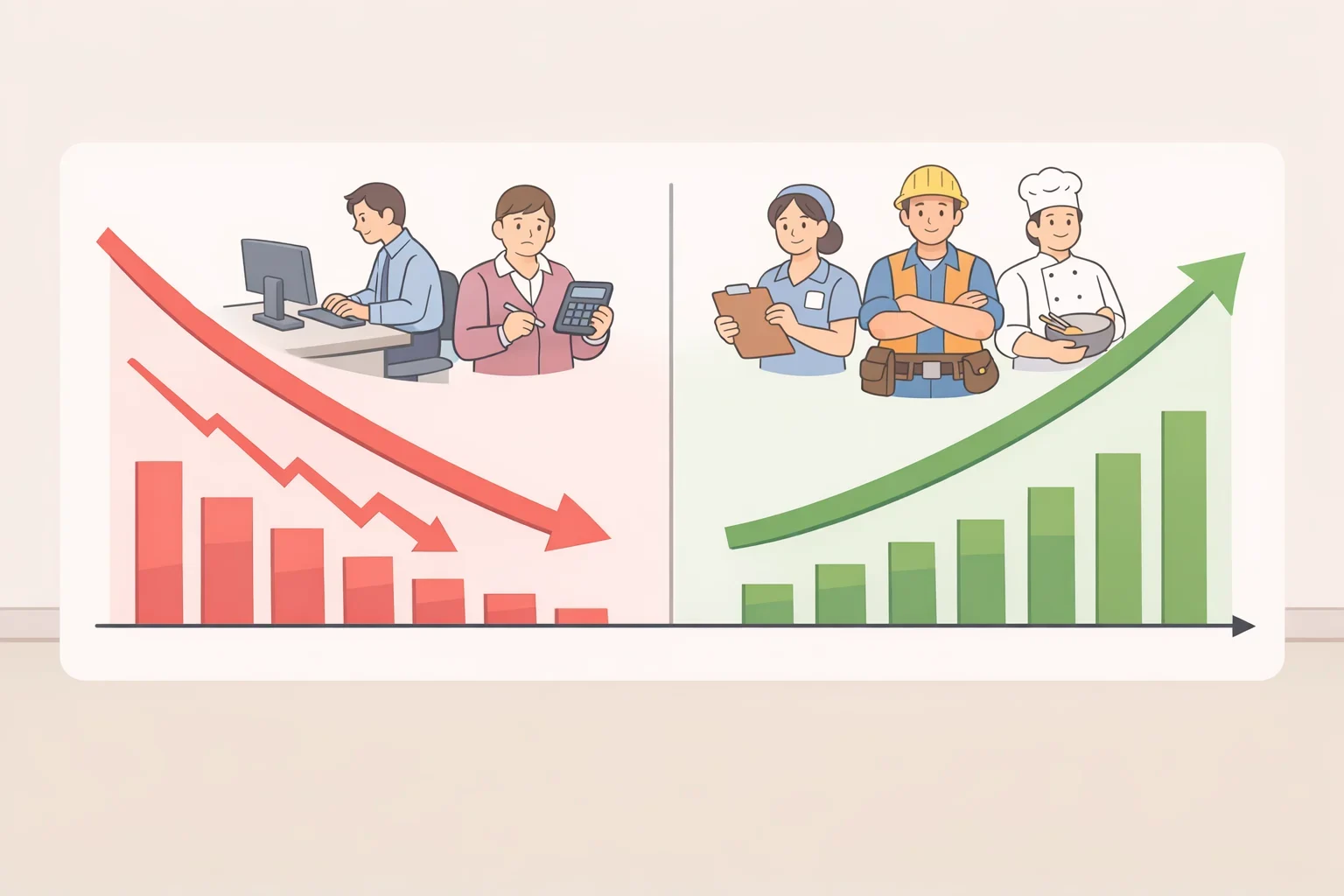
Employment among 22-to-25-year-olds in the two most AI-exposed occupation categories fell 11% between November 2022 and June 2026, while it rose about 10% in the three least-exposed categories, according to Stanford's analysis. That split, rather than a uniform downturn, is the core pattern in the data.
The Census working paper found something similar using a different method, though its status matters. It's a working paper, not yet peer reviewed, and its author flags that finding as preliminary. With that caveat, early-career employment among 22-to-24-year-olds fell 12% over the 10 quarters following ChatGPT's release in the industry-state combinations most exposed to AI, again concentrated in weaker hiring rather than terminations, according to the Census working paper.
Both studies point to a similar mechanism, even though they measure it differently. Employment built on codified knowledge, meaning standardized, documented, teachable tasks like software development or customer service, has declined for young workers. Employment in occupations where AI mostly complements rather than automates human work is flat or rising, with Stanford noting the strongest gains have gone to experienced workers whose expertise depends on tacit knowledge built through mentorship and repeated practice, not to young workers broadly.
Stanford's own researchers add real caveats. The gap narrows once education is controlled for, some of the divergence predates generative AI's spread, and the researchers say no single study, including their own, should be treated as definitive proof of what's causing it. Use that as a reason to research a target role's actual task mix, not as proof that an entire field is closed off.
Why AI fluency alone won't set you apart in an entry-level job search
AI tools measurably help less experienced workers close skill gaps, which makes the hiring slowdown counterintuitive at first glance. An AI customer service assistant raised overall productivity 15%, with less-skilled workers improving 30% in issues resolved per hour, while highly skilled agents saw no gain and even a slight dip in quality, according to Stanford SIEPR. GitHub Copilot let developers complete tasks 56% faster, with the largest gains going to less-experienced programmers, according to the same Stanford SIEPR brief. That's a specific finding about programmer productivity; it doesn't by itself explain the broader hiring gap for 22-to-25-year-olds across other AI-exposed occupations.
One possible explanation is that these productivity gains change how many entry-level workers an employer needs to produce the same output. That's a hypothesis worth understanding, not something the cited research proves for any individual employer's hiring decisions. The studies show a productivity effect, not the reasoning behind specific staffing choices. What the data does show is that adjustment so far has shown up mainly in employment levels, not in base pay for the people who do get hired, per Stanford's data.
It's also not universal. Firms with the highest AI investment per employee actually grew employment 10% over the two years following adoption, and 80% of executives surveyed by the Federal Reserve Bank of Atlanta said AI investments hadn't yet changed their headcount or productivity, according to Stanford SIEPR. Outcomes vary by employer as much as by occupation, which is one more reason a blanket "avoid this industry" approach doesn't hold up.
Given the productivity data above, treat basic AI tool fluency as a baseline expectation in your applications, not a differentiator. Use your resume and interview answers to show judgment, verification of AI output, and ownership of a project from start to finish instead.
Job search strategies for college graduates in 2026: build a role-comparison worksheet
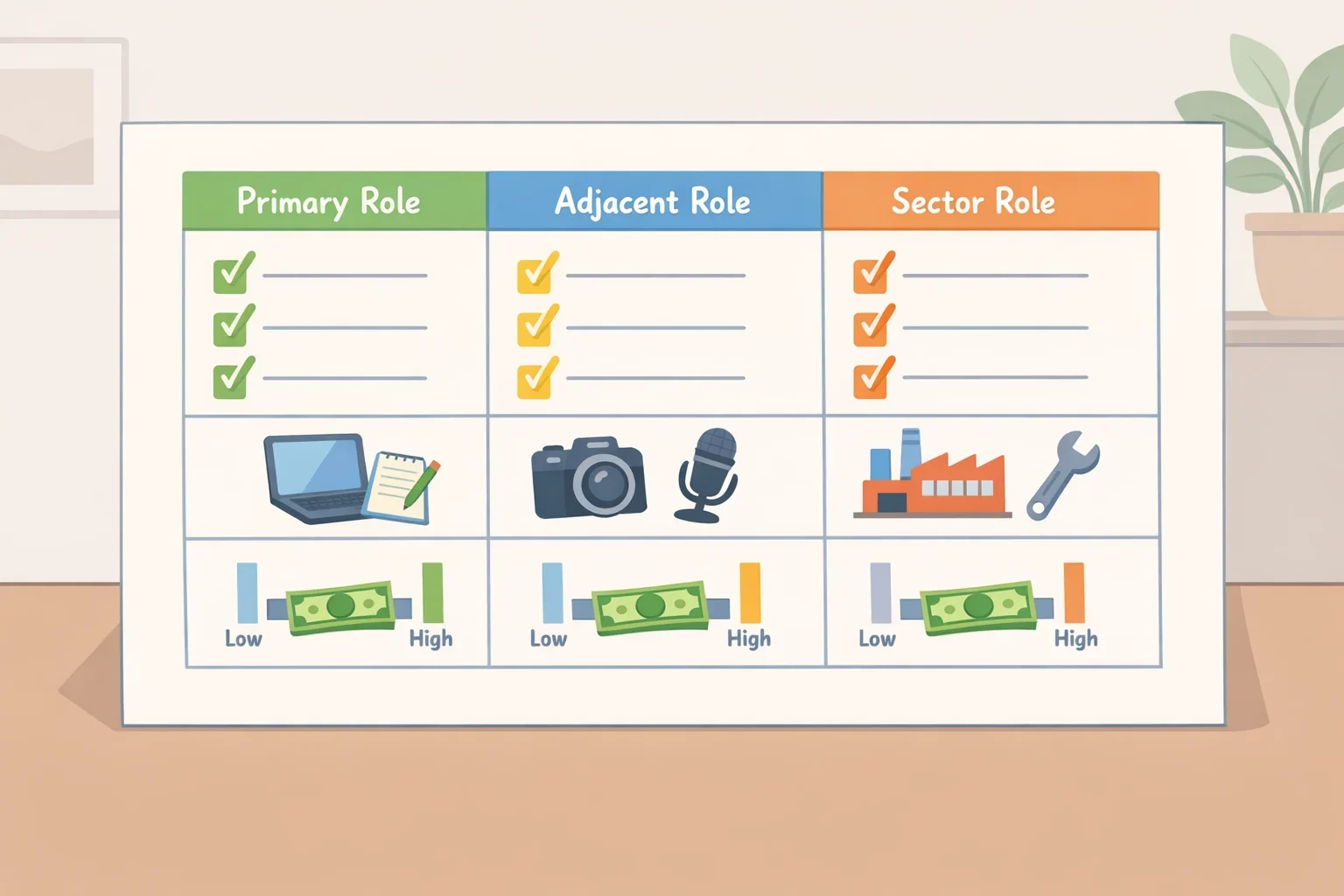
A pivot doesn't have to mean changing majors or abandoning a field. It usually means figuring out whether your specific target role sits closer to the automating side of the research above or the complementary side, then adjusting where you apply. Before finalizing a job search plan this fall, build a comparison worksheet rather than relying on assumptions about which fields are "safe."
Start by pulling 20 current postings: your primary target role, plus two adjacent roles or sectors in your field. For each, note the day-to-day tasks listed, the software or tools mentioned, and whether the role reads as client-facing or largely operational. That's a research lens for comparing your options, not a prediction that any single job will or won't be automated; the underlying research supports a general automation-versus-complementarity distinction, not a checklist that labels specific traits as safe or risky.
Then narrow to three roles and compare them side by side:
Factor to check Primary target role Adjacent role, same field Role in a hiring sector Degree required vs. preferred Years of experience requested Mostly routine/standardized tasks or mostly judgment-based tasks Local openings posted in the past 30 days Posted pay range Licensing or credential required
If health care is your growing-sector option, largely because BLS data shows it was among the sectors adding jobs in July, verify the specifics before treating it as an easy landing spot. Confirm which nonclinical, entry-level roles, such as health administration, data support, or patient services, actually hire bachelor's-level candidates without additional licensure, and check current local openings rather than assuming sector-wide payroll growth means every role in it is open to a new graduate.
Once the worksheet is filled in, track your applications against it. Log which of the three roles you apply to each week, note whether you found the posting through a job board, a referral, or a direct employer site, and follow up with anyone in your network connected to that specific role or employer. Spend more of your outreach on whichever column shows the clearest fit between your documented skills and what the postings actually ask for, and revisit the comparison every few weeks as new listings appear.
Some early-career churn is normal, but verify it against your own search
If your search takes longer than expected, or a first job after graduation doesn't stick, that isn't automatically a sign something has gone wrong. Frequent job changes and short first-year stints have long been typical for workers in their early 20s, well before AI entered the hiring conversation, and supplementing a degree with a certificate or bootcamp later in a career is an established pattern rather than a red flag.
That context describes how early careers have generally unfolded across past generations, not a prediction for how the Class of 2026 specifically will fare against the AI-linked hiring shifts covered above. Treat it as a reason not to panic over a slow start, not as a reason to skip researching your own numbers. Weigh any additional training against the actual requirements listed in the postings on your worksheet before spending money or time on it.
Rewrite your resume and interview answers around what your application should show
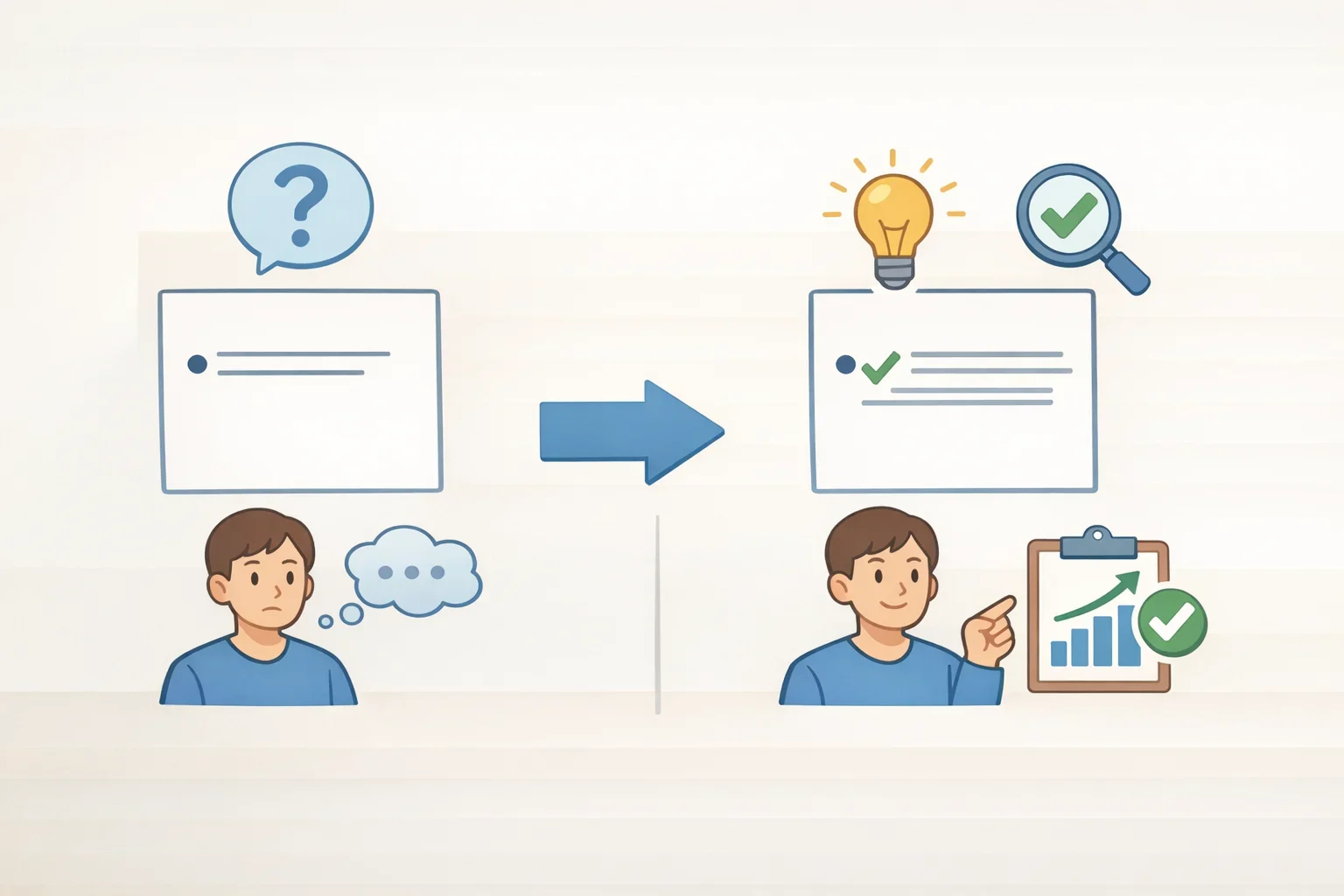
Once you know which roles in your search lean toward standardized tasks and which lean toward judgment and relationship-building, rewrite your application materials to match. Employers evaluating candidates for AI-exposed roles are likely comparing applicants who all have similar baseline technical skills, so specificity about your role in a project matters more than the deliverable itself.
Instead of writing "built a dashboard," describe the judgment involved: "Interviewed three student-organization leaders, defined their reporting needs, and built a dashboard used to plan two events." The second version shows the part of the work that required understanding a client's actual problem, not just executing a technical task.
Prepare one specific example for each of these before an interview:
- A time you exercised independent judgment on an ambiguous problem without clear instructions.
- A time you collaborated with someone outside your immediate team or discipline.
- A time you caught an error, your own or someone else's, before it became a bigger problem.
- A time you used an AI tool and checked or corrected its output rather than accepting it as-is.
Pull the postings you saved for your worksheet's top-fit role and match each bullet point on your resume to a specific line in the job description this week. If a requirement on the posting has no matching evidence on your resume, that's the gap to close before you submit the application, either with a different example from your experience or a note about what you're building toward next.
