
- How AI Is Changing the Graduate Job Market: What Students Should Prepare For
- What AI projections can and cannot tell graduates
- Where AI is creating growth and pressure
- AI and entry-level jobs: growth does not mean easy entry
- Skills graduates need in the age of AI
- How graduates can prepare for an AI-driven job market
How AI Is Changing the Graduate Job Market: What Students Should Prepare For
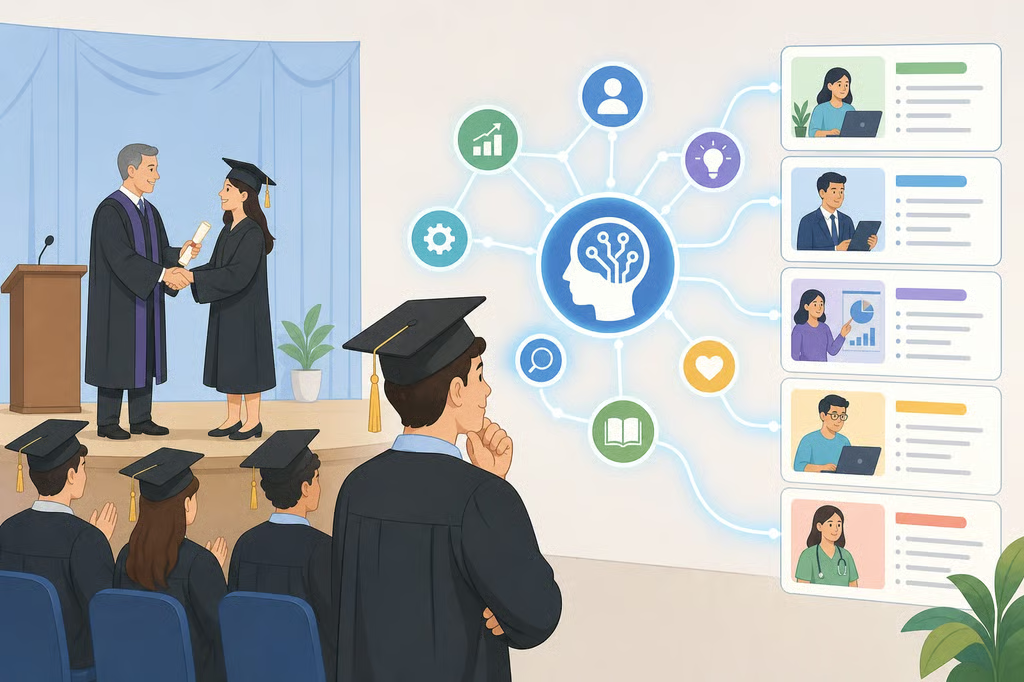
The question of how AI is changing the graduate job market cannot be answered by counting technology jobs alone. The more useful question is what AI may change inside the occupations graduates enter, which tasks employers may value, and how students can build experience that shows more than familiarity with a tool.
The available projections point in several directions at once. BLS expects AI adoption to support demand in some professional, scientific, technical, computing infrastructure, and data-processing activities. It also expects automation, including AI-powered tools, to reduce demand in several office and administrative support occupations. These are projections of occupational employment, not confirmed hiring outcomes for new graduates, so they should guide comparison rather than promise a job.
That limitation is easy to overlook. A growing occupation may still be competitive for entry-level applicants, and a declining occupation may continue to have openings as employers replace departing workers or change the work itself. Students need to examine both the direction of an occupation and the route into it.
What AI projections can and cannot tell graduates

Employment projections estimate how the total number of jobs in an occupation may change over a defined period. They do not directly answer how many positions will be open to someone graduating with limited experience.
A student comparing career paths should separate three questions:
- Is the occupation growing or shrinking? This describes total occupational demand.
- How many openings may occur? Openings can come from employment growth and from replacement needs.
- Can a new graduate realistically enter? This depends on education, related experience, employer expectations, and the responsibilities assigned to junior workers.
That last question is where broad AI forecasts become less useful. A projection can suggest that an occupation will remain important, but it cannot establish that employers will hire recent graduates at the same rate, in the same locations, or for the same tasks.
BLS introduced an AI exposure data product last year to compare occupations using theoretical and observed exposure to artificial intelligence. The decision to track exposure does not mean that every highly exposed occupation will decline. It does show that AI-related effects are being examined occupation by occupation, rather than treated as one economy-wide outcome (BLS reported last year).
For students, the practical use is comparison. Look at the target occupation’s projected direction, then examine its typical preparation and current job postings. A role with AI exposure may be changing rather than disappearing. A role with lower exposure may still offer limited entry-level access.
Where AI is creating growth and pressure
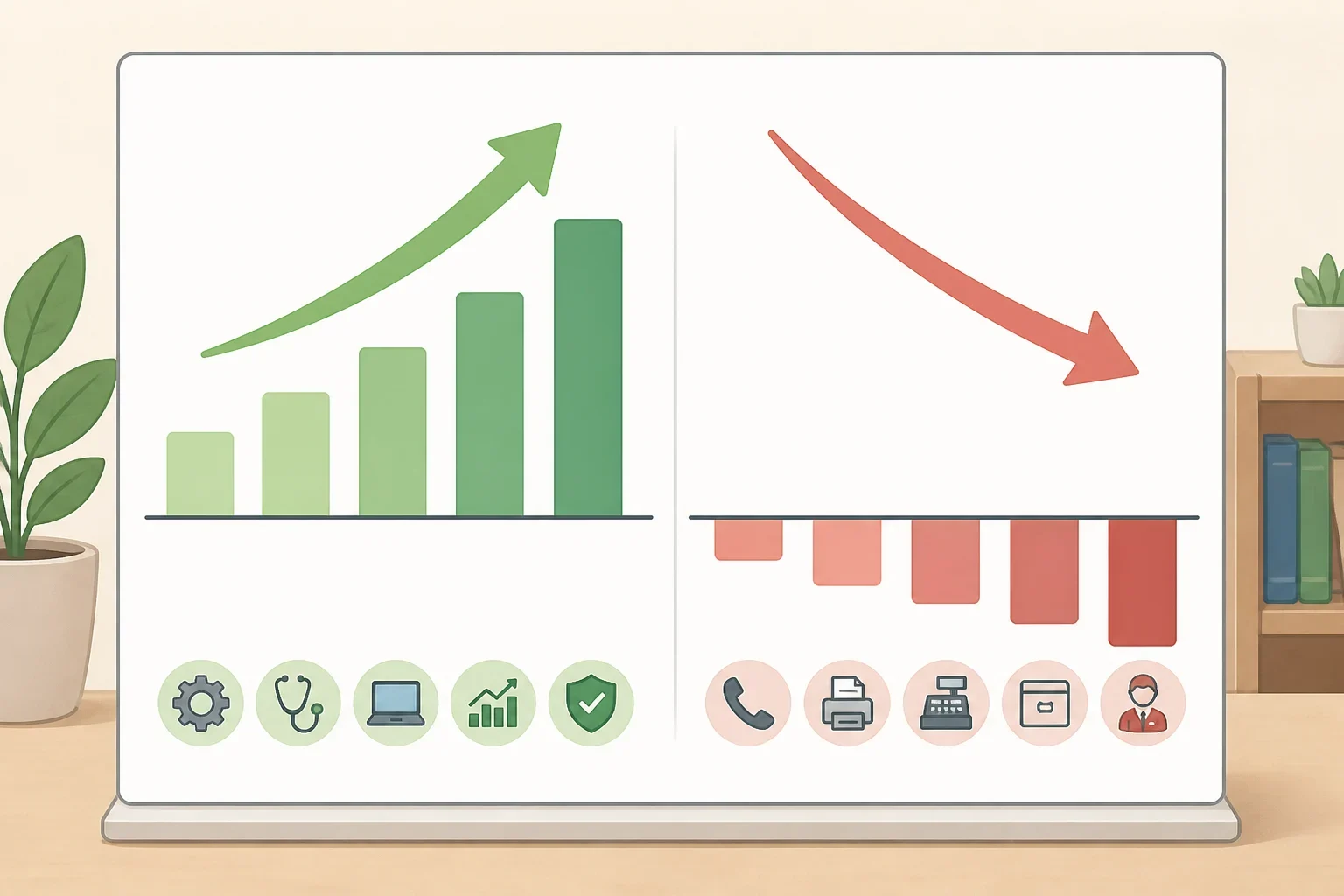
BLS expects demand for AI-based systems, research and development, and related consulting services to support employment in professional, scientific, and technical services. It also expects accelerated AI adoption to support computing infrastructure providers, data processing, web hosting, and related services (BLS reported last year).
That creates a wider set of possible paths than an “AI job” label suggests. Software development is one route, but students may also encounter work connected to infrastructure, data, systems, business operations, or technical services. The connection will vary by employer. A degree title alone will not show whether a candidate can contribute to the work.
The pressure is more visible in routine information processing. BLS expects the office and administrative support occupational group to decline at the fastest pace among major occupational groups, falling 4.0% and losing 752,100 jobs over the 2025–35 projection period (BLS reported last year). The same source points to reduced demand for several occupations, including procurement clerks, credit authorizers, legal secretaries and administrative assistants, and customer service representatives.
Those figures describe occupations, not the fate of every worker in them. Automation may remove some repetitive tasks while leaving other responsibilities in place. It may also change what employers expect from people who remain in the role. A customer service position, for example, could involve fewer routine interactions and more escalation, judgment, or relationship management. The projections do not specify how each employer will redesign work, so students should avoid treating either “AI-resistant” or “AI-exposed” as a complete career category.
The distinction between task change and occupational decline matters in graduate planning. A student considering administrative work should ask which responsibilities are becoming automated and which responsibilities require communication, judgment, coordination, or accountability. A student considering technology work should ask what the role involves beyond producing an initial technical output.
The future job market for graduates is therefore better understood as a redistribution of tasks and demand. Some fields may gain workers because organizations need to build, maintain, or apply AI systems. Other fields may need fewer workers for routine processing. Still others may continue to grow while their daily work changes.
AI and entry-level jobs: growth does not mean easy entry
Software development illustrates the difference between occupational opportunity and entry-level readiness. O*NET classifies software development as Job Zone Four, where considerable preparation is needed. In the profile updated last month, 85% of surveyed respondents said a bachelor’s degree is required for software developers (O*NET Online).
The work also extends beyond writing code. O*NET describes software developers as researching, designing, and developing software, analyzing user needs, considering whether a design is feasible within time and cost constraints, and updating existing capabilities (O*NET Online). Those responsibilities give students a better standard for judging their preparation.
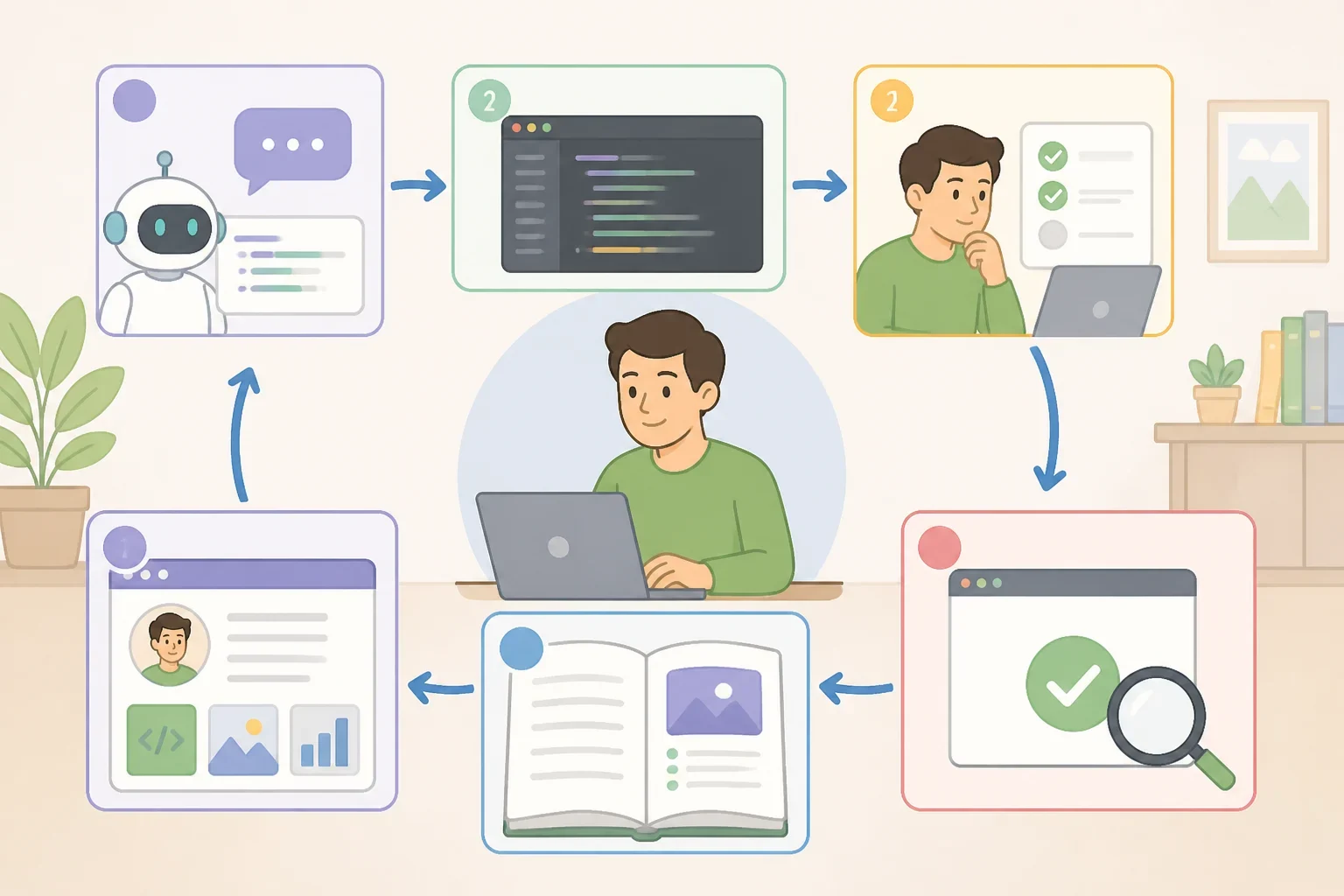
A portfolio made up of isolated code samples may show technical practice, but it may not show how the work responds to requirements or users. A stronger project can document the problem, the proposed solution, the testing process, the revisions, and the final result. If AI was used, the project should make clear what the tool produced and what the student evaluated or changed.
BLS reported last year that software developers can use AI to develop, test, and document code, improve data quality, and build user stories that explain the value of a software feature (BLS). That describes possible uses of AI in programming, not a universal requirement for every job. Students should present AI fluency as part of a working method, not as a replacement for coding knowledge.
The same principle applies outside software. Using a tool is easy to claim. Explaining why an output was accepted, rejected, tested, or revised gives an employer more useful evidence.
Skills graduates need in the age of AI
The strongest skills data in the available research comes from software development, so it should not be treated as a universal profile for every graduate. It does, however, show how a technical occupation combines digital work with collaboration, accuracy, and responsibility.
In O*NET’s profile updated last month, 71% of respondents rated working with or contributing to a work group or team as extremely important. Forty-six percent rated coordinating or leading others in accomplishing work activities as very important. Being exact or accurate was very important to 44%, while 50% reported high responsibility for the work outcomes and results of other workers (O*NET Online).
These figures do not prove that every employer uses identical hiring criteria. They do show why technical ability by itself may not make an application persuasive. A graduate may need to explain how a solution was selected, how an error was found, how changing requirements were handled, and how the work was communicated to others.
BLS identifies leadership, problem-solving and decision-making, and adaptability as important skills for general and operations managers (BLS). Because that occupation typically requires related work experience, these skills should not be read as a promise of immediate management work. They are better understood as capabilities students can develop through projects, internships, student organizations, and early-career responsibilities.
Useful AI skills for college students include:
- understanding what an AI tool can and cannot do in a chosen field
- checking outputs against reliable information and project requirements
- documenting decisions, revisions, and limitations
- communicating clearly when an output is incomplete or uncertain
- combining technical or analytical work with teamwork
- showing domain knowledge instead of relying on a tool to supply it
A resume can support these claims with evidence. Instead of writing “used AI tools,” a student might describe an AI-assisted project, the testing performed, the errors identified, and the decisions made before delivery. That wording gives the hiring reader something to evaluate.
Accuracy deserves particular attention. AI can produce a quick answer that still fails a requirement, contains an error, or misses the context of a problem. A graduate who can verify work and explain the verification process offers a more useful contribution than someone who can only produce an initial output quickly.
How graduates can prepare for an AI-driven job market
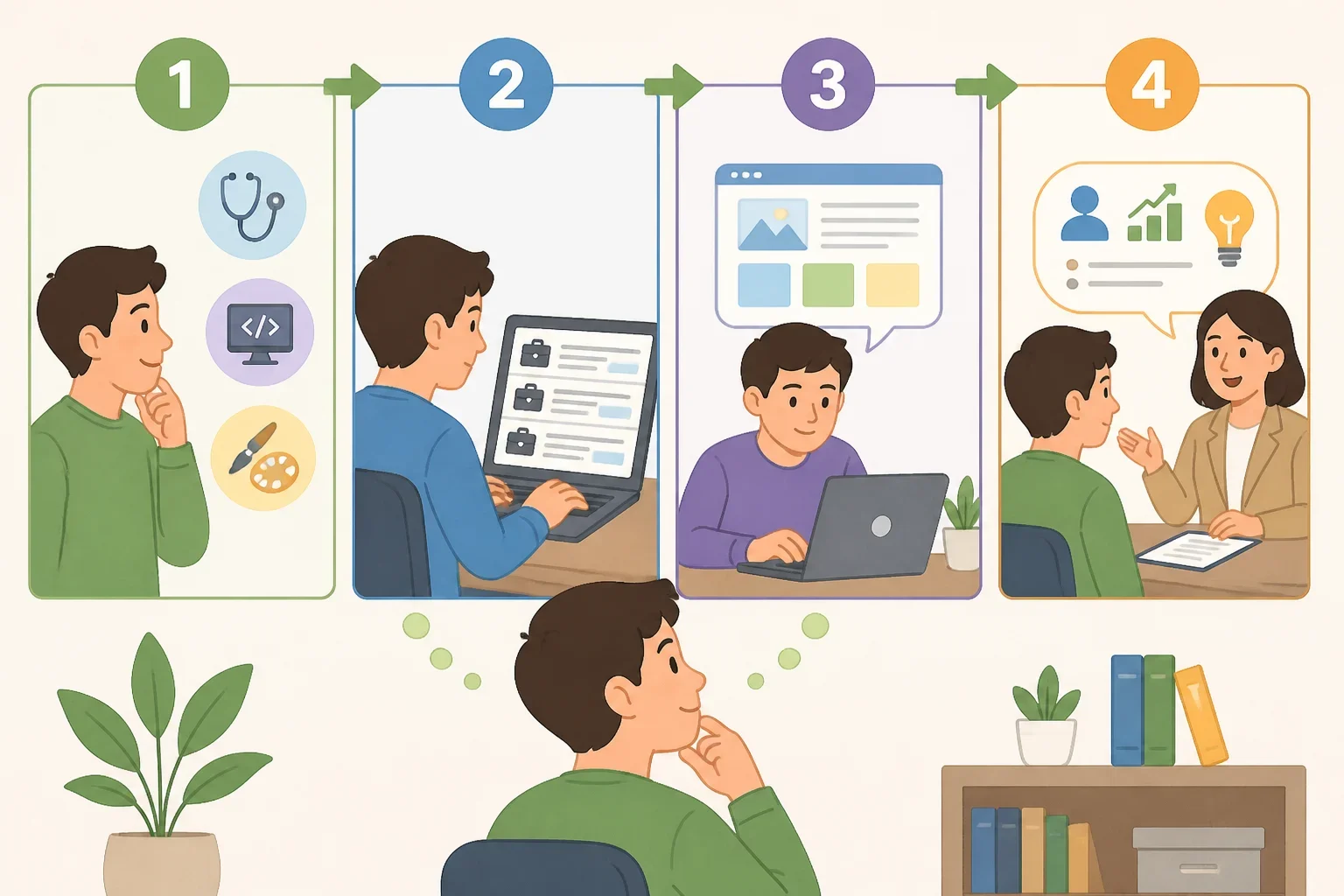
Students do not need to predict one winning occupation. They need a specific target and evidence that connects their preparation to it.
A practical process can stay manageable:
- Choose one target occupation. Start with a role rather than a broad label such as “technology” or “business.” Check the role’s projected direction, typical education, related experience, and daily responsibilities.
- Compare current job postings. Look for repeated tools, responsibilities, credentials, and examples of entry-level work. O*NET explains that its “Hot Technologies” list identifies requirements frequently included across employer postings, while “In Demand” skills are frequently included in postings for the occupation (O*NET Online). Use those lists as a starting point, then compare them with employers a student may actually apply to.
- Build one project that shows judgment. The project might involve software, analysis, research, operations, or another field-specific task. If AI is used, record the workflow, review the output, test it against requirements, and explain the final decisions. The portfolio should make the student’s contribution visible.
- Ask a focused question. A career-center adviser, instructor, mentor, or recruiter may be able to explain which responsibilities are realistic for a new graduate, which tools appear repeatedly in internship postings, or what evidence would make a project credible. Asking whether an entire career will be replaced produces a much less useful answer.
AI and entry-level jobs will not move in the same direction across every occupation. BLS projections point to growth connected to AI systems and infrastructure, alongside declining demand in several routine office and administrative roles (BLS). O*NET’s software developer data shows that technical preparation sits alongside teamwork, accuracy, coordination, and responsibility (O*NET Online).
Before applying, graduates should connect one occupation’s outlook with current employer expectations and a project that demonstrates domain knowledge, collaboration, accuracy, and responsible AI-assisted work. That is a more practical foundation than chasing a single “AI-proof” major.
