

- How to get a job in today's job market: 5 key shifts
- 1. Read the posting before you apply
- 2. Make your resume machine-readable
- 3. Tailor keywords without copying the job description
- 4. Target applications instead of treating every opening alike
- 5. Complete a final accuracy review
- A practical seven-day job search plan
How to get a job in today's job market: 5 key shifts
Knowing how to get a job in today's job market requires more than sending a polished resume to every promising opening. This guide walks through five practical shifts: evaluate postings carefully, make your resume machine-readable, tailor keywords honestly, target fewer applications, and build professional connections alongside your applications.
The hiring process often has two audiences. First, software may store, filter, or rank an application. Then a recruiter or hiring manager decides whether the candidate’s experience fits the role. Earlier this year, IESE Insight reported that nearly every large employer relied on applicant tracking systems, or ATS, as an initial gatekeeper. A 2025 analysis cited by the same source found that 98% of Fortune 500 companies used ATS on their career sites.
That does not mean every system works the same way, or that a keyword match guarantees an interview. It does mean a strong background needs to be presented clearly enough for software to interpret and a person to trust. The steps below are designed for active job seekers, recent graduates, career changers, and working professionals applying for their next role.
1. Read the posting before you apply
A job search becomes easier to manage when “the market” is narrowed to a specific role, employer, location, and set of requirements. Start with a short list of positions that match your experience or represent a realistic next step. Then compare several postings for the same title.
Look for:
- Requirements that appear repeatedly
- Skills one employer prefers but another requires
- Different names for similar tools or responsibilities
- Duties that reveal what the job actually involves
- Qualifications that appear unrelated to your current experience
Sort each posting into three groups:
- Required qualifications: credentials, experience, technical abilities, location, or other conditions the employer presents as necessary
- Preferred qualifications: skills that may strengthen an application but are not described as mandatory
- Job duties: the work the successful candidate is expected to perform
For example, a marketing coordinator posting might require email campaign experience, prefer analytics software knowledge, and list content calendars as a regular responsibility. A candidate who has built email campaigns but has not used that specific analytics platform can emphasize campaign reporting and related tools without claiming experience that does not exist.
Pay close attention to knockout questions. Some ATS platforms allow questions such as whether a candidate has an MBA and may automatically disqualify applicants who answer no, according to IESE Insight. A question may reflect a stated employer requirement, so answer accurately rather than trying to bypass the screen.
Before opening the resume, write down the posting’s required qualifications, preferred terms, and three main duties. That list becomes the working brief for the rest of the application.
2. Make your resume machine-readable
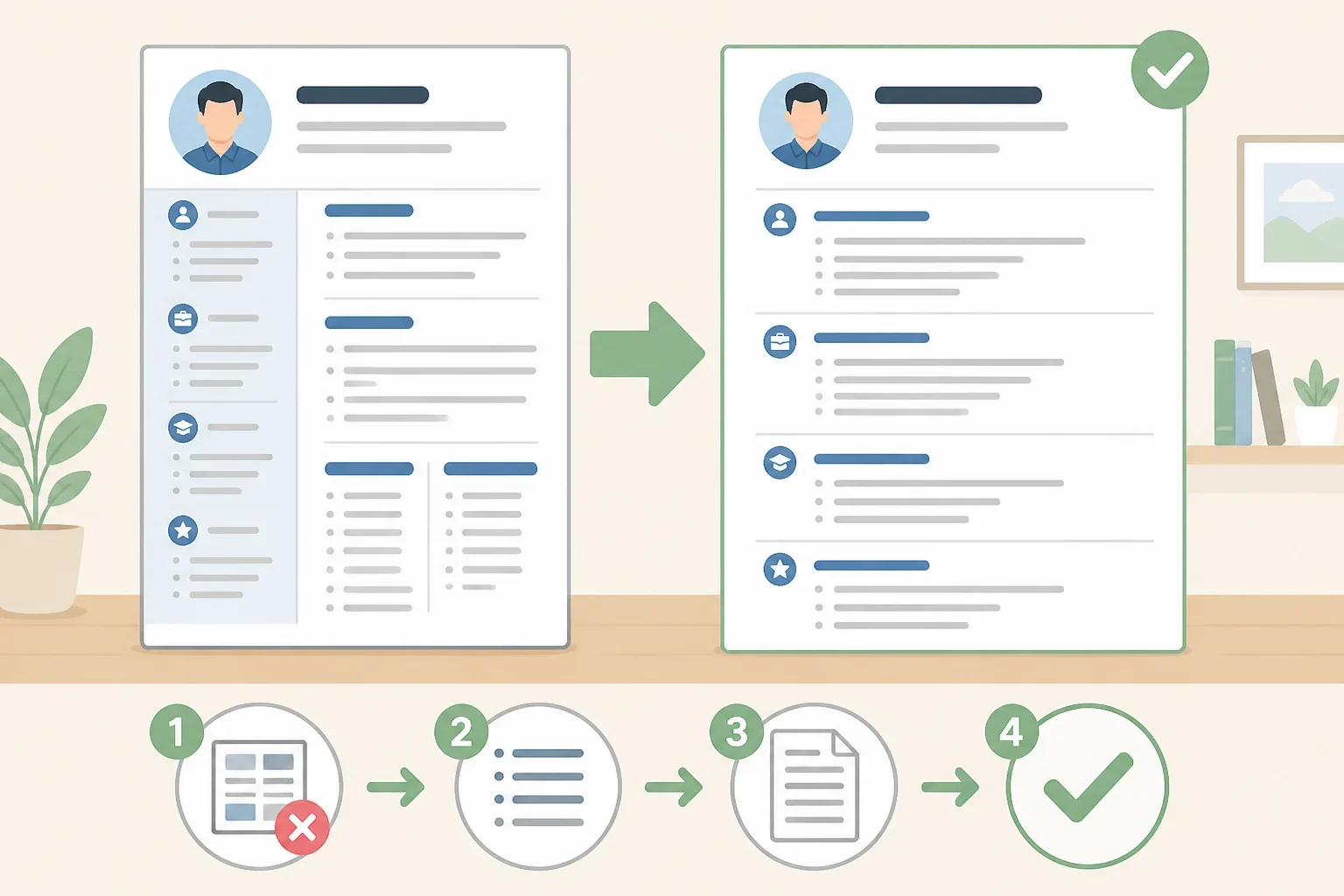
An ATS is not one universal tool with one fixed set of rules. Still, many hiring processes place software between the application and the recruiter. ATS platforms can act as centralized applicant databases and use algorithms, sometimes basic AI, to filter or rank candidates, IESE Insight reported earlier this year.
A clean format gives the document a better chance of being interpreted as intended. Use:
- One column
- A standard font
- Literal section headings such as “Work Experience,” “Education,” and “Skills”
- Contact information in the main body of the document
- A Word document or text-based PDF when the employer permits either format
Avoid text boxes, tables, multiple columns, graphics, images, unusual symbols, and scanned PDFs. Some parsers may skip information in headers and footers. Others may struggle with scans or unusual file types. The employer’s submission instructions take priority, but IESE Insight recommends Word files or text-based PDFs as safer choices than scans.
Standard headings also help a recruiter move through the document quickly. If a job posting uses “Work Experience,” there is little benefit to replacing it with a creative label such as “Career Highlights.” Clarity usually beats design flourishes in an application that must be understood quickly.
Acronyms deserve the same treatment. Write the full term and abbreviation at least once, such as “Amazon Web Services (AWS).” IESE Insight notes that including both forms can help a resume surface in searches for either term. Use the same approach for certifications, technical tools, and industry terminology when the wording accurately describes your background.
Action: Open the resume in Word or copy its text into a plain document. Check whether the name, contact details, employers, dates, job titles, and skills appear in the correct order. If important information disappears or becomes difficult to read, revise the format before applying.
3. Tailor keywords without copying the job description
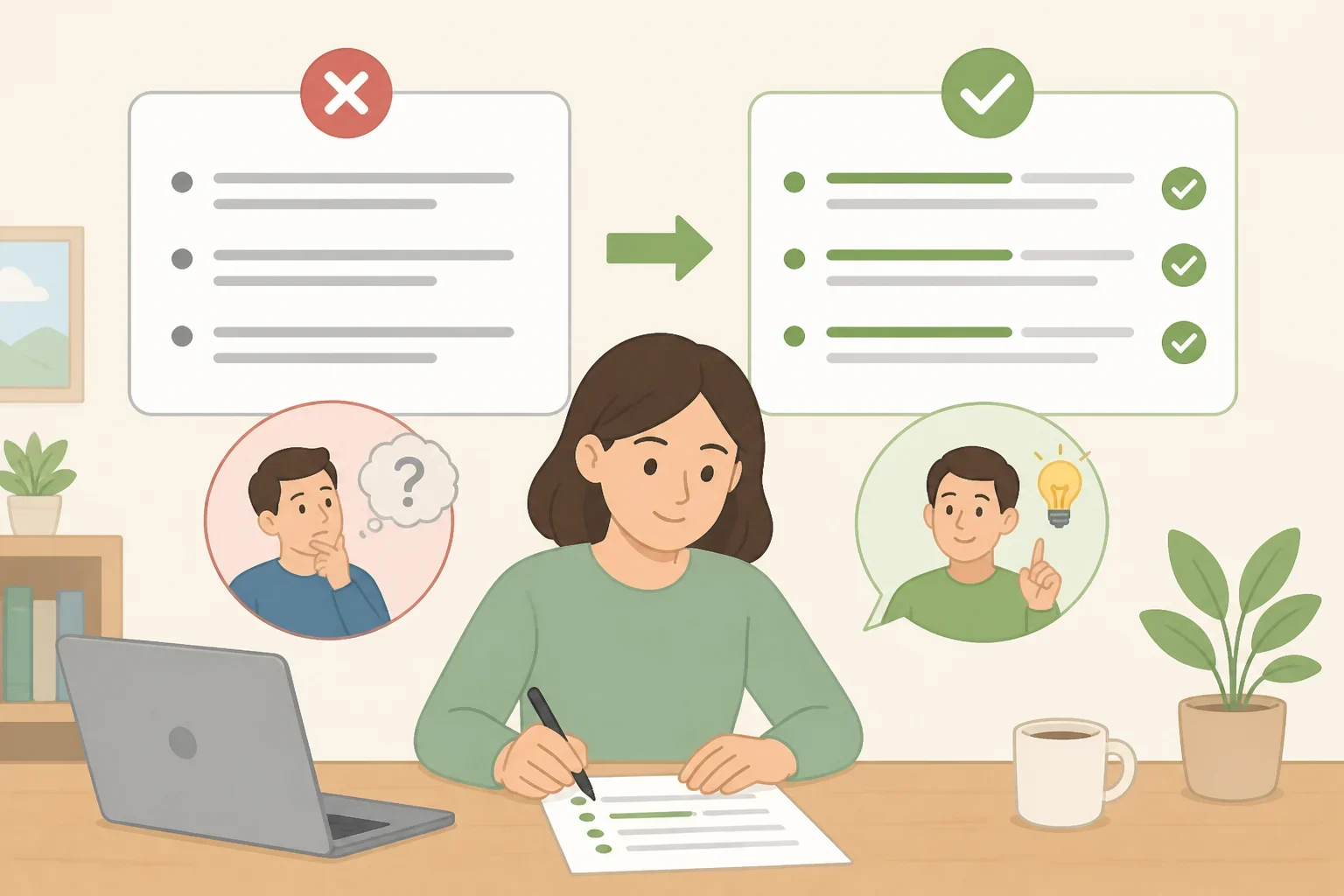
Application volume makes generic materials easier to overlook. Earlier this year, IESE Insight reported that platforms such as LinkedIn processed an average of 11,000 job applications per minute, a 45% increase from the year before. The figure describes application volume across platforms such as LinkedIn, not necessarily one company’s total activity.
ATS tools may perform straightforward string matching, so terminology can matter. If a posting asks for “project management” and the resume says only “helped with projects,” the system may not recognize the connection. That does not justify adding skills that were never used.
Use this four-part process:
- Mark the required terms. Identify the exact names of tools, credentials, methods, and job functions.
- Separate requirements from preferences. Give stated requirements more attention than optional qualifications.
- Match only accurate language. Use “project management” when the experience supports that description. Do not claim ownership of projects if the work involved only attending meetings.
- Attach each term to evidence. Explain what was done, for whom, with which tool, and with what result when the information is available.
Suppose a posting asks for “customer relationship management,” while the resume says only “client database.” If the candidate used a CRM to track recurring accounts, a bullet could be revised to say: “Managed customer relationship management records for recurring client accounts.” That is stronger than placing “CRM” in a hidden skills list without supporting evidence.
IESE Insight recommends aiming for a 60% to 80% keyword match rather than forcing complete overlap. The source presents that range as expert guidance, not as an independently verified hiring benchmark. It also warns that 100% overlap can raise concerns.
The safer standard is straightforward: use the employer’s terminology when it truthfully describes the experience, then explain the accomplishment in original language. Never copy sentences from the posting word for word. A resume has to make sense when it reaches a person.
Action: Revise two or three bullets for each application. Include accurate terminology, preserve the candidate’s own voice, and connect every added term to a real task, tool, credential, or result.
4. Target applications instead of treating every opening alike
Submitting applications can feel productive even when each one receives too little attention. A more deliberate approach starts with a shortlist of roles and companies that fit the candidate’s background, location, schedule, and career direction.
For each target role, ask:
- Can the required qualifications be demonstrated honestly?
- Does the work represent a sensible next step?
- Is the application process clear?
- What part of the experience is most relevant to this employer?
- Is there a professional connection who can offer perspective on the role or team?
A cover letter does not need a dramatic personal story. One accurate, company-specific detail is often more useful. If the posting emphasizes coordination across departments, describe a comparable coordination responsibility. If the role serves a particular customer group, explain relevant experience with that audience, provided the claim is true.
Earlier this year, IESE Insight suggested that someone spending 10 hours a week on a search could use four hours to connect with people and six hours to prepare targeted applications. That is a planning suggestion, not a proven optimal formula. Adjust the split for the number of suitable openings, the career stage, and the type of work.
Networking does not have to begin with a referral request. A short message can ask for perspective:
Hello, I’m exploring coordinator roles in your industry and noticed your experience with cross-functional projects. I’m comparing a few types of positions and would appreciate hearing what skills your team values most.
That message is specific, respectful, and easy to answer. It also avoids asking someone to make a promise on the candidate’s behalf.
Professional groups, webinars, conferences, and meetups can provide other ways to learn about a field and meet people connected to it. IESE Insight notes that many of these events are online and free.
Action: Build a shortlist for the week. Prepare a tailored resume version for each role, add one employer-specific detail to the application, and send one thoughtful message to a relevant contact or professional group.
5. Complete a final accuracy review

A well-targeted application can still be weakened by a missing attachment, an incorrect employer name, or a bullet that does not support the skill it claims. The final review is where accuracy becomes part of the job-search strategy.
IESE Insight describes the final 10% to 20% of effort as an opportunity to tailor examples, add a human touch, and check the application for accuracy. That is practical advice, not a measured hiring effect. Specificity should fit the employer and industry. Humor is optional, and an overly familiar tone can be inappropriate in some fields.
Use this checklist before selecting “submit”:
- Does the resume use the employer’s accurate terms for relevant skills?
- Are required qualifications easy to find?
- Are dates, job titles, employer names, and contact details correct?
- Does the file open properly in the requested format?
- Does the cover letter name the correct employer and role?
- Does every accomplishment claim reflect actual experience?
- Have hidden keywords and white text been removed?
- Have prompts designed to manipulate an AI reviewer been avoided?
Hiding keywords in white text or inserting instructions intended to influence an AI screener may make the application look deceptive if discovered. IESE Insight describes both tactics as attempts to manipulate automated review. Optimize for accurate reading instead.
Keep a basic application tracker with the employer, role, submission date, resume version, contact person, and follow-up date. It does not need to be elaborate. Its purpose is to prevent repeated errors and show which kinds of roles are receiving responses.
A practical seven-day job search plan
Put the shifts into one focused week:
- Day 1: Choose a shortlist of roles and compare their requirements.
- Day 2: Reformat the resume into a readable, single-column document if needed.
- Day 3: Create a role-specific version using accurate keywords and evidence.
- Day 4: Draft a brief, employer-specific cover letter or application response.
- Day 5: Contact a relevant professional, group, or potential referral source.
- Day 6: Review the application for accuracy, file format, and unsupported claims.
- Day 7: Record what was submitted and decide which role to prepare for next.
The process is simple, but it is not passive. Choose roles carefully, make the application readable, match the posting honestly, build professional contact, and check every detail before sending. For the next application already in progress, start with the posting, revise two resume bullets, and send one relevant networking message before submitting.
