
- LinkedIn Top Colleges 2026: What the Ranking Really Measures
- The top 10 in LinkedIn Top Colleges 2026
- LinkedIn Top Colleges 2026: what the ranking measures
- Why alumni networks and recruiter demand drive the rankings
- What LinkedIn's ranking doesn't tell you about college value
- How to use LinkedIn Top Colleges 2026 when comparing schools
- What to check before shortlisting a school
LinkedIn Top Colleges 2026: What the Ranking Really Measures
Princeton University holds the top spot on LinkedIn Top Colleges 2026, the second edition of LinkedIn's ranking of the 50 U.S. schools whose graduates show the strongest long-term career outcomes (LinkedIn, this week). Duke, Harvard, MIT, and Dartmouth round out the top five (LinkedIn, this week). LinkedIn says the list is built on career-outcome data pulled from millions of alumni profiles, tracking how quickly graduates land first jobs, how their professional networks grow, and how many move into leadership roles (LinkedIn, this week).
That distinction matters if you're using this list to help pick a school. LinkedIn Top Colleges 2026 measures something specific and real, but it isn't a stand-in for financial return on investment, and it doesn't cover every factor a prospective student should weigh. This piece walks through what the ranking actually counts, how it's built, and what to check before letting any single list settle a decision this size.
The top 10 in LinkedIn Top Colleges 2026
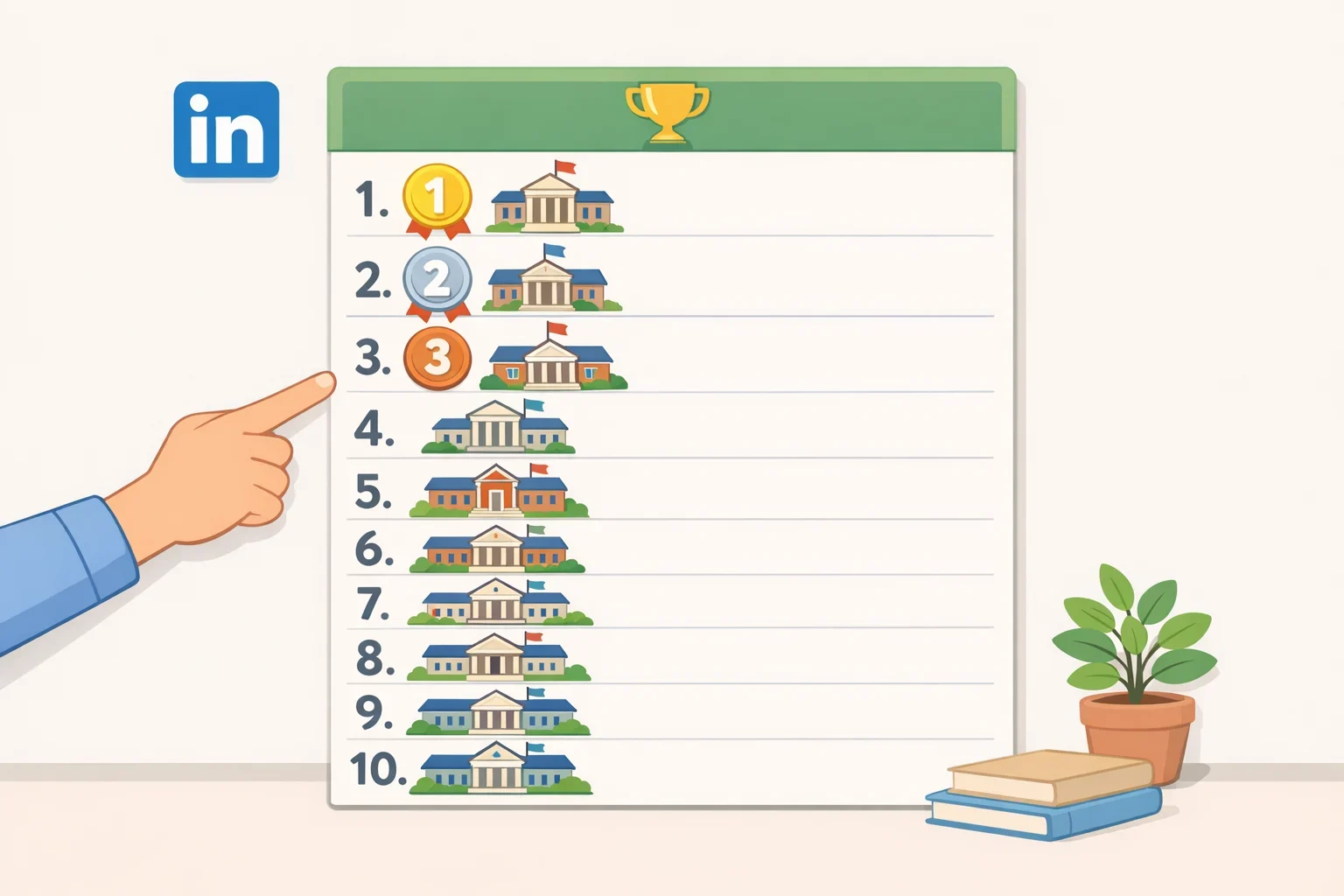
Here's this year's top 10, in order (LinkedIn, this week):
- Princeton University
- Duke University
- Harvard University
- Massachusetts Institute of Technology
- Dartmouth College
- University of Pennsylvania
- University of Notre Dame
- Cornell University
- Yale University
- Stanford University
Princeton also led the inaugural list last year, so this marks its second straight year at No. 1 (LinkedIn, last year).
The full 50 look less like an Ivy League showcase once you scroll past the top 10. Babson lands at No. 13 and Bucknell at No. 16, with Washington and Lee at No. 19, all of them ahead of several research universities on the list (LinkedIn, this week). Public flagships show up further down: UC Berkeley at No. 29, Michigan at No. 38, and UNC Chapel Hill at No. 45 (LinkedIn, this week).
If your target school didn't crack the top 10, that placement pattern is worth noticing before writing it off. A school in the 20s or 30s among 50 schools that made a fairly selective cut is still outperforming thousands of institutions that weren't eligible for the list at all. The more useful question isn't where a school lands overall, but what specifically is driving the score, which is what LinkedIn's methodology actually measures.
LinkedIn Top Colleges 2026: what the ranking measures

LinkedIn's disclosed methodology for the inaugural 2025 list scores schools across five equally weighted pillars: job placement, internships and recruiter demand, career success, network strength, and knowledge breadth (LinkedIn, last year). Most pillars combine two metrics that each carry half the pillar's weight, except job placement, which runs on a single metric (LinkedIn, last year).
Job placement specifically tracks the share of alumni from the 2019 to 2024 graduating cohorts who started a full-time job or entered graduate school within the same year they graduated (LinkedIn, last year). That's a narrower measure than it sounds. It doesn't confirm the job was full-time and permanent, and it doesn't tell you whether graduates landed work in the field they studied.
Career success looks at the percentage of alumni who reached the C-suite or launched their own companies after graduating (LinkedIn, last year). Knowledge breadth measures how many distinct fields of study and skills appear on alumni profiles from recent cohorts (LinkedIn, last year). Network strength and the internship pillar get their own section below, since they explain most of what separates the top of this list from the middle.
Eligibility rules narrow the field before any scoring happens. A school needs at least 2,000 total alumni on LinkedIn and 500 from the recent cohort, and the list excludes military academies, for-profit schools, and online-only programs (LinkedIn, last year). That means plenty of legitimate schools, including many community colleges and specialized professional programs, are structurally ineligible regardless of how their graduates actually fare.
One caveat worth flagging directly: LinkedIn's 2026 release doesn't include a separate methodology document. The pillars above come from the 2025 rollout. This article treats that framework as useful context for how the ranking likely works, not confirmed proof that the 2026 list used an identical formula.
For anyone comparing schools, the practical move isn't to accept the aggregate rank at face value. Ask the admissions or career-services office directly what percentage of graduates in your intended major complete internships, and what relationships the school maintains with recruiters in that field. Those numbers are the concrete version of what LinkedIn's job-placement and internship pillars are trying to capture at scale.
Why alumni networks and recruiter demand drive the rankings
The network-strength pillar measures how connected a school's alumni are to each other, and how connected new graduates are to the broader alumni base and current students (LinkedIn, last year). It's a measure of LinkedIn connections, not a measure of teaching quality or classroom learning. A school can score well here without it telling you anything about how good the instruction actually is.
The internships-and-recruiter-demand pillar combines internship completion rates with InMail outreach data, meaning recruiter activity on LinkedIn factors directly into the score (LinkedIn, last year). Recruiting activity clearly carries real weight in this number. That doesn't mean curriculum plays no role in outcomes, only that this particular pillar isn't set up to measure it.
LinkedIn's own commentary on last year's list pointed to a common thread among the top performers: many of the schools producing durable career outcomes also have strong alumni and community networks (LinkedIn, last year). That's a descriptive pattern, not a causal one. Because this is an observational ranking built from LinkedIn profile data, it can't separate what a college contributed to a graduate's trajectory from what that student already brought with them when they enrolled, whether that's family connections, test-optional admissions advantages, or simply attending a school that already recruits heavily.
What this section adds up to is fairly plain: a large share of the "career edge" this ranking measures is really a measure of access to people and opportunities. Some of that access is baked into a school's brand and alumni density before a student ever sets foot on campus. Some of it is buildable by any student, at any school, through deliberate effort. That's the more useful takeaway than treating the rank itself as a verdict on a school's overall value.
The practical version of this for someone comparing options: ask current students or admissions staff about internship placement support, career-center staffing ratios, and structured alumni mentorship programs. Those are the concrete, verifiable version of the network and recruiter-demand pillars LinkedIn measures in aggregate.
What LinkedIn's ranking doesn't tell you about college value
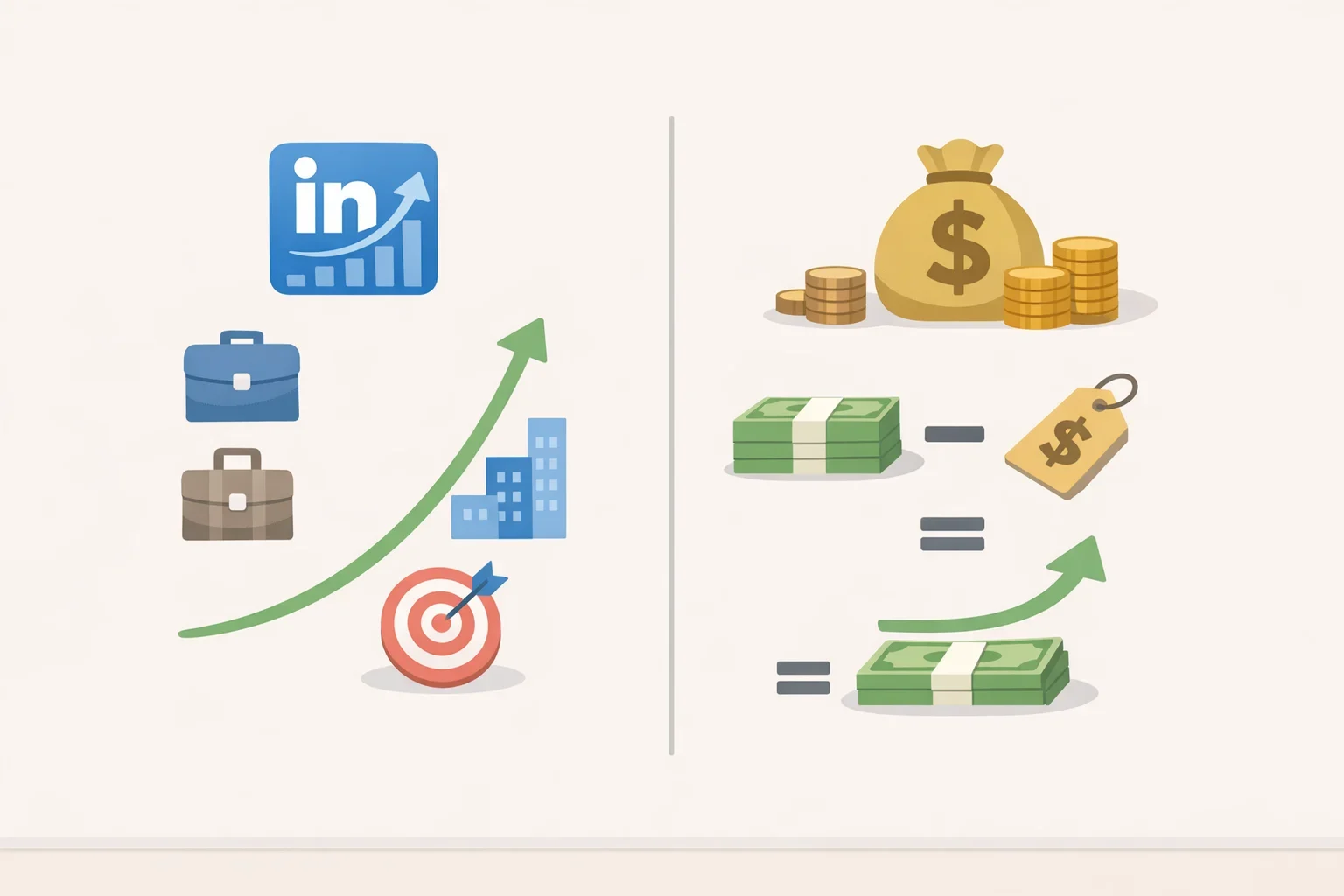
LinkedIn's list answers a career-trajectory question: how do a school's graduates move through the workforce over time. It doesn't answer a financial-return question: whether the degree was worth what it cost. Georgetown University's Center on Education and the Workforce publishes a separate ranking built for exactly that second question, scoring 4,600 institutions by cumulative earnings minus the average net price at 10-, 15-, 20-, 30-, and 40-year intervals after enrollment (Georgetown CEW, last year).
One detail worth being precise about: Georgetown's ROI figure does not factor in student debt. The center says debt is left out because variables like current and future interest rates make it too difficult to model with a single adjustment (Georgetown CEW, last year). So a high ROI score reflects earnings against sticker cost, not what a graduate is actually paying back each month.
Georgetown's own analysis found that graduation rates correlate strongly with ROI at institutions that predominantly award bachelor's degrees, with for-profit schools as a notable exception (Georgetown CEW, last year). Acceptance rates, by contrast, show only a modest negative correlation with ROI across most institution types (Georgetown CEW, last year). Pell Grant recipient rates trend negatively with ROI, and the correlation is moderately strong at private nonprofit schools, running around -0.50 for associate's-degree institutions and -0.66 for bachelor's-degree institutions (Georgetown CEW, last year). In plain terms: selectivity alone is a weak predictor of financial payoff, and schools serving more Pell recipients tend to show lower measured ROI, likely reflecting broader economic patterns rather than anything about the education itself.
Georgetown is direct about the limits of its own tool. The center advises weighing ROI alongside program availability, cost, location, delivery format, and how likely a student is to actually get admitted, rather than treating ROI as the deciding factor on its own (Georgetown CEW, last year). Georgetown's data tool does allow comparisons by degree type in a given year, but neither Georgetown's ROI ranking nor LinkedIn's career list gives a simple, apples-to-apples comparison for a specific major across every school on the list. A nursing program's outcomes and an engineering program's outcomes at the same university can look very different from that school's aggregate score.
None of this means LinkedIn's rank is a "value" indicator in the financial sense. A school can score well on career trajectory and unremarkable on ROI, or the reverse. Treating the LinkedIn rank as shorthand for "worth the money" risks steering a decision toward an expensive option without ever checking net price.
How to use LinkedIn Top Colleges 2026 when comparing schools
Before adding LinkedIn's ranking, or any single ranking, to a shortlist, work through a short set of questions specific to your situation:
- What is your estimated net price at each school, not the published sticker price? Net price calculators, available on most college websites, factor in aid and can shift the comparison substantially.
- Does the school offer your intended major, and what does its career-services or program page say about internship completion, licensure pass rates, or first-job placement specific to that program?
- Which employers actively recruit for your field at that school, and how often? A strong overall recruiter-demand score doesn't guarantee recruiting depth in every department.
- What do current students or recent graduates in your program say about internship support, faculty advising, and alumni mentoring? These are the lived version of LinkedIn's network and internship pillars.
- Are outcomes available for students with an academic and financial profile similar to yours? Aggregate scores can obscure very different experiences by major, income background, or first-generation status.
These questions won't produce a single number the way a ranking does. They will tell you whether the access and outcomes a ranking is trying to summarize actually show up at the specific school and in the specific program you're considering.
What to check before shortlisting a school
LinkedIn Top Colleges 2026 is a useful signal for one specific thing: how graduates from a given school tend to move through the workforce, based on job placement, internships, recruiter attention, career advancement, and alumni network strength (LinkedIn, this week). It is not a financial-return measure, and it draws only from active LinkedIn profiles, which may not represent every graduate equally.
Before using it to narrow a list, pull the net price calculator for each school you're seriously considering, check the career-services page for internship and recruiter data tied to your intended major, and compare that against Georgetown's ROI data or the federal College Scorecard for earnings context specific to that program. A single ranking, whatever it measures, shouldn't carry a decision this size on its own.
