

- How to Prepare for a Tech Job Interview: Step-by-Step
- 1. Research the role before the tech job interview
- 2. Match your preparation to the technical role
- 3. Practice for a technical interview by narrating your reasoning
- 4. Build a behavioral interview story bank
- 5. Prepare for phone, video, and on-demand interviews
- 6. Use AI for preparation, not performance
- A practical one-week preparation schedule
How to Prepare for a Tech Job Interview: Step-by-Step
A strong technical interview requires more than solving a coding problem. This guide explains how to prepare for a tech job interview by researching the role, practicing technical reasoning, building useful interview stories, and preparing for phone, video, on-demand, and in-person formats. It also shows how preparation should change for software engineering, IT support, data, cybersecurity, and senior engineering roles.
One hiring manager described receiving 120 CVs, narrowing them to nine interviews, and favoring candidates who provided context about their technical skills instead of listing technologies without evidence, according to Dice last year. That account describes one hiring process, not a universal rule, but it points to a practical standard: make it easy for an interviewer to understand what you know, how you used it, and what you can contribute.
Harvard’s career center advises candidates to understand the company’s work and the position’s requirements, then explain how their skills meet those requirements. It also identifies collaboration, curiosity, and sustained effort as qualities many employers seek (Harvard FAS, five months ago). Use the steps below to prepare for the specific role in front of you.
1. Research the role before the tech job interview
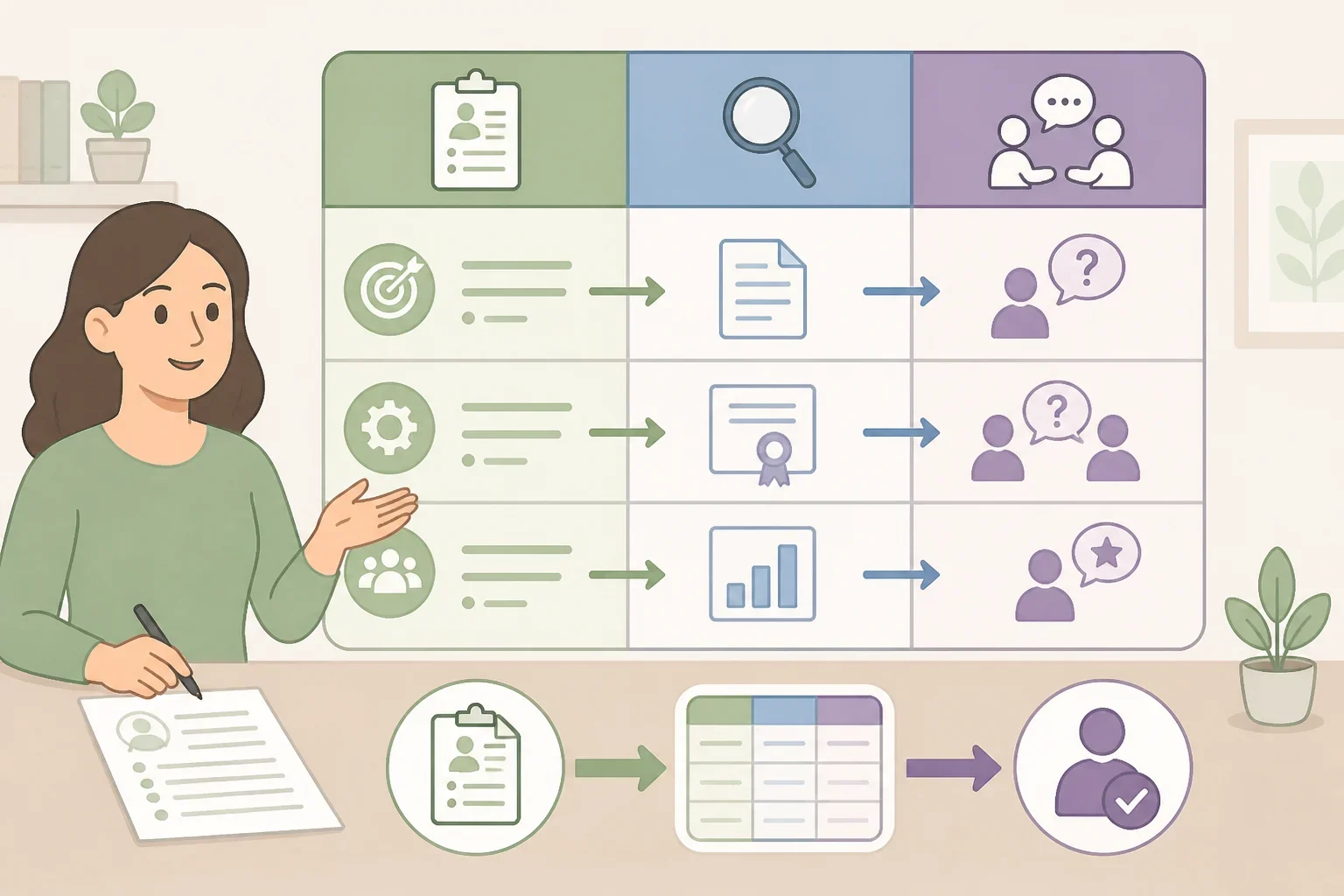
Start with the job description. Do not read it as a list of technologies to memorize. Read it as a description of the problems the employer wants someone to solve.
Create three columns in a document:
- Requirement: What the posting asks for
- Evidence: Where you have used that skill
- Interview connection: How the experience could help in this role
For example:
- Requirement: Troubleshoot technical issues for internal users
- Evidence: Resolved recurring access and software problems during a campus technology job
- Interview connection: Explain the troubleshooting process, documentation used, and how the user was kept informed
Repeat this exercise for the most important requirements. If the posting emphasizes Python, do not simply write “Python” in your notes. Record the kind of work completed with it, how recently you used it, and the level of responsibility involved. Dice recommends giving context such as proficiency and duration rather than presenting an unsupported list of skills (Dice, last year).
Then write a short role-fit paragraph. Keep it specific:
“This role combines Python development, API work, and troubleshooting. My strongest match is building an internal API that connected two services, then investigating failures when the integration produced inconsistent results. That experience would help me contribute to the team’s application work while communicating clearly when problems arise.”
This paragraph is not a script to recite. It gives answers a consistent direction. Harvard’s career center quotes one employer saying that qualified candidates may be distinguished by their level of interest, so research should help you ask informed questions and explain why the work appeals to you (Harvard FAS, five months ago).
Use the company’s website, the job posting, and other trusted material to understand the organization’s work. Generative AI can help with initial industry research, question generation, brainstorming, and feedback on draft answers. Its output still needs to be checked because it can produce inaccurate information (Harvard FAS). Never rely on an AI-generated company detail in an interview without verifying it.
2. Match your preparation to the technical role
The phrase “tech interview” covers several different hiring processes. Confirm what the employer expects before spending most of your preparation time on coding drills.
Target role Prioritize in preparation Software engineering Coding, debugging, explaining code, performance implications, and system design when the role calls for it IT support or systems Troubleshooting, incident response, customer communication, documentation, and explaining a diagnostic process Data roles SQL, analysis choices, interpreting results, and communicating findings to a nontechnical audience Cybersecurity Threat reasoning, risk prioritization, incident examples, and clear explanations of security decisions Senior engineering Architecture, tradeoffs, ambiguity, influence, collaboration, and leadership stories, along with role-specific coding
These are preparation priorities, not universal interview requirements. Assessment stages, technical topics, and seniority expectations vary by employer and position.
For software engineering interviews, Roy Bakker presents a framework of coding, system design, and leadership, while arguing that senior candidates often spend too much time on coding practice and too little on the latter two areas (Roy Bakker, last year). That is one practitioner’s view, but it provides a useful decision point. If the job is senior and the posting emphasizes architecture or cross-team work, do not prepare as though the interview will only test algorithms.
For an IT support interview, replace a coding session with a troubleshooting rehearsal. Practice answering:
- What information would you collect first?
- How would you isolate the cause?
- How would you explain the issue to the user?
- What would you document after resolving it?
For a data role, practice explaining why a particular query or analysis approach fits the question. For cybersecurity, prepare to describe how you would evaluate competing risks. The goal is to demonstrate a method, not to pretend every problem has an immediate answer.
3. Practice for a technical interview by narrating your reasoning
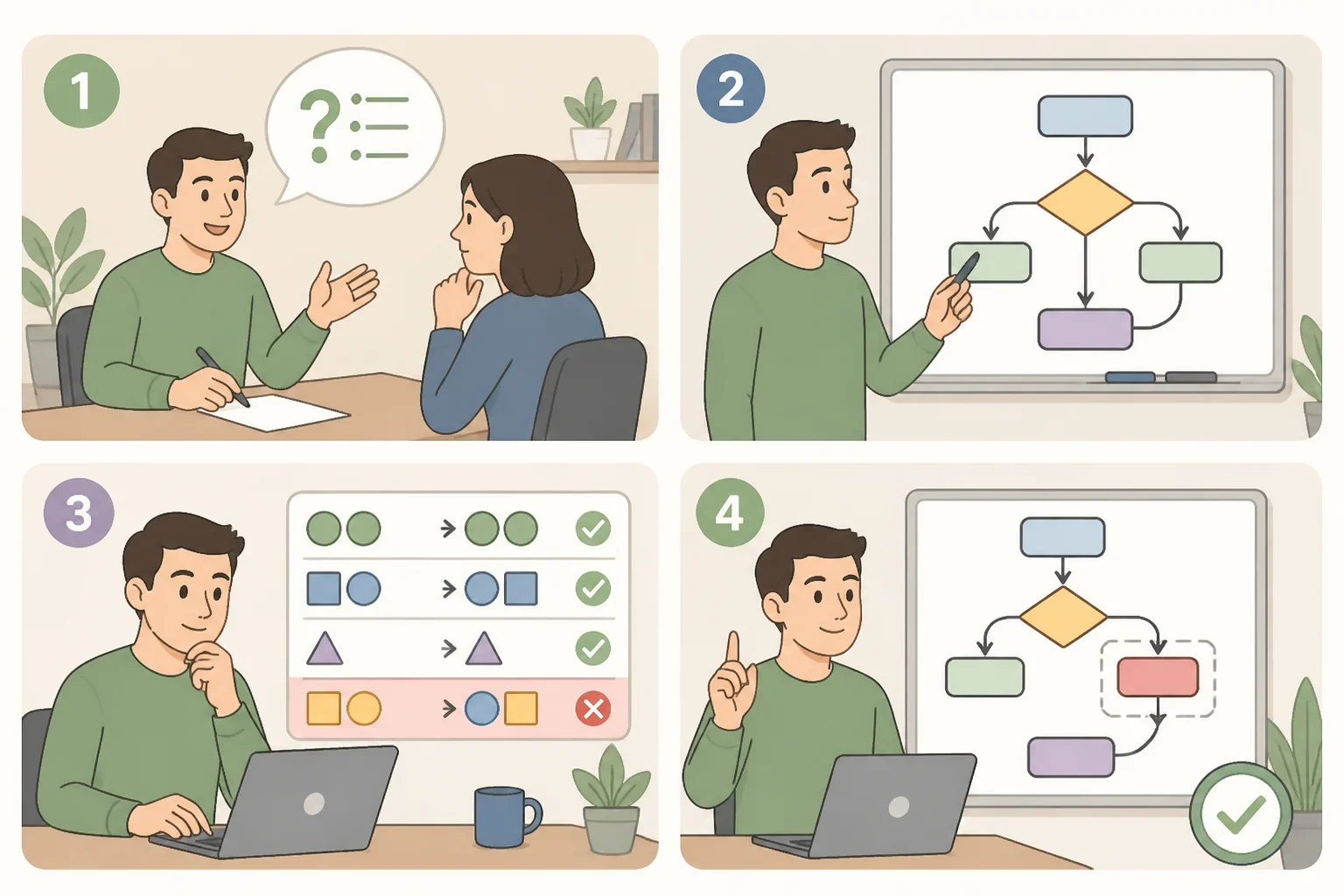
Silent problem-solving can hide useful work from the interviewer. Formation’s discussion of the “silent optimizer” contrasts a candidate who works quietly with a “collaborative explainer” who clarifies the prompt, proposes a simple approach, improves it, and discusses tradeoffs (Formation, last year).
Practice using this sequence:
- Clarify the problem. Ask what the inputs look like, what output is expected, and what constraints matter.
- State an initial approach. Explain the straightforward solution before searching for a more efficient one.
- Work through an example. Use a small input to show how the approach behaves.
- Discuss tradeoffs. Address performance, complexity, reliability, maintainability, or security when relevant.
- Test the result. Check an ordinary case, an edge case, and a case that could expose an error.
- Adjust when prompted. Treat interviewer feedback as information, not as proof that the first approach failed.
Useful phrases include:
- “Before I choose an approach, I want to confirm the expected input size.”
- “The simplest solution would be X. Its limitation is Y.”
- “I’m choosing this structure because it makes lookup faster, although it uses more memory.”
- “Let me test that against an empty input and a repeated value.”
- “That constraint changes the tradeoff. I would revise the approach this way.”
Dice advises candidates to explain code logic and performance implications, not merely produce working output (Dice, last year). Formation similarly describes online platforms as places where exact answers may be rewarded, while live interviews can reveal more through clear communication and adaptability (Formation, last year). Treat an automated assessment and a live interview as separate skills to practice.
For senior software roles, Bakker’s framework gives system design and leadership greater weight than basic coding alone, though the balance depends on the employer and role (Roy Bakker, last year). Practice describing a system you have worked on, the constraints it faced, the alternatives considered, and the decision made. If your experience is limited, use a school, internship, volunteer, or personal project example and be clear about your level of responsibility.
4. Build a behavioral interview story bank
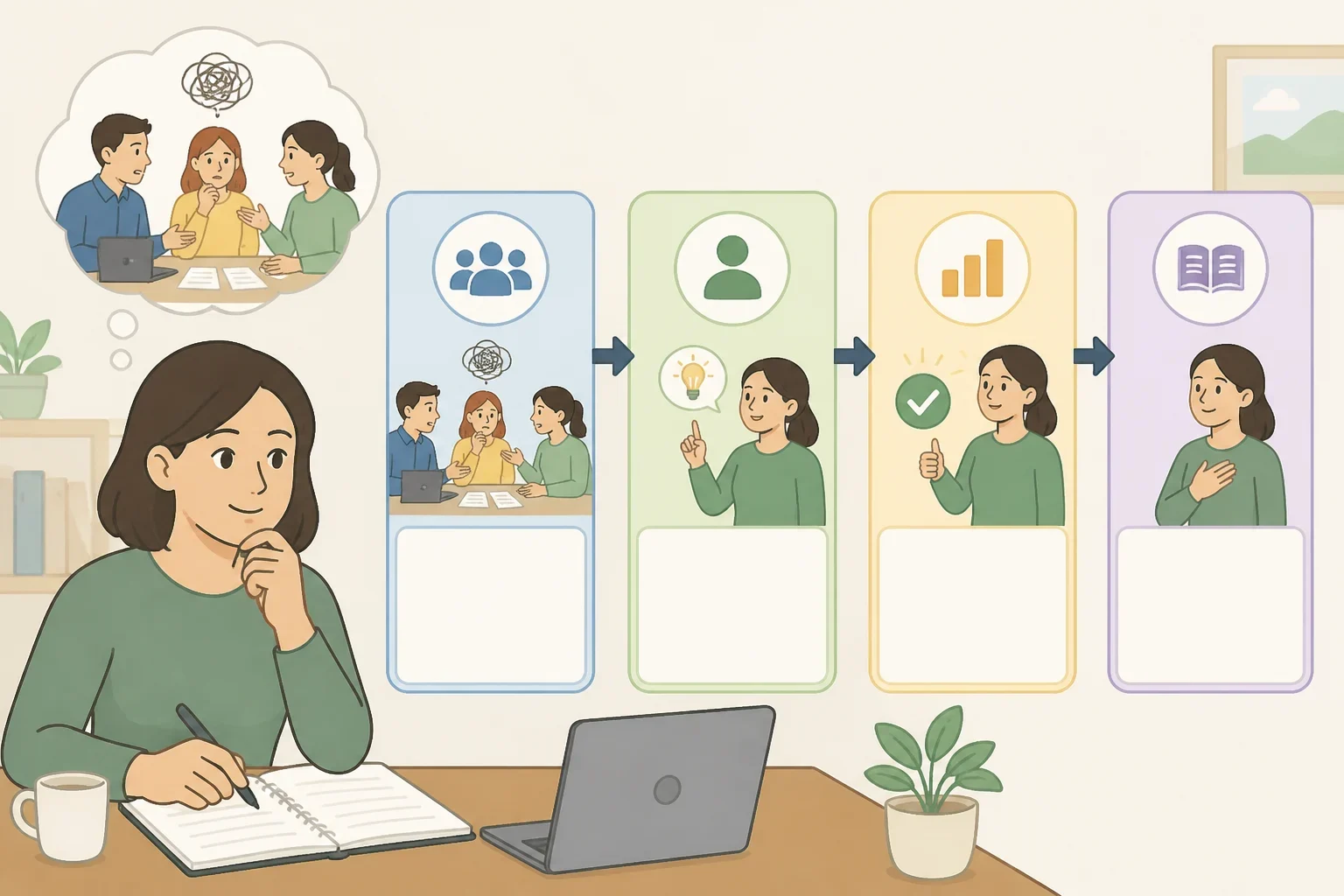
Technical reasoning shows how you approach a problem. Behavioral stories show how you work with people, respond to setbacks, and make decisions when the answer is not obvious.
Harvard’s career center says many employers use behavioral interviews to assess skills and fit. The competency areas differ by organization, but the questions often ask what you did in a past situation. Harvard recommends a Situation, Action, Result structure, using examples from work, school, extracurricular activities, or volunteer experience (Harvard FAS.
Build each story with four parts:
- Situation: What was happening, and why did it matter?
- Action: What did you personally do?
- Result: What changed afterward?
- Lesson: What would you repeat or handle differently?
A weak answer says, “The team had a disagreement, and communication improved.” A stronger answer identifies the disagreement, your specific contribution, and the outcome:
“Our team disagreed about which database to use. I organized technical discussions, documented the competing requirements, and helped compare the options. The team selected an approach that improved performance, and I learned to make architectural disagreements concrete by separating technical constraints from personal preferences.”
Bakker recommends preparing five to seven career stories covering the problem, action, outcome, and lesson, with numbers, timeframes, and other concrete evidence where available (Roy Bakker, last year). Treat that as a useful preparation target rather than a hiring requirement.
Prepare stories for:
- a difficult technical problem
- a disagreement or competing recommendation
- a mistake or failure
- a time you learned something quickly
- a project completed with limited time or resources
- collaboration across different perspectives
- leadership, mentoring, or ownership
Expect questions such as “Tell me about a time you made a mistake,” or “What is an area of weakness for you?” Harvard identifies negatively framed questions like these as particularly difficult behavioral questions (Harvard FAS. Answer directly, explain the corrective action, and avoid turning the response into a disguised claim of perfection.
Do not memorize complete answers. Harvard’s career guidance recommends using preparation to generate ideas while keeping responses in your own voice and remaining able to adapt during the interview (Harvard FAS). Write bullet points, then practice telling each story in a natural order.
5. Prepare for phone, video, and on-demand interviews

Ask the recruiter which format to expect. A process may include a phone conversation, live video interview, technical assessment, recorded responses, or an in-person meeting. Harvard notes that phone and video interviews are used beyond a general prescreen, and that phone interviews remove many nonverbal cues (Harvard FAS.
For a phone interview, keep the job description and role-fit notes nearby, but do not read answers aloud. Speak with more verbal structure because the interviewer cannot see your expression or body language.
For a live video interview:
- test the camera, microphone, and connection beforehand
- close all tabs and silence email and text alerts
- turn off the phone
- keep the meeting link accessible
- join one or two minutes early
Harvard specifically recommends closing all tabs, silencing alerts, and arriving one or two minutes early for a virtual interview. Dice also advises testing technology before a remote interview (Harvard FAS; Dice, last year).
An on-demand interview uses software to present written or prerecorded questions, then gives the candidate an allotted time to record responses (Harvard FAS). Practice answering a question after a short pause, without restarting every time a sentence comes out imperfectly. Focus on a clear structure, direct examples, and an appropriate pace.
Some employers may use AI to analyze recorded responses, including tone and presentation, while sorting a large applicant pool (Harvard FAS). That does not mean every employer uses these tools or that an automated assessment reliably captures a candidate’s ability. Prepare for the format you are given, and ask the recruiter what the stage involves when the instructions are unclear.
6. Use AI for preparation, not performance
AI can generate potential questions, brainstorm behavioral answers, and offer feedback on a draft. A useful prompt might be:
“Review this Situation, Action, Result answer for clarity. Identify where the candidate’s personal contribution and result are unclear. Do not rewrite it in a different voice.”
Fact-check the output against the job posting and trusted company information. Remove claims that are not accurate. Do not paste confidential employer information, private project details, or proprietary code into a tool.
The final answer should sound like the candidate. Harvard’s guidance cautions against memorizing AI-generated responses because interviewers may ask follow-up questions and candidates need to adapt in the moment (Harvard FAS). Use AI to find gaps in preparation, then practice speaking without it.
A practical one-week preparation schedule
If the interview is one week away, use the available time deliberately:
- Day 1: Mark the job description and create the requirement, evidence, and interview-connection columns.
- Day 2: Write the role-fit paragraph and research the company’s work using trusted sources.
- Day 3: Practice two technical problems aloud, including clarification, approach, tradeoffs, and testing.
- Day 4: Draft three behavioral stories using Situation, Action, Result, and lesson.
- Day 5: Practice the role-specific areas: coding, troubleshooting, SQL, security reasoning, system design, or leadership.
- Day 6: Run a mock interview in the scheduled format and fix the largest communication or logistics problem.
- Day 7: Review short notes, confirm the link or location, test the technology, and stop adding new material.
Before the interview begins, confirm the next step in the process. Harvard recommends asking, “When might I expect to hear from you?” (Harvard FAS. Before the day arrives, make sure the format is clear, your role-fit summary is ready, one technical problem has been practiced aloud, and three adaptable stories are available. That is a more useful final checklist than another round of unfocused drills.
