
- Helicopter Parents and Adult Children's Careers: Explained
- Helicopter parents and adult children's careers: what the studies actually measure
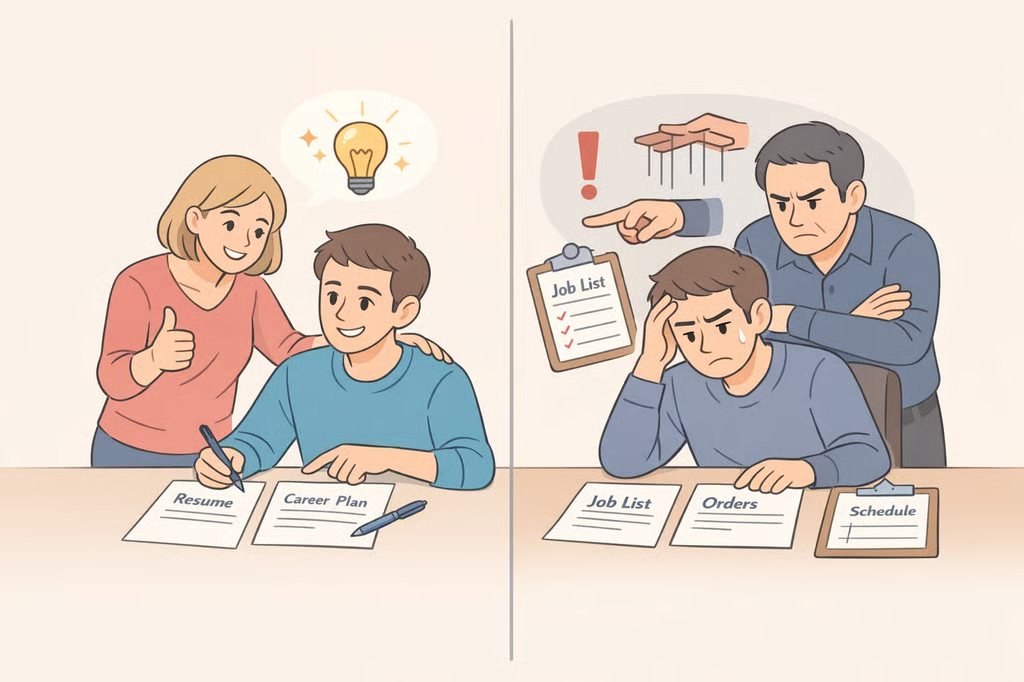
- The difference between parental support and career control
- How parental involvement affects career adaptability
- Setting boundaries with parents about career choices
- How to keep career-related parental support useful
Helicopter Parents and Adult Children's Careers: Explained
Ask a researcher about helicopter parents and adult children's careers, and the answer depends on which study crossed their desk last. One body of research links perceived helicopter parenting to lower career adaptability, thinner career exploration, and more self-doubt. Another finds that career-specific parental support is associated with stronger job-search behavior and job-search self-efficacy. Both conclusions rest on real data. The gap between them has less to do with parental involvement in adult children's careers overall and more to do with what kind of involvement each study actually measured.
A 2022 study of 491 emerging adults at a university in Western Ontario, Canada, with an average age of 20.4, found that higher perceived helicopter parenting was associated with lower career adaptability and less in-depth career exploration (Frontiers in Psychology, 2022). A separate study drew on a nationally representative U.S. survey that asked adults ages 18 to 28 a range of questions every other year for up to a decade, producing 7,899 surveys collected from 2,680 people. It found that adult children with strongly tied family involvement were associated with lower occupational prestige, while those with lighter involvement were associated with higher prestige (NC State/Journal of Youth Studies, earlier this year). Meanwhile, a study of 864 college students found that career-specific parental behaviors significantly and positively predicted job-search behavior and job-search self-efficacy (SCISCAN Publishing, earlier this year).
These aren't three versions of the same finding. They examine different constructs and populations using different measures. Once that gets separated out, the picture becomes more useful for anyone navigating a job search alongside a parent who wants to help.
Helicopter parents and adult children's careers: what the studies actually measure
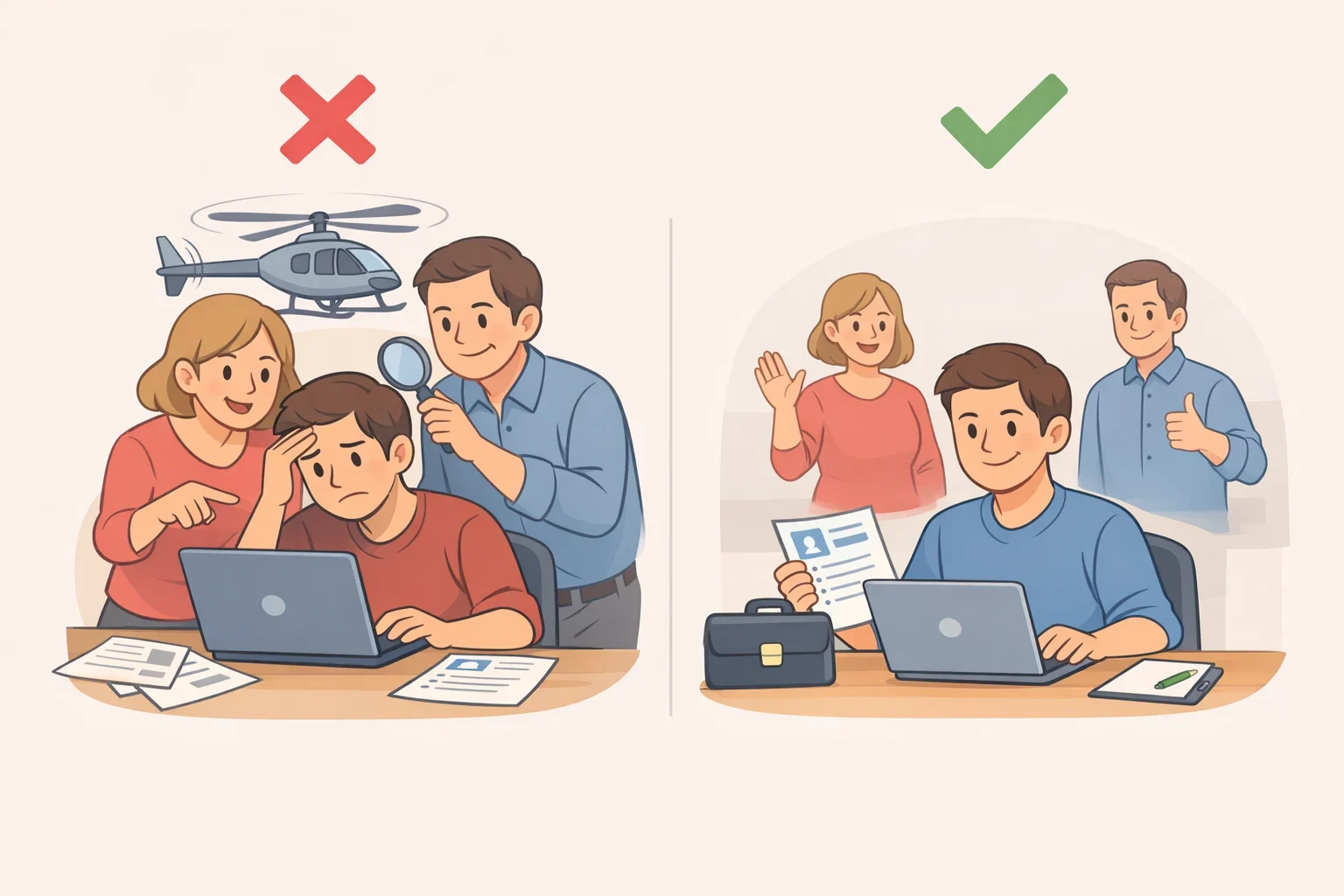
Helicopter parenting has a specific working definition in this research. Segrin and colleagues describe it as excessive involvement paired with parenting tactics that fail to match the autonomy appropriate to a young person's age, and researchers treat it as a pattern that takes place primarily during emerging adulthood, not childhood (Frontiers in Psychology, 2022). That distinction matters. This isn't research about parents helping a ten-year-old with a science fair project. It's about parents still directing decisions for someone old enough to be interviewing for jobs.
In the Canadian sample, perceived helicopter parenting correlated with lower career adaptability, less in-depth career exploration, and higher career self-doubt. It was also associated with a greater likelihood that a young adult stayed in what the study calls "searching moratorium," meaning unresolved uncertainty about a career direction rather than active progress toward one (Frontiers in Psychology, 2022). None of that means parental interest in a career is harmful. The pattern researchers are pointing to is narrower: whether a parent is substituting their own judgment for a young adult's decision-making at exactly the stage when that skill is supposed to develop.
The difference between parental support and career control
The NC State-summarized study did not measure helicopter parenting at all. It measured what researchers call family social capital, the norms, information, and support parents pass along through everyday interaction, tracked through the nationally representative Transition to Adulthood Supplement of the Panel Study of Income Dynamics (NC State/Journal of Youth Studies, earlier this year). Occupational prestige in this study isn't a measure of salary or job satisfaction. It's calculated from the average education and income associated with an occupation, an occupation-level score rather than a snapshot of any one person's paycheck or happiness at work (NC State/Journal of Youth Studies, earlier this year).
The researchers were candid that the direction of the result surprised them. "This absolutely took us by surprise," said Manzoni, one of the study's authors, describing the finding that heavy parental involvement, measured through time spent advising and shared activities, was associated with adult children landing in lower-prestige occupations (NC State/Journal of Youth Studies, earlier this year). Manzoni offered an interpretation rather than a proven mechanism: "As young people move into early adulthood, the parental role may need to shift away from intensive guidance and toward a more hands-off, supportive posture that allows children to develop autonomy, make mistakes, and navigate the labor market on their own" (NC State/Journal of Youth Studies, earlier this year). That's a proposed explanation for an association, not a demonstrated cause.
Set that against the SCISCAN findings. Using a Career-specific Parental Behaviors Scale, researchers found that career-specific parental behaviors significantly and positively predicted both job-search behavior and job-search self-efficacy among 864 college students (SCISCAN Publishing, earlier this year). One possible distinction is whether involvement is measured as broad family connection or as career-specific support, but the two studies weren't designed as a direct comparison of each other, and neither tested amount of involvement against type of involvement in the same model. The throughline that does hold across both, and across the Canadian study as well, is the difference between parents influencing career choices and parents making those choices instead of their adult child.
How parental involvement affects career adaptability
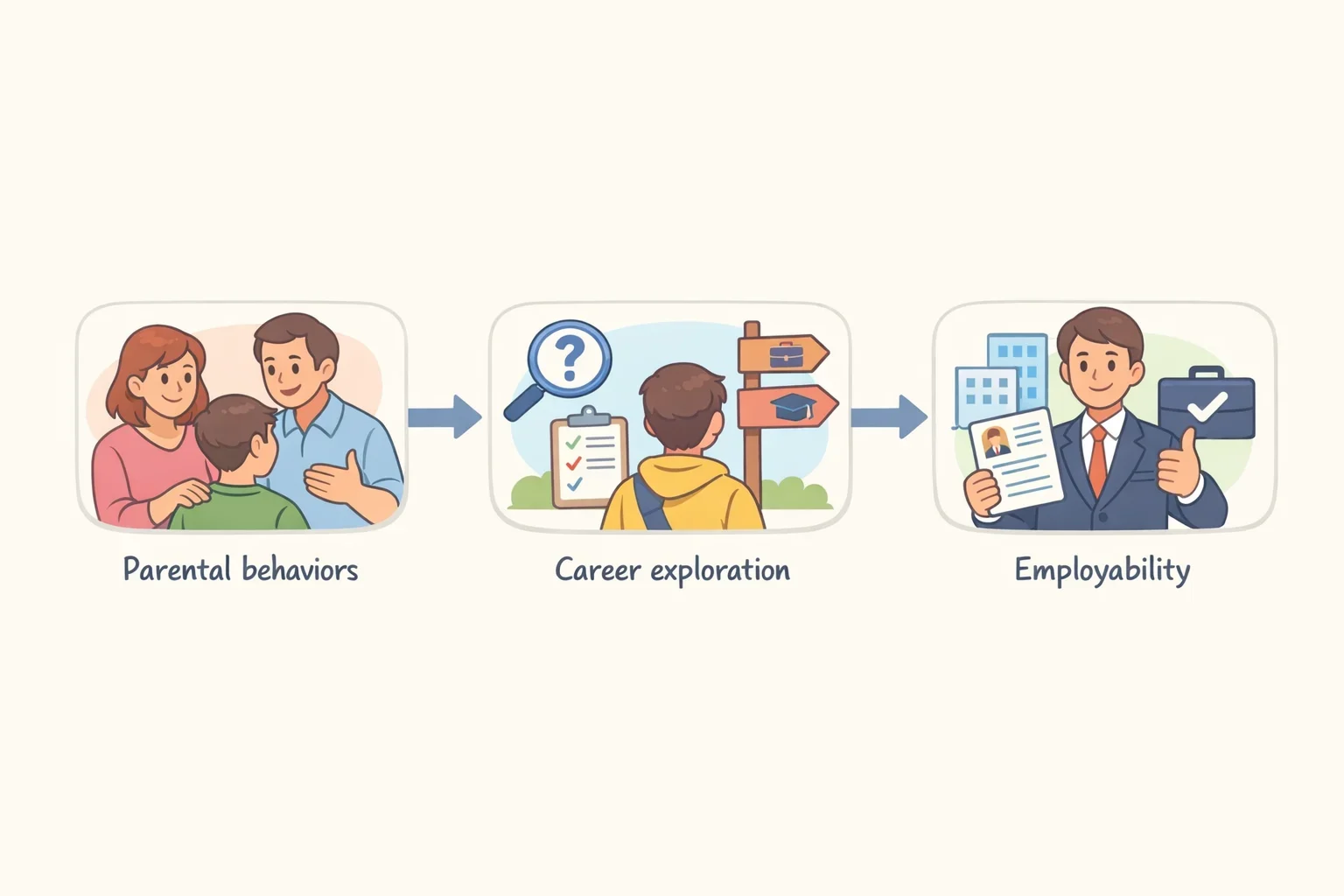
Career adaptability, as this research uses the term, describes how ready and resourceful someone feels when facing career transitions, unexpected setbacks, or decisions about what to do next. Researchers typically break it into subdimensions such as career concern, or planning ahead; career control, or taking ownership of decisions; and career curiosity, or actively exploring options. Career exploration is the concrete legwork underneath those traits: researching occupations, testing interests against real information, gathering facts about employers, and clarifying what a path actually involves before committing to it.
The SCISCAN researchers tested a mechanism, not just a correlation. Career exploration statistically mediated the relationship between career-specific parental behaviors and college students' employability, meaning the strength of the link between those parental behaviors and employability outcomes was explained in part by how much career exploration students reported (SCISCAN Publishing, earlier this year). The data supports that mediation; it doesn't say whether the exploration was independent, parent-prompted, or done together, so it's worth treating that detail as an open question rather than a settled fact.
A related pattern turned up in a 2026 study of 265 Chinese international students attending universities in the Seoul area of South Korea, surveyed online from May 1 to May 18, 2024. Career adaptability fully mediated the relationship between parental support and what the study measured as future work self-salience, a measure of how salient a student's imagined future work self was (Current Psychology, earlier this year). The sample skewed a bit older than typical undergraduate research, averaging about 24.65 years old, and nearly two-thirds of participants were only children (Current Psychology, earlier this year).
That study added a layer the others didn't test: the pathway's shape depended on the type of career-related filial piety a student reported. Under reciprocal filial piety, marked by mutual respect and voluntary deference, the indirect effect ran through career concern, career control, and career curiosity. Under authoritarian filial piety, the indirect effect showed up across all four adaptability subdimensions (Current Psychology, earlier this year). The study didn't spell out beyond those labels exactly what separates the two forms of filial piety, so this is best read as a possible implication of one sample rather than a settled finding about how culture shapes parental support generally.
Taken together, these two studies point to career exploration and career adaptability functioning as statistical pathways, connecting parental behavior to employability in one case and to future work self-salience in the other. Neither study tested what happens when a parent takes over the exploring, deciding, or troubleshooting instead of prompting it. But the pattern is at least consistent with an inference: consistently making career decisions for a young adult may leave less room for that young adult to practice the exploration and adaptability the models are measuring.
Setting boundaries with parents about career choices

The SCISCAN study also found that adolescent-parent career congruence, meaning how aligned a student and parent already were on career direction, moderated the way career exploration related to employability, along with certain direct paths in the model (SCISCAN Publishing, earlier this year). In practice, that suggests the effect of parental involvement isn't fixed. It shifts depending on how much a parent and child already agree, though the study didn't test why alignment mattered or how it should change a family's actual conversations.
None of this research settles what a specific family should do at a specific moment. But it does support a rough operating principle: support that builds a young adult's own capacity to search, decide, and act tracked with better outcomes across these studies; involvement that appears to substitute for that capacity tracked with worse ones, though that second half of the comparison rests on studies that didn't directly measure substitution. Applied to the three moments where parental involvement most often shows up, that principle turns into something more concrete:
- Choosing a direction. Instead of assuming advice is wanted, a parent might ask, "Do you want my opinion on this, or do you just want me to listen?" An adult child can treat the answer as one data point among several rather than a deciding vote.
- Applying for jobs. A young professional can draft a resume bullet or cover letter paragraph first, then hand it to a parent with a specific request: "Tell me if this sentence is clear," not "Can you fix this?" A parent can ask before opening an application rather than editing it unprompted.
- Handling an offer. Neither party should email a recruiter or hiring manager on the applicant's behalf. A parent can help rehearse a salary conversation out loud, playing the role of the hiring manager, but the actual conversation belongs to the person taking the job.
The evidence behind this guidance has real limits. The cited studies draw on university-student samples in Canada and South Korea, one sample described only as students at five colleges "in a certain region," and a nationally representative U.S. study of adults ages 18 to 28 (Frontiers in Psychology, 2022; SCISCAN Publishing, earlier this year; Current Psychology, earlier this year; NC State/Journal of Youth Studies, earlier this year). All four are observational studies whose findings don't by themselves establish causation. Family structures, income levels, and industries vary widely, and none of these samples can speak for every household navigating a job search together.
How to keep career-related parental support useful

Helicopter parenting and career-specific parental support are different constructs measured in different studies, not two names for the same behavior. The first tracks with lower adaptability and more self-doubt; the second tracks with stronger job-search self-efficacy. Career exploration and adaptability appear to be the connective tissue in the studies that tested a mechanism directly, which is a reasonable basis for practical caution even though it isn't a guarantee about any individual family.
Before the next resume update, application, or offer conversation, pick one task that's currently getting outsourced to a parent, whether that's writing the resume, emailing a recruiter, or figuring out a counteroffer. Draft a first version of it alone, decide exactly what kind of feedback would actually be useful (wording, tone, a gut check on timing), and ask for that specifically rather than for someone else to take over. Keep any direct contact with an employer, recruiter, or hiring manager in your own hands. That's the boundary the research points to most clearly, and it's one worth testing before it becomes a habit.
