

- Young college graduates unemployment in New York: what degree value means
- What the New York data actually measures
- New York college graduate unemployment rate compared with other education groups
- Why Gen Z unemployment in New York remains difficult to interpret
- What the data cannot show about degree value
- Affordability changes the degree decision
- What students and graduates should compare next
Young college graduates unemployment in New York: what degree value means
The New York college graduate unemployment rate is difficult to discuss without first defining who is being measured. Employment among young adults who have completed school is not the same as unemployment among all young adults. Neither measure fully captures access to stable, full-time work.
The state data points in a useful direction: education is associated with better employment outcomes for young New Yorkers, but it does not guarantee a job or financial independence. In 2023, just under 90% of young adults who were college educated and not currently attending school were employed, compared with 68.1% of those without a college education, according to the New York State Comptroller. The same report found that New Yorkers ages 26 to 34 without a college degree had an unemployment rate more than twice that of peers with one.
That finding does not prove that a degree caused the difference. It does show why claims that degrees no longer help can mislead students, families, and recent graduates. The more useful question is how education, age, school enrollment, work experience, field of study, and living costs interact.
What the New York data actually measures

The Comptroller’s report defines young adults as New Yorkers ages 18 to 34. That group included 4.6 million people in 2023, or 23.2% of the state’s population, based on Census Bureau American Community Survey data cited by the Comptroller’s report, published 10 months ago.
That age range covers very different stages of working life. An 18-year-old attending high school, a 22-year-old finishing college, and a 34-year-old with more than a decade of experience should not be treated as interchangeable job seekers. The report separates some of these groups, making its comparisons more useful than one headline unemployment figure.
The nearly 90% figure applies to people who were college educated and not currently attending school. The comparison figure, 68.1%, applies to people without a college education. Both are employment rates, not unemployment rates. The difference cannot be converted into a precise unemployment gap because the remaining share may include people who were not working and were not looking for work.
The source does provide a direct comparison for people ages 26 to 34. In 2023, the unemployment rate for those without a college degree was more than twice the rate for those with one, according to the New York State Comptroller. The supplied data does not provide the two exact percentages, so the difference should not be presented more precisely.
A broader measure adds context. The unemployment rate for all New Yorkers ages 18 to 34 was 8.6% in 2023, more than twice the statewide average, the Comptroller’s office reported. That figure includes people with different education levels and work histories. It cannot answer whether a college graduate faces the same risk as someone without a college degree.
For readers searching for “unemployment among young New Yorkers with degrees,” this distinction matters. A headline can combine the 18-to-34 unemployment rate with the experience of college-educated adults who have already left school, creating a comparison that sounds more direct than it is.
New York college graduate unemployment rate compared with other education groups
The state figures still offer meaningful evidence. Among young adults who had completed their education, college-educated people were employed at a substantially higher rate than people without a college education. Among 26- to 34-year-olds, those with a college degree also had a lower unemployment rate.
That is an association, not a guaranteed return on tuition. People who attend and complete college may differ from those who do not in prior academic preparation, work experience, family support, professional networks, financial resources, or access to particular locations and industries. The supplied data does not show how much each factor contributed to the employment gap.
Field of study may matter, too, but the New York figures do not break the results down by major or occupation. A state-level education comparison can show that outcomes differ by credential category without identifying which programs provide the strongest path into a particular career. Students should not treat the overall college-educated employment rate as a prediction for one degree program.
The age distribution complicates the comparison as well. Among New Yorkers, 31.5% of people ages 26 to 34 held a bachelor’s degree, compared with 19.6% of those ages 35 and older, according to the New York State Comptroller. This compares age groups rather than following the same people over time. It shows that younger adults have higher bachelor’s degree attainment, but not that every newer graduate will experience better results than an older worker.
The practical use of the data is directional. Someone deciding whether to pursue college can treat education-level employment figures as one piece of evidence, then investigate the specific field, program cost, likely entry-level roles, and local job opportunities. A general college degree job prospects in New York statistic cannot replace that research.
Why Gen Z unemployment in New York remains difficult to interpret
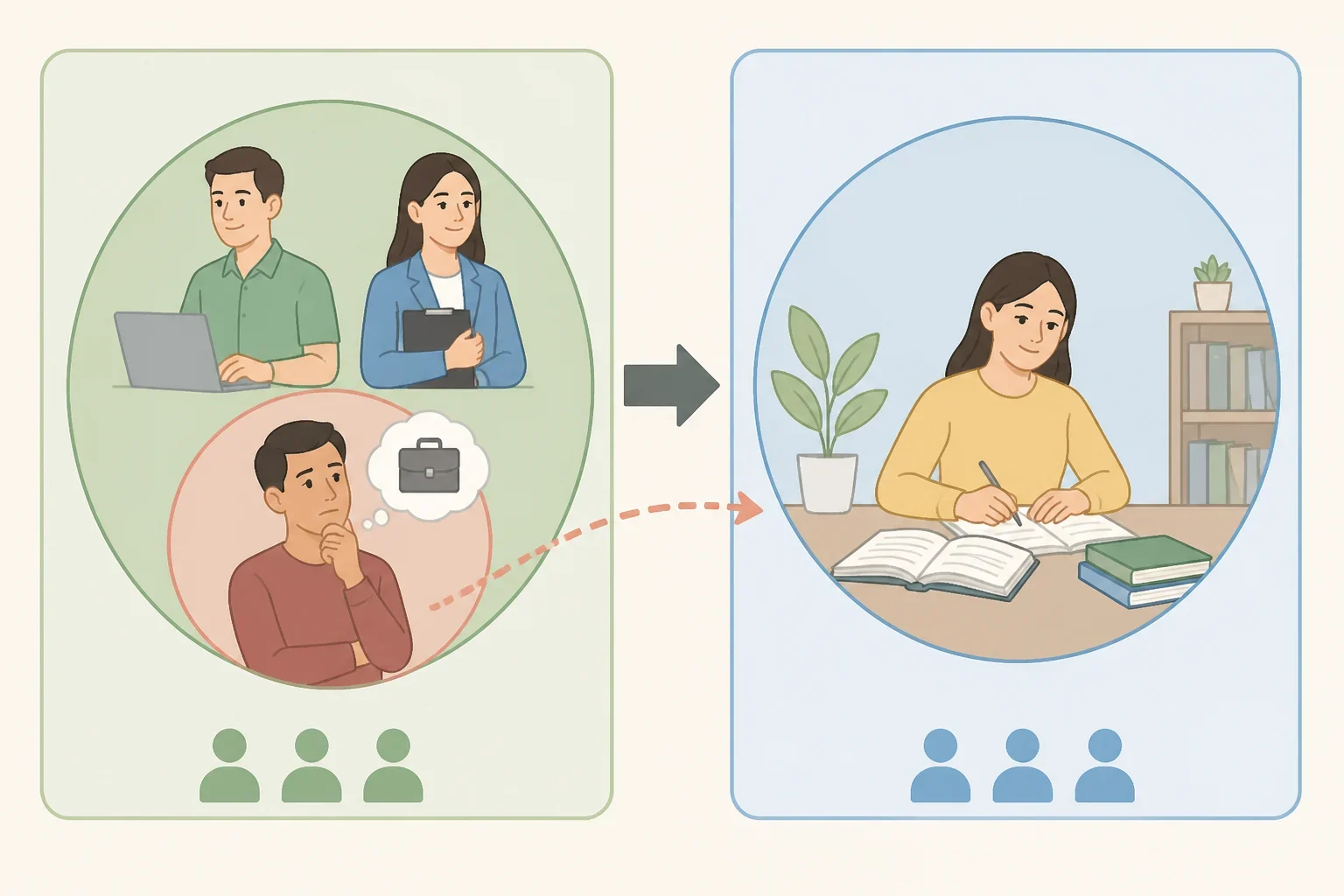
The entry-level job market in New York includes many people who are still in school, which affects both labor-force participation and the meaning of employment statistics. In 2023, the labor-force participation rate for New Yorkers ages 18 to 25 was 47.6%, while 49.9% were attending school, including high school and above, according to the Comptroller’s report.
A person enrolled in school who is not looking for work is outside the labor force and is not counted as unemployed. The unemployment rate for the entire 18-to-25 population therefore cannot be read as the share of young people who want full-time work but cannot find it.
The report offers more detail about people who were both in school and in the labor force. Among that group, 87.8% worked mostly part time, and the median workweek was 21.7 hours, according to the New York State Comptroller. Part-time workers are employed under standard labor-market definitions. Still, these figures show why employment alone may not capture the difficulty of securing enough hours while studying.
That distinction can help students present their experience more effectively. A part-time job can demonstrate reliability, customer service, technical ability, or time management even when it does not provide full-time income. Rather than hiding limited hours, a student can describe the responsibilities, results, and skills gained, then connect those skills to a target entry-level role.
The Comptroller’s office identifies a shrinking pool of entry-level jobs as one pressure on young adults and says the change is driven in part by AI, according to the Comptroller’s office, published 10 months ago. That is a stated concern, not occupation-level proof that AI caused New York’s unemployment rate or reduced hiring in every entry-level field. The report does not identify which occupations contracted or measure how much technology contributed.
That uncertainty should shape a job search. It is reasonable to examine whether employers in a target field are reducing junior roles, changing required skills, or combining responsibilities that were once split across several positions. It is not reasonable to assume every entry-level career has been displaced or that a degree has lost its value across the board.
Recent graduates can make the search more specific by reviewing actual job postings, identifying recurring skills, tailoring project and part-time experience to those requirements, and asking interviewers how new hires are trained and evaluated. A degree may help a candidate reach consideration, but the application still needs evidence of usable skills.
What the data cannot show about degree value
The employment gap does not settle whether college is worth the cost. The state data does not compare individual degree programs, calculate debt-adjusted earnings, or show whether graduates stayed in New York after completing school. It also does not establish that a degree is the best route for every occupation or student.
Selection into college is another unresolved issue. People who enroll may already have advantages that affect employment, including stronger academic preparation, more financial support, or better access to internships and professional contacts. The figures show different outcomes by education category, but they do not separate those influences from the effect of the credential itself.
The data also cannot show whether employed graduates found jobs related to their studies, whether they work full time, or whether their pay covers local living costs. That last question is central in New York, where being employed and being financially independent are different outcomes.
Students should therefore compare more than a general New York college graduate unemployment rate. Before enrolling, they can ask a program for information about total cost, completion time, relevant work experience, and the types of jobs graduates pursue. Before accepting a job, a graduate can compare pay, hours, location, advancement processes, and opportunities to build skills.
Affordability changes the degree decision

New York’s employment advantage for college-educated young adults exists alongside substantial living costs. Housing, food, and transportation accounted for more than two-thirds of young adults’ total spending in 2023, with housing alone representing 35%, according to the Comptroller’s office. These are shares of spending, not income, so they do not show exactly how much money every graduate has left after necessities.
Statewide median rental costs rose 33% from 2013 to 2023 while lower-cost units became less common. Among young adult renters, 35.9% faced housing cost burdens. Within that group, 22.4% spent 30% to 49% of income on rent and utilities, while 13.4% spent at least 50%, according to the New York State Comptroller. These statewide figures do not describe every local market. A graduate comparing New York City, Albany, Buffalo, or another area should examine the specific housing market.
Student debt adds another constraint. In 2024, 1.3 million New Yorkers ages 18 to 34 held $40.5 billion in student loans, representing 42.1% of all student-loan debt in the state, according to the Comptroller’s report. The report gives New York’s average student-loan balance as just over $30,300, the second-highest state average nationally. That average should not be treated as the balance of every young borrower.
The report also describes a national change in reported student-loan delinquencies. Delinquencies, defined as payments 90 days or more late, rose from 0.3% at the end of 2024 to 9.7% in the second quarter of 2025 after the Department of Education’s pause on credit reporting ended in October 2024, according to the Comptroller’s office. Those figures are not New York-specific.
Homeownership offers another measure of financial independence, although it does not capture every person’s goals. Among New Yorkers ages 26 to 34, homeownership declined from 31.2% in 2004 to 23.4% in 2023, according to the New York State Comptroller. The change suggests that employment and a degree do not automatically translate into the same financial milestones for every generation.
New York also has a relatively high rate of higher-education participation. Among 18-year-old high school graduates, 56.7% in New York pursued higher education, compared with 37.3% nationally, according to the Comptroller’s report. Because more young people are making this investment, comparing programs and likely outcomes becomes more important.
What students and graduates should compare next

The evidence supports a careful conclusion. College-educated young adults who were no longer attending school had better employment outcomes than those without a college education, and New Yorkers ages 26 to 34 with a college degree had a lower unemployment rate than peers without one. The data does not show that a degree guarantees employment, causes the entire difference, or delivers financial independence.
For a student or recent graduate, the next step is a focused comparison:
- Check employment and earnings information for the specific field, not just education-level averages.
- Compare total program costs, including borrowing, with likely starting pay for related jobs.
- Review entry-level postings to identify recurring skills and whether employers offer training.
- Estimate local rent, transportation, and other essential costs where a job would be located.
- Confirm loan balances, repayment status, and account information directly with a servicer or Federal Student Aid.
- Ask employers about hours, advancement timelines, and how performance is measured.
That process produces a more useful answer than either “degrees do not matter” or “a degree guarantees opportunity.” In New York, education remains associated with stronger employment outcomes, while the cost of turning employment into a stable adult life deserves equal attention.
