

- Thai graduate unemployment rate: 13–14% for youth explained
- What the Thai graduate unemployment rate actually measures
- AI impact on jobs in Thailand is only part of the skills mismatch
- Technical vacancies do not automatically solve young graduate unemployment
- Training is a shared responsibility
- What job seekers can check next
Thai graduate unemployment rate: 13–14% for youth explained
Thailand’s Thai graduate unemployment rate is reported at 13–14% among people aged 15–24 with a bachelor’s degree or higher, far above the country’s overall unemployment rate of about 1%. The figures were presented by Democrat MP Korn Chatikavanij at a Nation Forum session on Tuesday, but they do not establish an official national unemployment rate for all university graduates.
The gap matters for current students, recent graduates and career changers trying to understand the AI impact on jobs in Thailand. Speakers linked the pressure to changing skill requirements, while labour-market evidence also points to vacancies in technical and vocational roles. The numbers raise questions about how education, training and hiring are lining up, but they do not prove that artificial intelligence caused the unemployment gap.
What the Thai graduate unemployment rate actually measures

Korn said Thailand’s overall unemployment rate was about 1%, representing roughly 400,000 people, according to Nation Thailand on Tuesday. He put unemployment among people aged 15–24 at 3–4%, while the rate among people in that age group with bachelor’s degrees or higher reached 13–14%.
Those figures describe a narrow group: young people aged 15–24 who hold at least a bachelor’s degree. They should not be treated as the Thailand graduate jobless rate for every age group, field of study or university graduate. The report does not provide a published methodology, survey period, denominator or trend line showing that graduate unemployment is rising.
That distinction changes how job seekers should read the headline. A young degree holder who cannot find work may be facing a difficult transition into the labour market, but the figures alone cannot show whether the cause is the degree subject, employer expectations, location, economic conditions, limited experience or changing technology.
A separate ILO analysis from two years ago used Thailand’s National Statistical Office Labour Force Survey data from 2012 to 2021. It examined movement among employment, unemployment and leaving the labour force, including differences connected to education and part-time or full-time work. That approach offers a more structured way to study youth labour-market trends, although it does not supply the 13–14% figure reported at the forum.
Anyone evaluating a degree or job-search strategy should therefore check the latest Labour Force Survey release from Thailand’s National Statistical Office. Comparing results by field of study and age, rather than by “degree” alone, can provide a more useful picture.
AI impact on jobs in Thailand is only part of the skills mismatch

The forum discussion did not describe a labour market in which AI had simply eliminated jobs. Tanpong Sukhonpanich, Chief Enterprise Officer at FutureSkill for Business, said employers and workers needed to think beyond individual AI tools and prompts, according to Nation Thailand on Tuesday.
FutureSkill’s course-purchasing data showed Excel as the most popular individual course among consumers this year, followed by SQL and data analytics, with AI later gaining popularity. The figures describe learning demand, not hiring outcomes, but they suggest that basic data-management and workplace tools remain part of the skills conversation alongside AI.
Tanpong also said an assessment of AI capability among staff at Thai organisations averaged 1.8 on a four-level scale, according to Nation Thailand. He presented the problem as one of judgment and application: employees may use AI without understanding how it works, what it cannot do or how to connect it to the intended result.
For a graduate, that distinction is practical. “Used ChatGPT” is a weak description on a resume by itself. A stronger example would explain the task, the information provided to the tool, the checks applied to its output and the result produced. Spreadsheet work, data analysis and clear reasoning can support that example, rather than being displaced by it.
Tanpong said some skills, including content writing and image creation, could lose value as AI becomes faster at producing certain types of work. He expected thinking, marketing strategy, critical thinking and empathy to become more valuable, but those are his expectations, not a verified ranking of hiring outcomes.
Assistant Professor Jennifer Chavanovanich, associate dean of Chulalongkorn University’s Faculty of Psychology, focused on cognitive flexibility. She described the ability to adjust how a person thinks and solves problems as important to lifelong learning, and argued that people who can learn from mistakes may be better positioned to recover from setbacks, according to Nation Thailand.
Technical vacancies do not automatically solve young graduate unemployment
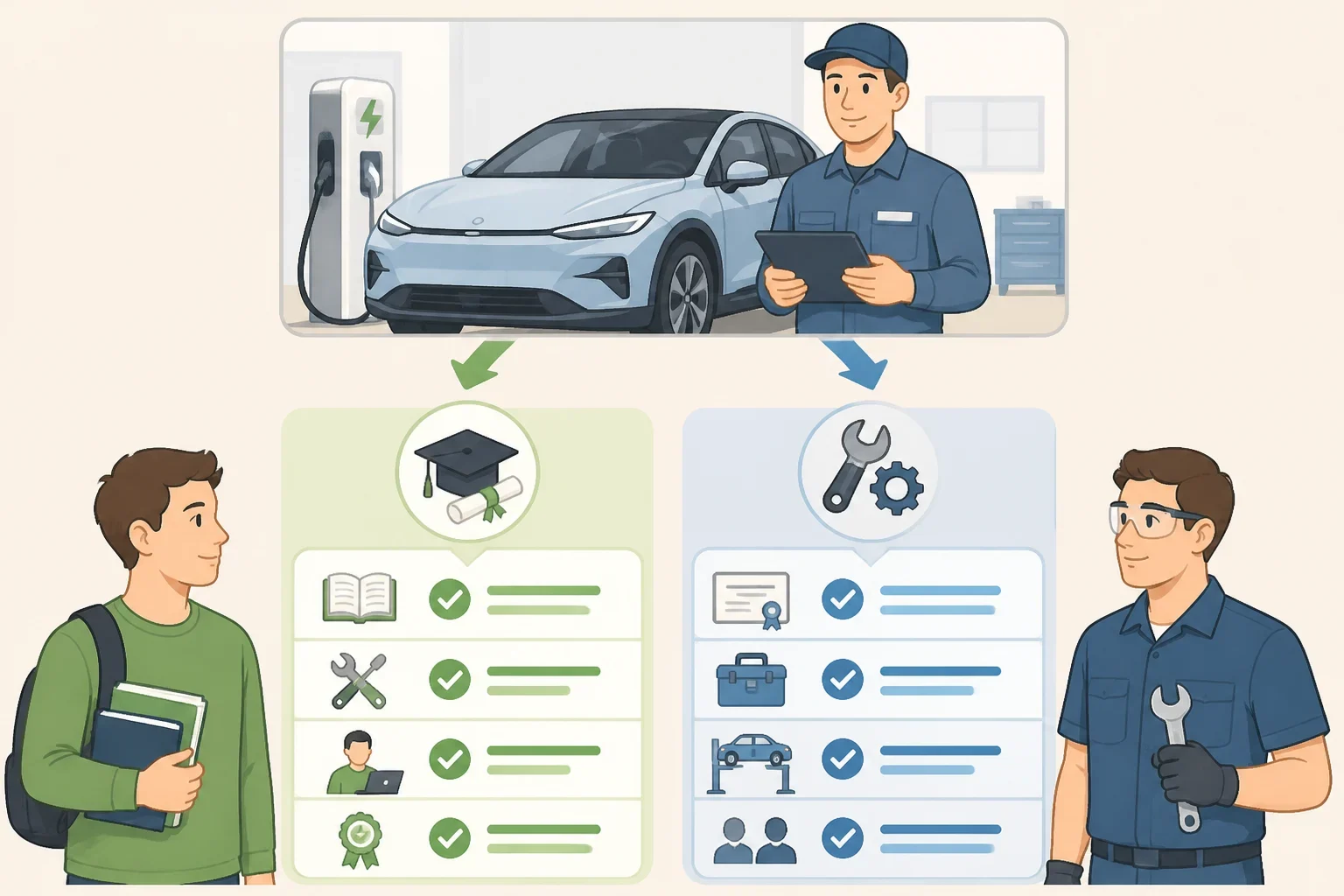
The contrast between degree-holder unemployment and technical vacancies is clearest in Thailand’s electric-vehicle sector. An ILO report from two years ago cited more than 53,000 positions that the sector found difficult to fill. Approximately 44,492 of those roles required a vocational-school education, according to the same report.
That evidence points to an access and preparation question, not an automatic route from university into an EV job. A bachelor’s degree holder may still need technical training, equipment experience or a credential that matches the position. The ILO figures document demand in a specific sector; they do not show that unemployed graduates could move into those roles without additional preparation.
The report also described Thailand’s EV targets as projections. The country aimed to produce 380,250 electric vehicles by 2027, while the EV market was expected to record a 22% compound annual growth rate from 2022 to 2025, according to ILO data. Those older projections should not be presented as proof of current expansion in October 2026.
Automotive manufacturing was Thailand’s second-largest export sector, accounting for 14% of total exports worth 1.02 trillion baht during the first nine months of 2023, the ILO reported. A survey conducted in 2020 found that more than half of automotive respondents, mostly parts suppliers, were operating at Industry 2.0, while fewer than 10% were at Industry 3.0, according to the ILO report.
The uneven technology readiness matters when reading job advertisements. An employer working with older production systems may seek a different combination of maintenance, operations and digital skills than a firm investing in more advanced equipment. Graduates considering a move into automotive or EV work should check the actual duties and credential requirements for each opening instead of assuming that a university qualification will transfer directly.
ICT offers another example. Thailand has a shortage of semi-skilled workers who support and maintain networks, servers, software packages and computer equipment, according to the ILO. That shortage exists alongside the reported unemployment among young degree holders, reinforcing that education level alone does not measure job readiness for a particular role.
Training is a shared responsibility

The ILO report found that training was the leading reported source of new skills for 69% of surveyed employers, according to ILO data. In a survey of 467 automotive workers, 52% had received formal training. Among the 242 workers who had received training, 98% identified their current employer as the provider, the report found.
Those findings place some responsibility on employers, not only on graduates trying to pay for courses after work. Tanpong proposed that businesses set aside two to three hours of paid working time each week for employees to develop new skills, according to Nation Thailand. That was a proposal from the forum, not a general employment standard.
Korn said workers could face major skills transitions every five years, while Chavanovanich argued that families, employers and government should help create conditions for continued learning. Their comments frame adaptability as an ongoing process, but they do not make any one credential unnecessary or guarantee that reskilling will lead to a job.
What job seekers can check next
Students and graduates can turn the uncertainty into a more specific research task:
- Check the latest Thai National Statistical Office Labour Force Survey rather than relying on the reported 13–14% estimate as a national graduate rate.
- Identify whether a target job accepts a bachelor’s degree, requires vocational training or lists technical experience as preferred.
- Compare the duties in EV, automotive, ICT support and other technical postings before paying for a course.
- Build evidence with Excel, SQL, data analysis or AI-assisted work, while explaining how the work was checked and what outcome it produced.
- Ask employers whether training is paid, whether mentoring is available and which skills new hires are expected to build.
The reported Thailand youth unemployment rate and the degree-holder figure describe a labour-market warning, not a verdict on every graduate. The most useful next step is to verify the population behind the statistic, match training to a real role and ask employers what support exists after hiring.
