

How to ask your employer for software training: a full guide
A software-training request lands better when it names the skill gap, shows the impact, and lays out a workload plan before anyone opens an email. That's the core of how to ask your employer for software training: treat it as a short business case, not a vague wish. NC State's HR office laid out that three-part framework earlier this year for professional-development requests generally, and it maps cleanly onto a software-specific ask, whether that means a reporting-tool certification or a short vendor course (NC State HR).
This guide covers a specific situation: asking for a course, certificate, or vendor training tied to current job duties. It's not a pitch for a new software license for a team, and it's not a broader promotion case. Those usually run through a different process and a different audience. The narrower ask, "I want training on this tool so I can do my current job better," is the one these scripts are built for.
Development opportunities, or the lack of them, factor into why people leave jobs. Sidecar data cited by NC State found that 34% of employees who left a previous job did so seeking better development opportunities, though that's secondhand turnover data, not a prediction of how any one manager will respond to any one request (NC State HR).
Check company policy before you ask

Before drafting anything, find out what already exists. UGA's Terry College advises checking the employee handbook or company intranet for a professional-development policy, then asking HR or colleagues what's been approved before (UGA Terry College, last year).
Funding doesn't always sit inside one tuition-reimbursement program. ASU Career Catalyst describes three possible channels worth asking HR about, though not every employer uses all three:
- An educational assistance or reimbursement program
- A professional-development stipend, often a flexible annual dollar amount
- A learning and development budget that a manager controls directly, separate from HR
(ASU Career Catalyst, last year)
If an educational assistance or reimbursement program exists, ask HR directly about eligibility, which expenses it covers, and how it's taxed, rather than assuming the terms match another employer's plan. Also worth asking: whether the benefit covers standalone courses and certificates, not just degree programs, whether the company already partners with specific training platforms, and whether training has to tie to the current role or can support where an employee wants to go next (ASU Career Catalyst, last year). The answer helps identify the right first contact: HR for a formal benefit, a manager for a team budget line.
How to request software training at work: build your case

ASU's career guidance is blunt about what doesn't work: an aim like "I want to build my skills" isn't something a manager can act on. A workable version names the program, the exact price, and a finish date (ASU Career Catalyst, last year).
NC State's framework adds two more pieces: the impact, meaning how the training changes performance or output, and a workload plan covering how coverage or deadlines get handled during training (NC State HR). UGA frames this similarly, pointing to measurable outcomes such as improved efficiency or cost savings, backed by data or examples where possible (UGA Terry College, last year).
Timing matters, too. ASU notes that a shorter program, something around eight weeks, produces a visible result inside the same budget cycle, which the source describes as making approval easier (ASU Career Catalyst, last year). That's worth weighing when two course options would solve the same problem.
Here's a hypothetical version of how that comes together: an employee spends several hours each month manually building a sales report, and a reporting tool such as Tableau or Power BI might help automate parts of that process, depending on how the team's data and permissions are set up.
- Course and provider: a named certification course from a specific training provider
- Cost, dates, and time commitment: the exact price, start and end dates, and roughly how many hours a week the course requires
- The problem: a stated baseline, such as "the report currently takes about four hours per cycle"
- A cautious outcome statement: something testable, like "I'd like to see whether this reduces prep time," rather than a guarantee of fewer errors or full automation
- The workload plan: a specific proposal, such as completing modules outside the week the report is due
If no specific course comes to mind yet, that's a different but still usable conversation: ask the manager directly what tool or capability would help the team most before researching providers.
The conversation script

Timing often matters as much as wording. The Association for Talent Development (ATD) recommends using an existing one-on-one, or requesting dedicated time, with a direct opener: "I'd like to set up time to discuss the job I'm doing so I can get feedback on my effectiveness and be helpful to the team" (ATD, 2024).
NC State's reporting notes that requests tend to land more easily when they connect to development goals already discussed with a manager, rather than showing up as a surprise ask (NC State HR). If that groundwork hasn't happened yet, a script built around the reporting-tool example might run like this:
"I wanted to flag something that's been eating up time. Building the monthly sales report takes close to four hours each cycle because so much of it is manual. I found a certification course in [tool name] through [provider], running [start date] to [end date], about [X hours] a week. It costs [$X]. I'd want to test whether it actually cuts down the report-building time, and I'd plan to do the coursework outside the week the report is due. Is there a training budget I could put this against? I'm happy to send the details in writing."
If a manager raises budget concerns, NC State's guidance models a response worth listening for: "Tell me what you were hoping to gain. Maybe we can find an alternative" (NC State HR). That's an opening to name a specific fallback, like a partial-cost version or a payment plan, instead of letting the conversation end at no.
The software training request email template
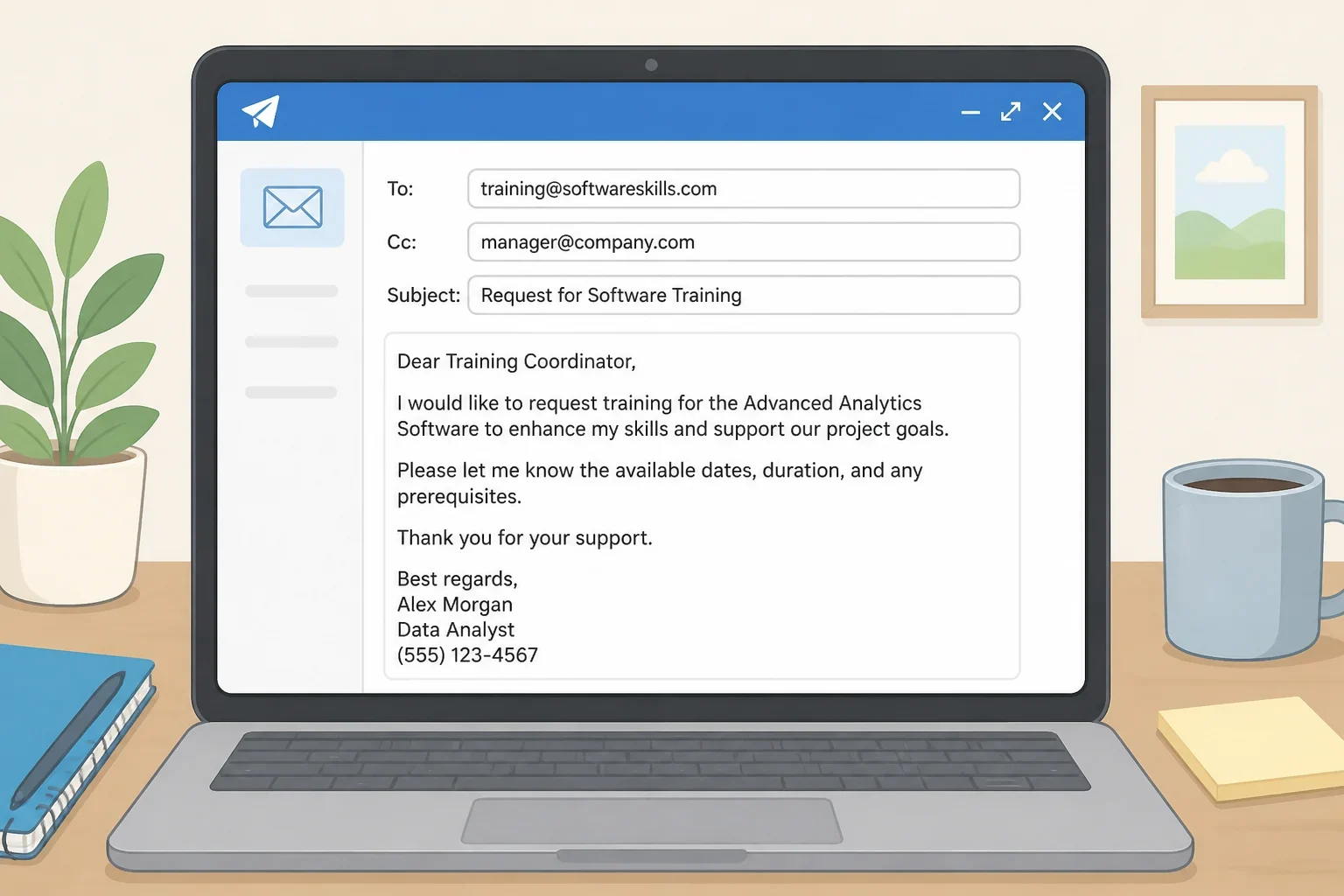
If a manager asks for the request in writing, or a cold email is the first point of contact, UGA's template structure offers a usable starting point, adapted here for a software-training request:
Subject: Request for software training support
Dear [Manager's Name],
I wanted to flag a training opportunity tied to [specific work task]. The report currently takes about [X hours] a month because [the manual process]. I found a course called [program name], offered by [provider], covering [key skills]. It runs [start date] to [end date], roughly [X hours] a week, and costs [$X]. [If there's a deadline to register, note it here.]
I'd like to test whether this reduces the time spent on [the task] and improves how consistent the report is. I'd plan to complete the coursework [during slower weeks / outside peak reporting periods] so it doesn't affect current deadlines, and I'm glad to share a quick write-up with the team once I'm finished.
I'd like to discuss whether there's a training budget or stipend that could cover this, and if budget is tight, I'm open to alternatives like partial reimbursement or a payment plan.
Thank you for considering it. Let me know a good time to talk it through.
Best, [Name]
If the full cost doesn't fit the budget, a few fallbacks are worth naming in either version: a payment plan that spreads the cost over several months (ASU Career Catalyst, last year); redirecting an unused team or travel budget line (UGA Terry College, last year); or a group rate if a colleague needs the same software skill (UGA Terry College, last year). Any of these can turn a flat no into a smaller, more affordable yes.
What to confirm after approval
A yes isn't the finish line. UGA recommends clarifying three things once a request is approved: whether the company pays upfront or reimburses after completion, whether there's a minimum grade or performance requirement attached, and whether there's an expectation to stay with the employer for some period after finishing (UGA Terry College, last year).
Revisit the workload plan from the original ask, too. Confirm whether coursework happens during work hours, outside them, or some mix, so coverage expectations match what was actually agreed to. Ask HR or a manager how the company typically documents that agreement, since the process varies by employer and isn't something a general guide can specify.
Before your next one-on-one
Confirm which funding route applies, a tuition policy, a stipend, or a manager-controlled budget, and who approves it. Attach the course name, provider, cost, dates, and the work problem it solves. Put the conversation on the calendar rather than waiting for a review cycle, and if the manager agrees, follow up in writing so the terms are easy to point back to later.
