

- How to Create a Portfolio for Non-Creative Jobs: A Template
- What a portfolio for non-creative jobs actually looks like
- How a portfolio case study differs from a resume bullet
- Non-creative job portfolio examples for HR, finance, administrative, and operations roles
- Building your first case study page
- Protecting confidential information and giving team credit
- Using your case study portfolio in job interviews
- Your next step
How to Create a Portfolio for Non-Creative Jobs: A Template
Almost nobody working in HR, finance, operations, or administration walks into an interview with a documented work sample, and that gap is exactly what makes one worth building, according to career-services blog TailorCV (TailorCV, last month). Learning how to create a portfolio for non-creative jobs starts with that absence: almost no competing candidate will have one, so a plain, honest case study is a rare thing for a hiring manager to see.
Resumes in these fields tend to blur together. Same titles, same responsibilities, same vocabulary, and a hiring manager reading twenty HR generalist resumes has very little to tell one candidate from another, according to TailorCV (TailorCV, last month). Analytics hiring runs into a related problem. A degree and a tool list can suggest someone is capable of the work, but they don't establish that the person has done it well, on a real problem, with a result someone actually used, according to the operations research professional society INFORMS (INFORMS, three months ago). A work portfolio for non-creative professionals addresses that gap without a website, design skills, or a dramatic project behind it. Two documented examples of real work, paid or otherwise, written clearly enough for a stranger to follow the reasoning, is the whole undertaking.
What a portfolio for non-creative jobs actually looks like

TailorCV recommends keeping the whole document to two short case studies, roughly two to four pages, with one case study per page or two (TailorCV, last month). Treat that as a practical starting format rather than an industry standard, though it lines up with how case studies are read in analytics hiring, where a strong example carries a decision from a vague business need to a documented, measured result (INFORMS, three months ago).
The document exists to show how you think, not how you design. Plain and readable is the actual goal (TailorCV, last month). A well-made PDF handles that job fine, and TailorCV notes it's frequently a better fit for non-technical roles than a website, since it's something you can attach to an email or hand across a table (TailorCV, last month).
How a portfolio case study differs from a resume bullet
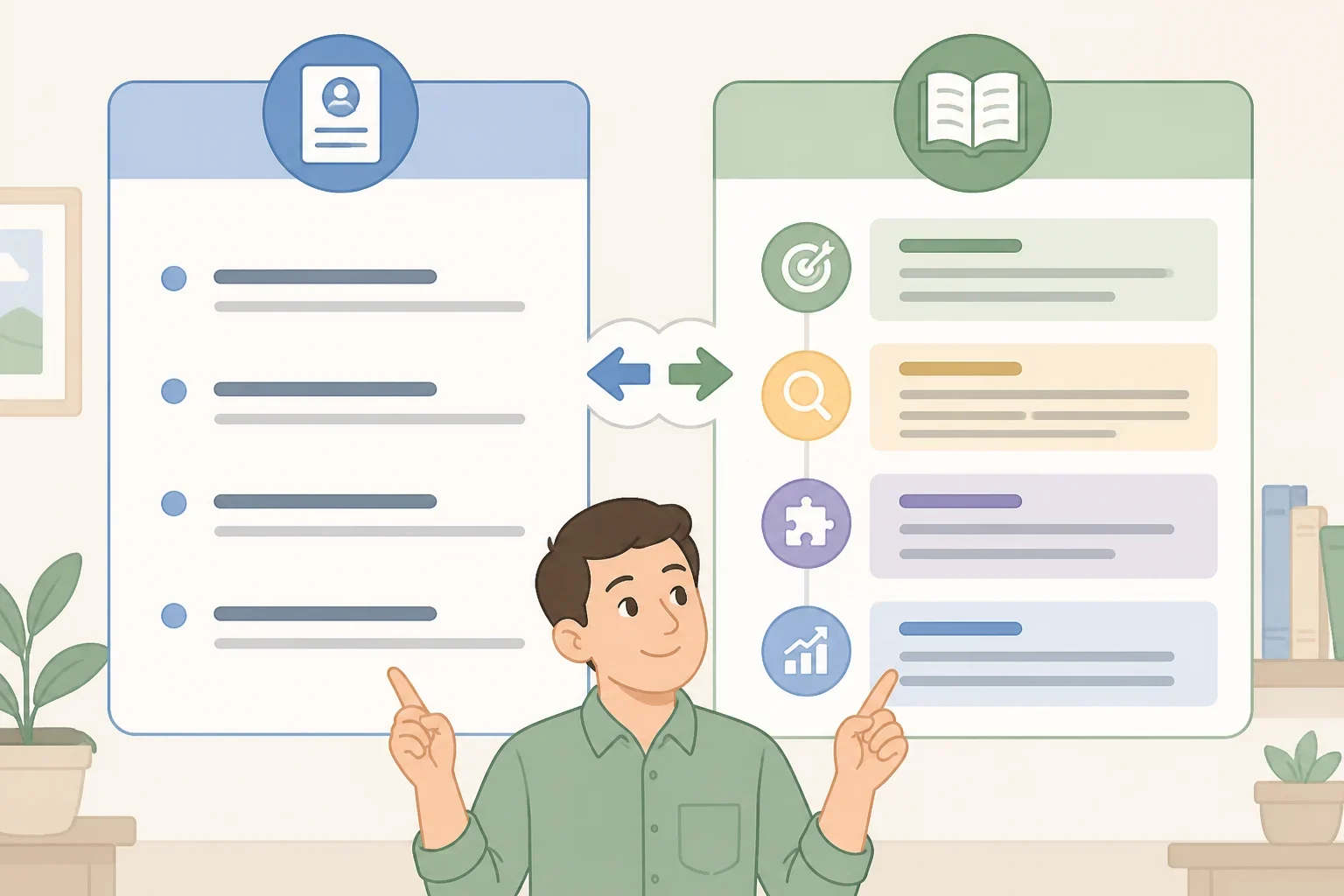
A resume line and a portfolio case study are doing different jobs, and mixing them up wastes both documents. A resume line exists to be specific, fact-based, and scannable in seconds: role, action taken, and a quantified result, according to Harvard's Mignone Center for Career Success guidance on resume language (Harvard FAS Mignone Center for Career Success, about 14 months ago). A case study is built to hold up under a follow-up question. It carries the context around the problem, the constraint you were working inside, the alternatives you weighed, the decision you made, how you implemented it, and what you measured afterward, plus one honest lesson.
That difference is also why the two documents belong at different points in a hiring process. The resume usually introduces your qualifications, while the portfolio adds depth once an employer has already engaged with your application, a distinction that holds in both non-technical hiring and analytics hiring (TailorCV, last month; INFORMS, three months ago). Expanding a resume bullet into six headings without adding the constraint, the alternatives considered, or the lesson learned just produces a longer resume. Those extra sections only earn their place if they show reasoning the resume line couldn't fit.
Non-creative job portfolio examples for HR, finance, administrative, and operations roles
The work worth documenting is usually smaller than people expect. TailorCV's guidance is direct here: the strongest examples are small process changes with clear before-and-after numbers, not large programs with big budgets (TailorCV, last month).
Picture what that looks like across a few roles. An HR coordinator might document redesigning a new-hire onboarding sequence to shorten how long it takes employees to finish paperwork and get system access. A finance analyst might write up standardizing a month-end close checklist or cutting down invoice exceptions. Someone in operations might document shortening a handoff between two departments or reducing a service backlog. A career portfolio for administrative roles could cover consolidating a scattered calendar-coordination process, speeding up records retrieval, or streamlining vendor onboarding paperwork. These are illustrative roles, not cases TailorCV or INFORMS specifically documented, but they follow the arc reviewers in analytics hiring look for: a real problem framed clearly, an approach chosen because it fit the constraints, and an honest, implemented outcome (INFORMS, three months ago).
Which of your two examples to lead with matters almost as much as writing them. Match the example to what the posting emphasizes: a finance role built around accuracy calls for the error-reduction story, an HR role built around employee experience calls for the onboarding story, and an operations role focused on throughput calls for the handoff or backlog story.
Illustrative example, not a reported case study
The figures below are invented for demonstration. Neither TailorCV nor INFORMS reported this specific case.
- Problem: New hires at a mid-size distribution company were taking about 12 days on average to finish onboarding paperwork and get system access, delaying their start on real work.
- Constraint: No budget for new software, and no room to add headcount to the onboarding function.
- Options considered: Outsourcing the paperwork to a temp agency, or building a custom intake tool. Both required money that wasn't there.
- Action taken: Consolidated five separate forms into a single intake packet and set up automated reminder emails using the HR system already in place.
- Outcome: Average onboarding time dropped to about 5 days over the following quarter, and new-hire survey scores on the onboarding experience improved.
- One honest lesson: Piloting the new packet in a single department first would have caught a few form questions before the company-wide rollout.
None of that requires design software or a dramatic turnaround. It requires a real problem and an honest account of what happened, laid out so someone unfamiliar with the work could follow it.
If two workplace examples aren't available yet, whether you're early in a career, a recent graduate, or changing fields, older roles, volunteer work, and personal projects demonstrate the same reasoning. A spreadsheet model built for a community organization can carry the same weight as a workplace project (TailorCV, last month). Go through your own history, including volunteer or academic work if needed, and hold each candidate example against the structure covered next: problem framed, options weighed, action taken, result measured.
Building your first case study page
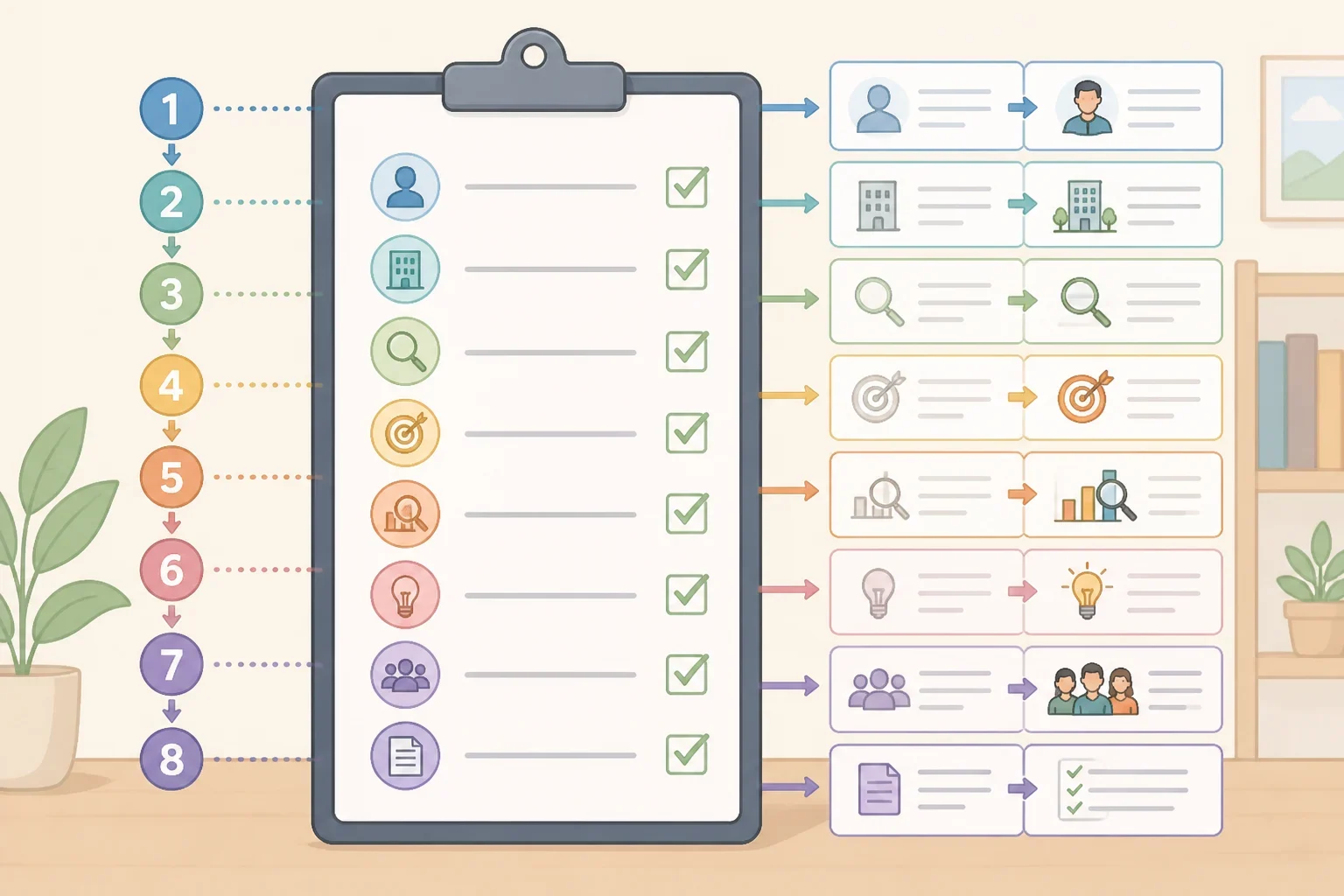
TailorCV's guidance for writing one of these follows a specific sequence: the problem, the constraint, what you considered, what you did, the numbers on both sides, and one honest thing you'd do differently (TailorCV, last month). Broken into a template, it looks like this:
- Problem (1 to 2 sentences): what wasn't working, and for whom.
- Constraint (1 sentence): the budget, headcount, timeline, or policy limit you were working within.
- Options considered (1 to 2 sentences): what else was on the table.
- Action taken (2 to 3 sentences): what you specifically did.
- Outcome (1 to 2 sentences): a before-and-after comparison.
- One honest lesson: what you'd do differently next time.
The lesson is an addition to TailorCV's five-part structure of problem, constraint, options, decision, and outcome, not a required sixth step, so include it when it adds something real.
A process improvement without a number attached is an assertion, not evidence. Outcomes should be stated in terms a stakeholder would actually recognize, a point both TailorCV and INFORMS make in their own hiring contexts (TailorCV, last month; INFORMS, three months ago). A stakeholder-recognized qualitative result, such as specific feedback from someone who used the process, can also serve as evidence when a clean number genuinely isn't available. Cycle-time changes, error-rate changes, and adoption or completion rates are other reasonable substitutes for forcing a number that isn't really there. That's editorial advice worth following, not a rule from either source, so treat it as a fallback rather than a formula.
Draft one full case study using this template. TailorCV notes that two of these can come together in about an afternoon, though the actual time depends on how much detail you're working from (TailorCV, last month).
Protecting confidential information and giving team credit
Confidentiality is a reason to generalize, not a reason to skip the exercise. Sensitive details can often be reworded rather than omitted: naming "a mid-size insurance company" instead of the employer, and using relative figures such as "reduced processing time 40%" instead of absolute volumes (TailorCV, last month). The structure of a problem is rarely confidential even when the underlying data is (TailorCV, last month). Treat that as a recommendation, not a guaranteed safe harbor, and use judgment case by case.
Some information should never appear no matter how generalized the rest of the write-up is, according to TailorCV (TailorCV, last month):
- Customer data of any kind.
- Internal financials.
- Personnel information.
- Anything covered by an NDA.
On team credit, state the team's overall goal in one sentence, then specify your individual role and the decisions you personally made, rather than describing a shared result as though you delivered it alone. That's a practical suggestion for staying accurate, not a documented industry norm.
Asking your employer directly beats assuming. TailorCV notes that sanitized write-ups are frequently permitted when an employee actually asks, and that asking is simply safer than guessing (TailorCV, last month). If anything about your employment agreement is unclear on what you can share, that's a question for your manager, an HR contact, or another qualified source, not something to resolve by assumption.
Using your case study portfolio in job interviews
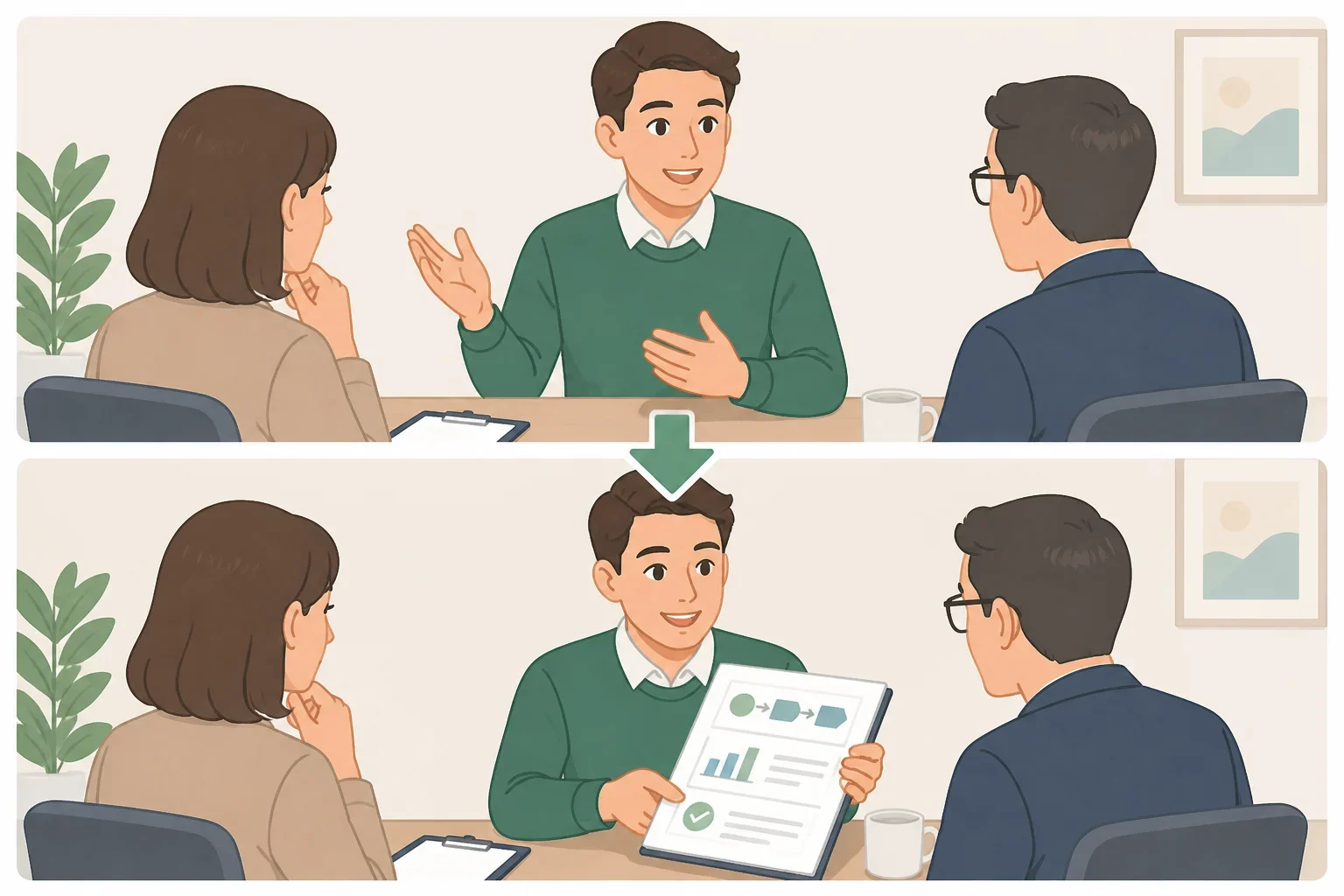
A portfolio is most useful in the room, at the moment someone asks a question like "tell me about a process you improved" and you can walk through a documented example instead of describing something from memory (TailorCV, last month).
In practice, that means answering the question first, with the problem and the action from your case study, then offering the page rather than leading with it. Something like: "I actually documented this one, if you'd like to see how it played out." A couple of other entry points are worth having ready. Mention the portfolio in a cover letter only when one is expected, or send it as a targeted follow-up after an interview touches on the relevant topic, such as "you asked about onboarding, so I've attached the write-up I mentioned" (TailorCV, last month).
On formatting, name the file clearly with your name attached, something like FirstName_LastName_Case_Studies.pdf, and print one copy if you're interviewing in person (TailorCV, last month). Skip attaching it to every application by default; an unsolicited attachment adds friction rather than helping (TailorCV, last month). The one exception is a posting that explicitly asks for work samples, in which case follow that instruction.
Before your next interview, prepare one spoken sentence that introduces your case study naturally, and settle in advance which of your two examples fits the role best, using the tailoring approach described above.
Your next step
Pick one project this week and draft the page using the template above. Check with your employer on anything that needs to be generalized before you'd actually use it, mark any sentence that needs a stakeholder's blessing, and decide which of your two case studies fits the roles currently on your list.
Keep working on the resume alongside it. A strong one won't get you hired by itself, but it remains an important factor in obtaining an interview where the portfolio can do its work, and Harvard's career-services guidance recommends keeping it tailored to the role, easy to scan, and fact-based or quantified wherever possible (Harvard FAS Mignone Center for Career Success, about 14 months ago).
