
- South Korea semiconductor boom jobs and labor share: evidence
- What Korea’s semiconductor boom shows
- What Korean technology studies show about jobs
- AI and manufacturing jobs in South Korea are changing unevenly
- Why the worker experience may differ by employer
- What Korean manufacturing labor share means for job seekers
- How to evaluate a Korean semiconductor job
- What to verify before drawing a conclusion
South Korea semiconductor boom jobs and labor share: evidence
A strong export cycle can make an industry look like an obvious career bet. It cannot, by itself, tell a job seeker whether a role is permanent, whether training is available, or whether wages are rising with productivity. That is the central question behind South Korea’s semiconductor boom, jobs, and labor share.
The available research connects Korea’s economic rebound to semiconductor exports, but it does not establish whether chip-sector growth is producing proportional job gains, more secure employment, or a larger share of value for workers. The evidence is useful for people considering roles at chipmakers, equipment companies, materials suppliers, and subcontractors, but it leaves important semiconductor-specific questions unanswered.
What Korea’s semiconductor boom shows

Korea’s recovery has been closely tied to exports. The OECD reported two years ago that growth had strengthened largely with the fortunes of semiconductor exports, with GDP growth projected at 2.6% in 2024 and 2.2% in 2025 (OECD). Employment remained high and unemployment low, but private consumption was weak, partly because of high interest rates and weak real-wage growth (OECD).
Those figures describe the national economy, not a semiconductor hiring plan. The same OECD analysis attributed growth broadly to rising employment and heavy investment in capital and education (OECD). That combination can support chip production, but it does not show how many jobs were created at Korean chipmakers, how many were added by suppliers, or what proportion were permanent.
The global market provided a powerful backdrop. Two years ago, the Semiconductor Industry Association reported that the World Semiconductor Trade Statistics projected worldwide sales of $611 billion in 2024, a 16% increase from the previous year (Semiconductor Industry Association). That projection describes global sales, not Korean employment or wages. It is useful for understanding the scale of the industry cycle, not for predicting what an applicant should expect from a particular Korean employer.
The distinction matters. The OECD and firm-level studies reviewed here do not report employment, wages, and contract types separately for Korean chipmakers. That is a narrower and more defensible conclusion than claiming that no published research contains such information. For job seekers, the practical result is clear: national growth figures cannot substitute for employer-level questions.
What Korean technology studies show about jobs
The broader Korean labor market offers clues about how technology investment can affect work. A study published last year in Telecommunications Policy found that, at the firm level, doubling IT investment per worker was associated with a reduction of more than 60 workers in total workforce size (Telecommunications Policy). The study examined associations across firms. It did not prove that a particular investment caused layoffs at a particular company, and it did not isolate semiconductor employers.
The same research found a positive association between IT investment, total salary bills, and average wages per capita, while the overall labor share of value added appeared to decline (Telecommunications Policy). Those findings can coexist. A company may pay higher average wages to a smaller or differently composed workforce while directing a larger portion of the value created by production toward capital.
That is why wage growth and labor share should not be treated as interchangeable. A higher average wage can improve an employee’s earnings, but it does not necessarily mean workers are receiving a larger portion of the firm’s value added. Applicants comparing offers should look at pay, contract status, overtime expectations, and advancement separately rather than assuming one measure answers all four questions.
The OECD’s analysis, published last year, adds another distinction. Between 2018 and 2023, a 10-percentile-point increase in exposure to traditional AI appeared to be associated with 5.7% lower growth in full-time, permanent employment, particularly in manufacturing (OECD). The same analysis found no statistically significant relationship between generative-AI exposure and permanent-employment growth (OECD).
That is not a forecast of mass job loss in Korean manufacturing. Full-time, permanent employment grew 2.4% during the period, while total employment, including non-standard work, grew 5.8% (OECD). The results point instead to different outcomes depending on the technology measured and the type of employment counted.
For someone applying to an engineering, maintenance, production, or quality role, the useful question is not simply whether the employer uses AI. Ask what the technology has changed on the team, whether headcount is expected to grow, and how temporary workers can qualify for permanent positions. A job description may remain unchanged while daily tasks, performance measures, and required skills shift underneath it.
AI and manufacturing jobs in South Korea are changing unevenly

Survey evidence points more strongly to task redesign than wholesale elimination. Among Korean firms that had adopted AI, 56.5% reported that it replaced specific tasks within existing jobs, while 35.1% said AI was used for entirely new tasks (OECD). Among firms reporting task changes, only 8.4% reported full automation of all tasks in a job (OECD).
The denominator matters. The 8.4% figure applies to firms that reported task changes, not every Korean firm and not every AI adopter. At the department or team level, 95.5% of Korean firms reported no workforce changes following AI adoption (OECD). Another survey measure found 71% of Korean firms reported that AI substituted approximately 10% of an employee’s tasks, while 17.2% reported that AI had not replaced any tasks (OECD). The available research does not establish that the 71% figure refers only to AI-adopting firms, so it should not be presented as a typical semiconductor workplace.
The pattern is still relevant to manufacturing applicants. A role may survive while inspection, scheduling, documentation, forecasting, or troubleshooting becomes more technology-intensive. The OECD found that 32.2% of surveyed firms said AI increased the kinds of skills required for current tasks, and 38.3% said it increased the level of skills required (OECD).
That gives applicants a concrete preparation list. Technical literacy, data interpretation, process documentation, and the ability to work alongside automated systems may matter even when an employer does not advertise an AI-focused role. Candidates should ask which systems the team uses, what training is provided, and how performance is assessed after implementation.
Why the worker experience may differ by employer
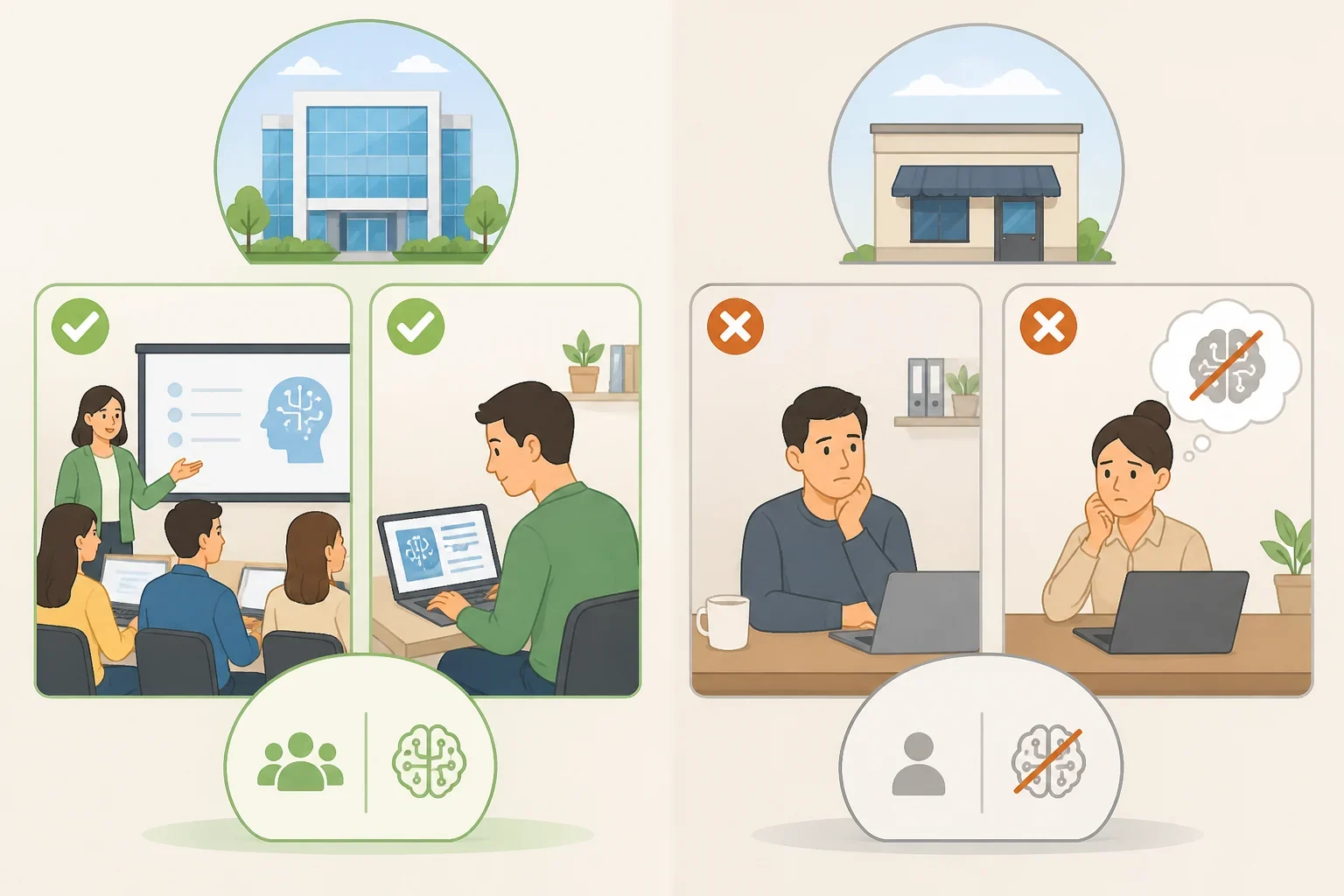
Training is not evenly available. The OECD reported last year that adult-learning participation in Korea was 13%, compared with an OECD average of 40% (OECD). That gap may make retraining harder at the population level, but it does not show that every worker lacks access to useful education.
Employer support is also uneven. Only 42% of firms that had adopted AI reported providing AI-related training, and the share was higher among large firms than small ones (OECD). This supports comparing large and small employers. It does not prove that semiconductor suppliers are less prepared or that every large company offers better career development.
The questions to ask are specific:
- Does training happen during paid working hours?
- Is it required, optional, or available only after a worker changes teams?
- Does it lead to a recognized credential or simply internal instruction?
- Who pays for external courses and examination fees?
- Can a worker use the training to qualify for a higher-level role?
Supplier size may also affect the day-to-day experience, but it should be investigated rather than assumed. The OECD reported last year that 37% of Korean SMEs had experienced a worker shortage during the previous two years, and 27% of SMEs reporting shortages said generative AI helped compensate for them (OECD). Separately, 24% reported a lack of skills and experience among staff, with 47% of those firms saying generative AI helped address that challenge (OECD).
For a worker, a shortage can mean opportunity, heavier workloads, or both. Ask whether the employer is using technology to expand production, cover vacancies, or reduce dependence on labor. Those are different business decisions, and they can produce very different job experiences.
Korea’s talent pipeline faces longer-term pressure as well. The OECD reported two years ago that Korea’s fertility rate had fallen to the lowest in the world and that the population was projected to halve over the next six decades (OECD). Last year, the OECD also reported that Korean AI specialists had emigrated to the United States and high-income European countries for better pay and working conditions, while visa hurdles constrained high-skill immigration (OECD).
These pressures may increase the value of technical skills, but they do not guarantee higher pay or secure employment for every applicant. Compensation still depends on the employer, role, experience, and contract.
What Korean manufacturing labor share means for job seekers
The labor-share evidence does not point in one direction. The IT-investment study found a decline in labor share alongside higher average wages, and an Asian Development Bank analysis found that adopting robots and AI reduced labor’s income share at Korean firms (Telecommunications Policy; ADB).
The ADB finding has an important limit. The immediate increase in temporary, rather than permanent, employment was associated with firms adopting both robots and AI. It should not be generalized to every form of automation or every manufacturing employer (ADB).
A separate study of externally audited Korean firms reached a different conclusion about the aggregate corporate labor share. Published last year in the Korean Economic Review, it found that labor share had risen since the 2000s across sectors, driven primarily by within-firm changes. Large firms contributed significantly because wages grew faster than value added (Korean Economic Review).
These studies use different samples, measures, and periods. The disagreement is not a reason to ignore labor share. It is a reason to avoid turning a national trend into a promise about one job. A strong offer should be evaluated through the actual wage, contract term, training pathway, workload, and promotion criteria.
How to evaluate a Korean semiconductor job

Before accepting a role, compare the employer’s answers in four areas.
Contract and headcount. Confirm whether the position is permanent or fixed-term, how long the contract lasts, and whether workers in similar roles have been converted to permanent positions. Because the ADB study distinguishes permanent workers from temporary workers and links joint robot-and-AI adoption to an immediate increase in temporary employment, ask whether new technology is changing the staffing model at the specific site (ADB).
Training and credentials. Ask what technical training is included, whether it takes place during paid hours, and whether the company pays for outside courses. The 42% figure is a national comparison point among AI-adopting firms, not a standard every chip employer must meet (OECD).
Task changes. Ask what automation has already changed on the team. Request examples involving inspection, maintenance, production scheduling, documentation, or quality control. The OECD evidence suggests task substitution is more common than complete job automation, but the national survey cannot predict the experience of one factory or supplier (OECD).
Employer tier and working conditions. Compare a major chipmaker with an equipment or materials company and a smaller subcontractor. Ask about staffing levels, overtime, shift patterns, training access, and who supervises the work. The research supports investigating firm-size differences, not assuming that one tier always offers better stability.
What to verify before drawing a conclusion
The evidence reviewed here points more toward changing tasks, uneven training, and possible pressure on permanent-job growth than toward mass displacement. It also shows why semiconductor boom and wage growth in Korea cannot be assessed through GDP or export figures alone.
For a specific career decision, check Statistics Korea’s KOSIS and Ministry of Employment and Labor releases using the semiconductor manufacturing classification. Compare employment by permanent and temporary status, wages over a matched period, vacancies, and changes in headcount. Then ask the employer the same questions directly.
Official data plus specific employer answers is more useful than assuming that a rising semiconductor export cycle automatically produces secure, well-paid work.
