

Building a Work Accomplishment Log for Performance Review
In a two-part case study published last year, Harvard Business School examined how Progress Software moved away from a purely annual review cycle. HBS Professor Katherine Coffman's research describes a pattern in which many managers spend that single yearly meeting tallying what already happened while skipping any conversation about what advancement would actually require (HBS Working Knowledge). That pattern matters for anyone heading into review season hoping to make a case for a raise or promotion: if a manager won't raise the advancement question, the employee needs something concrete to bring instead.
A work accomplishment log for performance review season is one way to bring it. Harvard Business Review has separately reported that a strong self-assessment shapes how a manager frames the formal evaluation, with effects that can reach merit increases and bonus decisions (HBR). What follows separates what the Progress Software research actually found from a distinct, practical suggestion for building that kind of log, since the case study itself describes one company's internal overhaul, not a personal tracking system.
What the case study found
Coffman's research centers on why annual reviews tend to fall short. "When a review is something that only happens once a year, it can feel very consequential and anxiety-inducing, but if it's happening on a more regular basis, it makes the stakes for any one of these conversations feel a bit lower," she told HBS Working Knowledge.
That dynamic helps explain the pattern Coffman's research describes: many managers default to backward-looking assessments and stop there, instead of using the same meeting to map out what a promotion would actually take (HBS Working Knowledge). Her advice to employers is to clearly outline promotion paths and the steps to reach them, partly because doing so can keep ambitious employees from leaving for a title elsewhere (HBS Working Knowledge).
The research ties this to a broader turnover trend: unclear advancement paths can push employees to look outside the company for opportunities rather than wait for one to open internally. The annual quit rate climbed over the past decade, peaked during the 2021-2022 Great Resignation, and has since moderated, though it remains above pre-pandemic levels, according to Bureau of Labor Statistics data cited in the research (HBS Working Knowledge). The tech sector illustrates the pattern: sector-wide turnover ran about 13 percent in 2017, a historical estimate rather than a current figure, and average tenure at the ten largest tech companies stayed under two years as rivals recruited workers away with better titles and pay (HBS Working Knowledge).
What Progress Software changed, and what the results show
As part of its alternative to the annual process, Progress introduced quarterly check-ins. Because the check-ins were optional, participation varied widely across the company, and more than half of the "quick" progress snapshots it offered were abandoned before completion (HBS Working Knowledge).
The company also built a technical promotion track for employees with no interest in becoming managers, giving them a path to advance without funneling everyone through the same leadership pipeline (HBS Working Knowledge). Among employees who participated in the reworked program, the researchers found improved retention and job satisfaction (HBS Working Knowledge), though that result describes participants in one company's program rather than a general rule about any single review practice.
The case also surfaced gaps the new system didn't close. Progress continued to struggle with gender representation, which Coffman attributes partly to men having stronger access to informal networks that pass along useful information (HBS Working Knowledge). Employees in offices farther from the company's core U.S. headquarters also had a harder time advancing (HBS Working Knowledge). Coffman notes that "we all are prone to in-group bias, drawn to individuals who remind us of ourselves," and without diverse decision-makers, that bias can perpetuate under-representation; she points to diversifying review panels and setting objective criteria as a partial remedy (HBS Working Knowledge).
All of this describes what one employer changed and what its own research found. It doesn't tell an individual employee, working inside whatever review system their company already runs, what to do if that same clarity hasn't arrived yet. The research doesn't prescribe a personal tracker for that situation. For employees who want to apply its lesson anyway, one practical option follows, built as a suggested framework rather than a research finding.
How to track accomplishments for a performance review
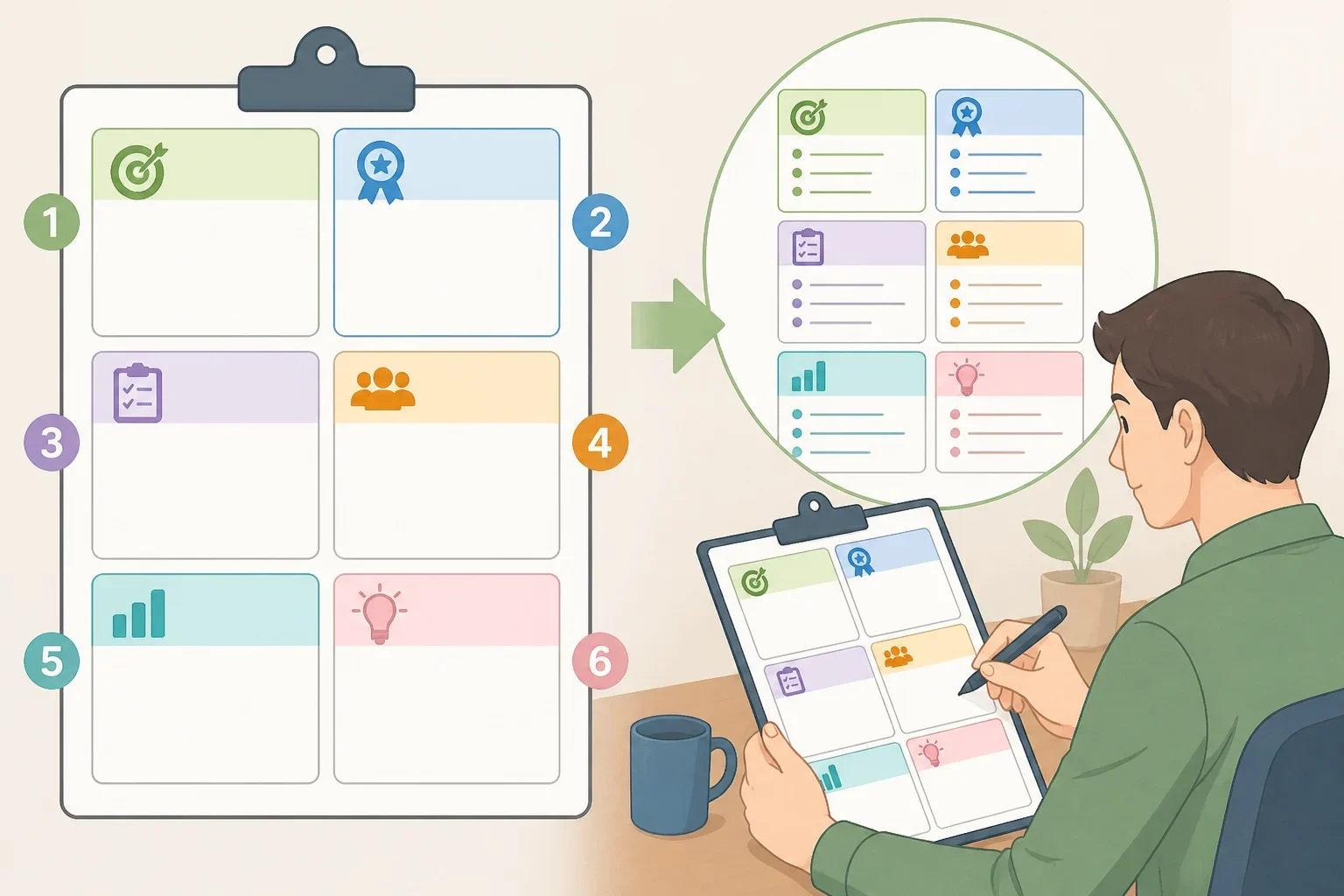
One workable approach is a log with six fields: context (what problem or request prompted the work), action (what the employee specifically did), result or scope (what changed or what responsibility expanded), collaborators (who else was involved), feedback (what a manager, peer, or client said), and growth relevance (which competency or future role the entry supports).
Field What it captures Context What problem, gap, or request prompted the work Action What the employee specifically did Result or scope What changed, or what responsibility expanded Collaborators Who else was involved or affected Feedback What a manager, peer, or client said about it Growth relevance Which competency or future role this supports
A hypothetical entry built on that structure might look like this: a team kept asking the same setup questions during onboarding, so an employee interviewed a few recent hires and rewrote the onboarding guide. Repeat questions dropped afterward, and a manager asked to reuse the format in another department. In this invented example, that manager called the effort "exactly the kind of initiative we want to see more of." The point of logging a detail like that is the combination it preserves: a specific problem, a documented fix, and a named reaction, which a plain list of completed tasks tends to lose.
Work that's collaborative or hard to quantify still belongs in the log. Reduced rework, faster handoffs, cleaner documentation, direct stakeholder feedback, or handling more complexity than before can all count as evidence, even without a revenue or cost figure attached.
Cadence matters more than format here. A short monthly entry, or one added right after a project wraps, tends to hold up better over a year than an elaborate tracker built once and then abandoned.
Turning entries into a self-assessment

By the time a review cycle arrives, the log should hold more material than any self-assessment needs. HBR frames the self-assessment as something meant to actively shape a manager's evaluation rather than restate a year of activity (HBR), so the next step, as a practical suggestion rather than a research-backed formula, is narrowing to the three to five entries that line up most directly with the employer's stated criteria and setting the rest aside.
For each entry that makes the cut, the context, action, and result fields translate fairly directly into examples for a performance-review self-evaluation: a few sentences on what the situation was, what the employee did, and what changed because of it. The growth relevance field does something different. It becomes the basis for a forward-looking question to raise directly, something closer to asking what scope or outcomes would need to be true before the next title becomes realistic.
Coffman's research backs up why that question is worth asking out loud rather than guessing at. She warns that when information about advancement is hard to access or unclear, employees can end up "confused, frustrated, or de-motivated," a risk that can cost an employer the talent it wanted to keep (HBS Working Knowledge). As she puts it, "ambiguity can be our enemy" (HBS Working Knowledge). A log doesn't close the structural gaps the research identified around informal networks or office location, but it gives an employee a documented, specific basis for the conversation instead of relying on being noticed informally.
What to verify before the next review

Review criteria, competency frameworks, and promotion expectations differ by employer, role level, and industry, so confirm the specifics with a manager, HR, or the employer's own review documentation before building log categories around assumptions. A log designed around the wrong framework won't translate cleanly into a self-assessment later.
Start now, regardless of when the next formal review lands. Locate the employer's actual review rubric or competency list first, then pick one project from the past month or so and record its context, action, result, feedback received, and relevance to the next role using the fields above. Add another entry a month from now, and the log will hold a year's worth of material long before the next review conversation starts.
