
Is Job Corps coming back: What DOL’s 2025 report shows
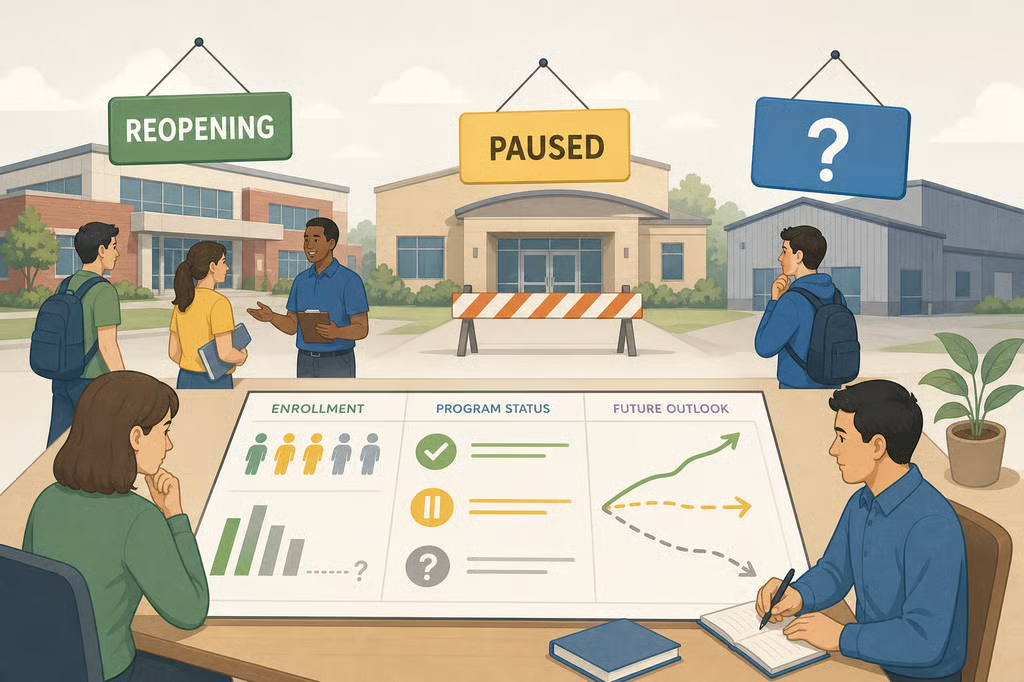
Is Job Corps coming back after two temporary center pauses, contract pressure, and questions about performance? The evidence reviewed here does not confirm a broad turnaround. The program remains active, but the available sources do not establish the current 2026 center count or show that enrollment, completion, placement, and funding have all improved.
For students, families, and career advisers, that distinction matters. A continuing program is not necessarily a recovering one. In this article, a comeback means more than continued operation: it would include reopened centers, stable or rising enrollment, stronger completion and post-program results, and funding that keeps pace with operating costs. That is a practical benchmark for evaluating the program, not a standard published by the Department of Labor.
What the Job Corps center closures and reopening record shows
The clearest disruption involved two specific centers. In December 2024, the Department of Labor temporarily paused operations at the Woodstock Job Corps Center in Woodstock, Maryland, and the Whitney M. Young Jr. Job Corps Center in Simpsonville, Kentucky. Students at those locations were to be transferred to nearby centers so they could complete their training, according to DOL.
The department also began negotiations with contractors operating non-federal Job Corps centers nationwide. The stated aim was to reduce costs while limiting the effect on student services. DOL said it would provide assistance to potentially affected staff, but the announcement did not establish what happened to those workers afterward, the agency said nearly two years ago.
The financial pressure was broader than the two pauses. DOL said the Job Corps budget had remained largely flat for several years while program costs increased, and Job Corps Administrator John E. Hall said earlier cost-cutting strategies would not be enough for the coming year, according to the department.
The same announcement described a “Job Corps 2.0” vision focused on job training, job placement, and the student experience. That language describes an intended direction, not a measured recovery. The sources reviewed do not confirm reopening dates for either paused center, new contract terms, higher enrollment, or improved placement outcomes.
That leaves a practical question for anyone considering a specific location: Is the center operating and accepting students now? Applicants should verify the answer with the center or the national Job Corps office rather than assume that conditions at one location represent the entire program. The lack of a later reopening notice in the sources reviewed is not proof that either center remains paused, but it is also not evidence that either one has reopened.
What the Job Corps Transparency Report 2025 shows
The Job Corps Transparency Report released in April 2025 examines the most recently available figures in the research reviewed here, covering program year 2023, according to the report. Its findings are useful, but they need to be read carefully because the report uses two different definitions of a graduate.
The traditional measure is narrower than the Workforce Innovation and Opportunity Act, or WIOA, measure. Under the WIOA definition, a graduate is an enrollee who receives a high school diploma or equivalency and/or completes the requirements of a career technical training program, the report explains.
That difference changes the headline results. The traditional graduation rate was 32%, compared with 38% under the WIOA definition, the report shows. The six-percentage-point gap does not mean that one number is correct and the other is misleading. It means readers are looking at different completion measures. Neither figure predicts the result for an individual center or student.
The report lists an average cost per enrollee of $49,769.53 and an average cost per student per year of $80,284.65, according to DOL. These are program operating costs, not charges billed to students. Job Corps services are provided free to students, but free access does not mean the training has no cost to the organization running it.
Average cost per graduate was $187,653 under the traditional measure and $155,600 under the WIOA definition, the report shows. The differences grew among the least-efficient programs. The 10 least-efficient programs averaged $512,800 per graduate under the traditional measure and $385,370 under the WIOA measure. Across the 50 least-efficient programs, the averages were $319,085 and $252,285, respectively, according to the report.
Those figures support a limited conclusion. High costs were visible across both a smaller group of 10 programs and a broader group of 50, rather than appearing only in one isolated example. They do not prove that every center is inefficient, nor do they reveal how a particular center compares without center-level data.
Participants earned an average of $16,695 annually after separation, the report says. That figure should not be treated as a guaranteed wage, a starting salary, or the expected result for a specific career track. The released summary does not provide a clear follow-up period, employment rate, or comparison group, which limits what applicants can infer from it.
When comparing Job Corps costs or outcomes, readers should first ask which graduate definition is being used. A single percentage or cost figure can give a substantially different impression of the program depending on that choice.
A documented partnership, not proof of a national recovery
The center pauses show operational and financial pressure. A New York City partnership illustrates a different part of the Job Corps model, but it does not establish that conditions improved nationwide.
Job Corps serves eligible students ages 16 to 24 through academic experiences and vocational training intended to support employment and career pathways, DOL described the program more than three years ago. It is mostly residential, with dormitories and a campus environment, and its programs and services are provided free to students, the department reported.
In 2023, DOL described a network of more than 120 centers across all 50 states, the District of Columbia, and Puerto Rico, according to the agency. That description is more than three years old, so it should not be used as the current 2026 center count without newer verification.
New York City became the first major city to sign a five-year partnership with Job Corps. The agreement coordinated recruitment through city agencies and more than 1,800 public schools, while connecting students and graduates with city employment information, college enrollment assistance, and support services, DOL reported more than three years ago.
The partnership also highlighted training in advanced manufacturing, information technology, clean energy, and construction, the department reported. It shows how local government, schools, and workforce partners can support recruitment and career pathways. It does not show that similar arrangements operate in every region or that Job Corps has recovered from the financial pressures announced in December 2024.
Students in other locations should ask whether their center has active employer, school, or workforce-agency partnerships, what those partners provide, and whether the center can share recent outcomes.
What to verify before applying
National figures should come after basic questions about the specific location. Before applying or recommending Job Corps, verify:
- whether the center is currently operating and accepting students;
- which career tracks are available now;
- whether residential placement is available and what arrangements apply;
- how long the selected program usually takes;
- which diplomas, equivalencies, or career credentials students may earn;
- what academic, career, transportation, health, or other support services are included;
- how the center defines completion and placement;
- which period its completion, employment, and earnings figures cover.
Compare Job Corps with nearby commuting programs, community colleges, apprenticeships, or other training providers using the same questions. Look at credential type, hands-on training, entry requirements, program length, living arrangements, and documented employer connections. A residential program may solve a different problem from a local option, so the better choice depends on the student’s circumstances and goals.
The sources reviewed here do not provide a current 2026 performance series. That is a limitation of the available research, not proof that conditions have improved or worsened. Ask the center for its newest figures, including whether the data covers all enrollees or only graduates and whether “placement” means employment, continued education, or another outcome.
So, is Job Corps coming back?
No confirmed comeback appears in the evidence reviewed. The sources document two temporary pauses, contract renegotiations, and a plan for long-term stability. They do not confirm that the paused centers reopened, enrollment increased, funding stabilized, or placement outcomes improved.
For a student or family making a decision now, the useful test is specific rather than national. Verify the center’s current status, available training tracks, residential arrangements, credentials, and most recent completion and placement figures. Then compare those details with other programs serving the same career goal before applying or enrolling.
