
ACT retake score improvement: 2025 data on testing again
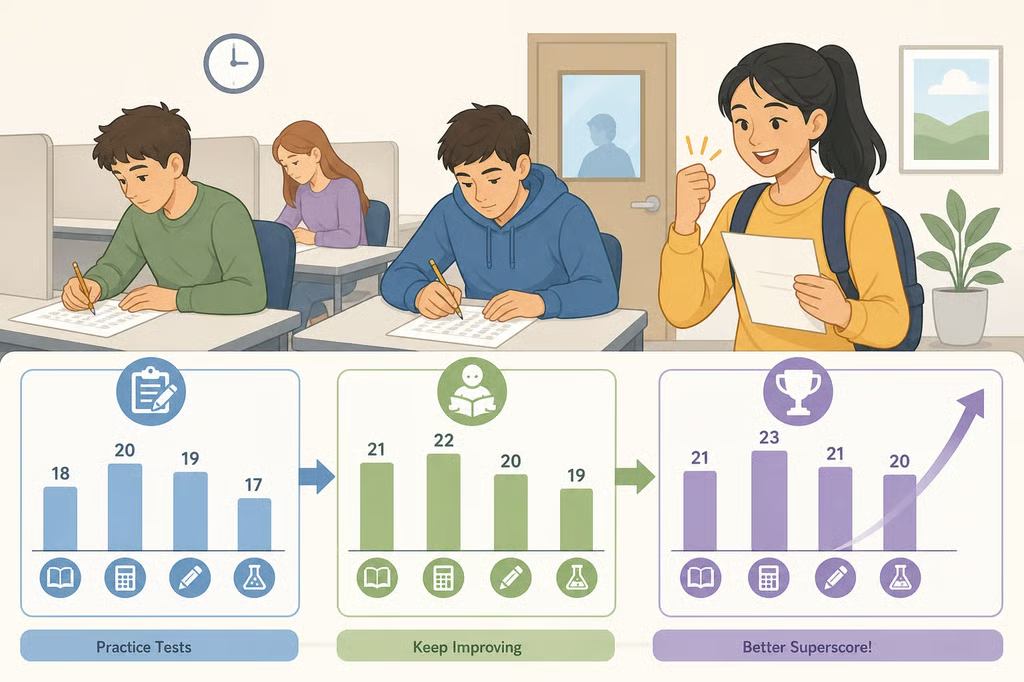
Does retaking the ACT improve your score? ACT’s data on the 2025 graduating class show that 76% of ACT-tested graduates took the exam more than once, and students who retested increased their ACT Superscore by an average of 2.4 points nationally, according to ACT.
That finding describes an average among students who took the ACT more than once. It does not guarantee that every student will gain 2.4 points, and it does not establish that retesting alone caused the increase. For students and families deciding whether another test date makes sense, the more useful questions are what the ACT data measure, how the benchmark comparisons were calculated, and whether a target college considers superscores.
What the ACT retake data actually show

In the group of 2025 graduates reported by ACT, 76% took the exam more than once, according to ACT’s newsroom report. That means retesting was more common than testing only once within this ACT-reported population. It does not mean that 76% of all U.S. high school graduates retook the exam.
The same report found that students who took the ACT more than once increased their ACT Superscore by an average of 2.4 points nationally, according to ACT. The wording matters. The reported result concerns an average superscore increase among repeat testers, not a standard improvement that every student should expect.
A student’s result can also differ from that average because the data describe a broad group rather than an individual testing plan. A student may improve substantially in one section, see little change in another, or receive a superscore that reflects stronger section results across test dates. The 2.4-point figure should therefore be used as a description of the reported group, not as a prediction for a particular student.
ACT Industry Insights offered one explanation for why later testing may produce a different result. Retesting later in high school gives students an opportunity to demonstrate mastery of more postsecondary skills, according to ACT Industry Insights. That is ACT’s interpretation of the role of later testing, not proof that the test date itself produces improvement.
Preparation, additional coursework, familiarity with the exam, and changes in a student’s testing circumstances could all be relevant to an individual result. The supplied ACT figures do not separate those factors or show that retesting, by itself, caused the average increase.
How repeat attempts relate to ACT College Readiness Benchmarks

The benchmark figures involve two different populations, and combining them too casually can create a misleading comparison.
Across the full 2025 ACT-tested graduating class, 30% met at least three ACT College Readiness Benchmarks, according to ACT Industry Insights. That figure describes the entire ACT-tested graduating class in the report.
A separate comparison focused only on students who took the ACT more than once. Among those repeat testers, 30% met at least three benchmarks on their first test attempt, compared with 53% on repeat attempts, according to ACT Industry Insights. The difference is 23 percentage points.
The 30% figures are therefore not necessarily identical groups. One refers to the full ACT-tested graduating class, while the other refers to repeat testers at two points in their testing history. A careful reading does not say that the entire graduating class moved from 30% to 53% after retaking the exam.
ACT Industry Insights also reported that students who meet the benchmarks are twice as likely to enter college directly after high school and earn an undergraduate degree in a timely manner compared with students who meet none of the benchmarks, according to the analysis. That is an association between benchmark attainment and later outcomes. It is not evidence that taking the ACT again causes college enrollment or degree completion.
For a student, the practical value of the benchmark comparison is diagnostic. A first score report can show whether a student is near a benchmark in one or more sections. That information may help guide study time, a conversation with a school counselor, or a decision about whether another test date fits the student’s academic schedule. It should not be treated as a promise that a retake will produce the same benchmark movement reported for the group.
The same ACT Industry Insights analysis predicted that 61% of 2025 ACT-tested graduates would earn at least a Silver-level ACT WorkKeys National Career Readiness Certificate, according to ACT Industry Insights. This is a separate career-readiness measure, not evidence that retaking the ACT improves an ACT Superscore or WorkKeys result. It provides broader context about the ACT reporting framework but does not answer the retake question.
Why a higher superscore may not have the same value everywhere

A stronger ACT Superscore matters only if a student’s target colleges consider that type of score in the way the student expects. Johns Hopkins, for example, states that its ACT evaluation includes the Math, Reading, and English sections, according to Johns Hopkins Admissions. That is one institution’s documented policy, not a universal admissions rule.
Students should check each college’s current testing and score-reporting information rather than relying on a general assumption about superscoring. The relevant details may include whether the college considers section results from multiple test dates, which sections it reviews, and whether submitting scores is recommended under its current policy.
The potential importance of submitting a score also varies by applicant group and institution. A National Bureau of Economic Research working paper found that, under test-score-optional policies, high-achieving applicants from disadvantaged backgrounds increased their admission probability from 2.9% to 10.2% when they reported scores, a 3.6-fold difference, according to NBER. The study concerns a defined group of high-achieving applicants and elite-college admissions. It should not be generalized to every applicant or every college.
The same NBER paper found that high-achieving first-generation applicants increased their admission chances by a factor of 2.4 when they reported scores. Again, that finding concerns score reporting under test-optional policies, not retaking the ACT specifically.
A possible implication is that a student who retests and earns a stronger superscore may have another score-reporting option when applying to a college where scores can add useful information to the application. That remains an application decision, not a guaranteed admissions strategy. A score increase does not replace the need to review the college’s current policy or consider how the score fits with the rest of the application.
What students should check before registering again

The 2025 ACT data provide evidence of widespread retesting and an average 2.4-point ACT Superscore increase among repeat testers, but they do not establish a guaranteed average ACT score increase after retaking. Before registering, students can work through three specific checks:
- Review the first score report. Identify which sections are closest to a desired benchmark or admissions target. A retake plan is more useful when it focuses on a clear section-level need rather than treating the composite as the only goal.
- Check each target college’s current policy. Confirm whether the college considers ACT superscores, which sections it reviews, and whether submitting scores fits its current test-optional approach. Johns Hopkins’ treatment of Math, Reading, and English shows why institution-specific details matter, according to Johns Hopkins Admissions.
- Discuss timing with a counselor. Compare another test date with coursework, application deadlines, preparation time, and the student’s available testing budget. The ACT data describe what happened across a large group, not what is most efficient for every student.
The clearest conclusion from the reporting is limited but useful: in ACT’s 2025-tested population, retesting was common, and repeat testers recorded an average ACT Superscore increase. Students should treat that result as evidence to evaluate, not as a promise. Their next step is to compare the score policies of the colleges they may apply to and decide whether another test attempt has a specific purpose.
