

- 5 time management techniques for professionals: What the research supports
- 1. Set outcome-based goals before opening your calendar
- 2. Prioritize with a repeatable rule
- 3. Turn priorities into protected calendar time
- 4. Organize tasks in a system that makes starting easier
- 5. Review the gap between the plan and the work
- A two-week implementation plan
5 time management techniques for professionals: What the research supports
Professionals looking for time management techniques for professionals usually face a practical problem: important work competes with meetings, email, urgent requests, and projects that keep changing. By the end of this guide, you will have a five-part system for deciding what matters, protecting time for it, organizing the work, and adjusting when the plan meets reality.
A systematic review published last year analyzed 107 studies across higher education and workforce settings. Goal-setting, prioritization, planning, and task organization emerged as particularly beneficial strategies for productivity, wellbeing, and performance, according to the 2025 review. The review included 32,959 people, including 24,068 higher-education students and 8,891 workforce professionals, so its findings are broad rather than limited to one type of job.
The evidence has limits. Time management has no universal definition, and 42 of the 86 peer-reviewed articles in the review lacked a clear conceptual definition, according to the 2025 review. Much of the research also relies on self-reported, cross-sectional data, which can show relationships more reliably than cause and effect.
The five steps below are best treated as a connected system of effective time management strategies. The first four have the clearest direct support in the research. Reviewing and adjusting is the adaptive thread that connects them, not a separately proven productivity hack.
1. Set outcome-based goals before opening your calendar
Start by deciding what progress should look like. A calendar can show where time went, but it cannot decide whether that time served an important outcome.
The Macan framework, used in 15 studies in the review, groups time-management behavior into goal-setting and prioritization, scheduling and planning, organizing, and perceived control over time. Another commonly used model, applied or adapted in 24 of the 86 peer-reviewed studies, treats time as a limited resource and includes goal-setting, prioritizing, planning, and self-assessing time use, according to the 2025 review.
Neither model proves that goal-setting must always come first. For practical purposes, a clear outcome gives the rest of the system something to work toward. The review defines time management as allocating time toward goal achievement through organization and adaptation, not simply placing activities into a schedule (Frontiers review).
Before planning the week:
- Write down two or three outcomes that would make the week productive.
- Describe each outcome in observable terms.
- Separate outcomes from activities. “Complete the client analysis” is an outcome; “attend the project meeting” is an activity.
- Check whether each outcome fits the responsibilities of the role.
A project manager might choose “approve the launch timeline,” “resolve the vendor dependency,” and “send the weekly risk update.” Those outcomes can then determine which meetings, calls, and work blocks deserve space.
The two- or three-outcome limit is an implementation choice, not a research-tested threshold. If the list keeps expanding, competing priorities may need clarification from a manager or project lead.
2. Prioritize with a repeatable rule
Goals identify the destination. Prioritization determines what receives attention when the destination competes with new requests.
Use a consistent question when work arrives: If this is completed, which important outcome does it advance? Then place the request into one of three categories:
- Work that directly advances a current priority
- Work that is necessary but can be scheduled later
- Work that needs clarification, delegation, or a different deadline
The research connects planning and prioritization with lower stress, job pressure, and psychosomatic symptoms after training. The reported correlations were r = −0.16 for stress, r = −0.43 for job pressure, and r = −0.35 for psychosomatic symptoms, according to the 2025 review. These figures describe relationships in the underlying research. They do not establish that one particular prioritization habit caused those outcomes.
A department coordinator might receive an urgent presentation request while preparing a compliance report due that afternoon. The newest request is not automatically the most important one. A practical question for the manager would be: “The compliance report is due today, and the presentation would take two hours. Which deadline should take priority?”
The cited review does not test the Eisenhower matrix as a distinct intervention. Treat it, or any similar framework, as a decision aid rather than a research-proven method. The useful feature is the repeatable rule, not the brand name.

3. Turn priorities into protected calendar time
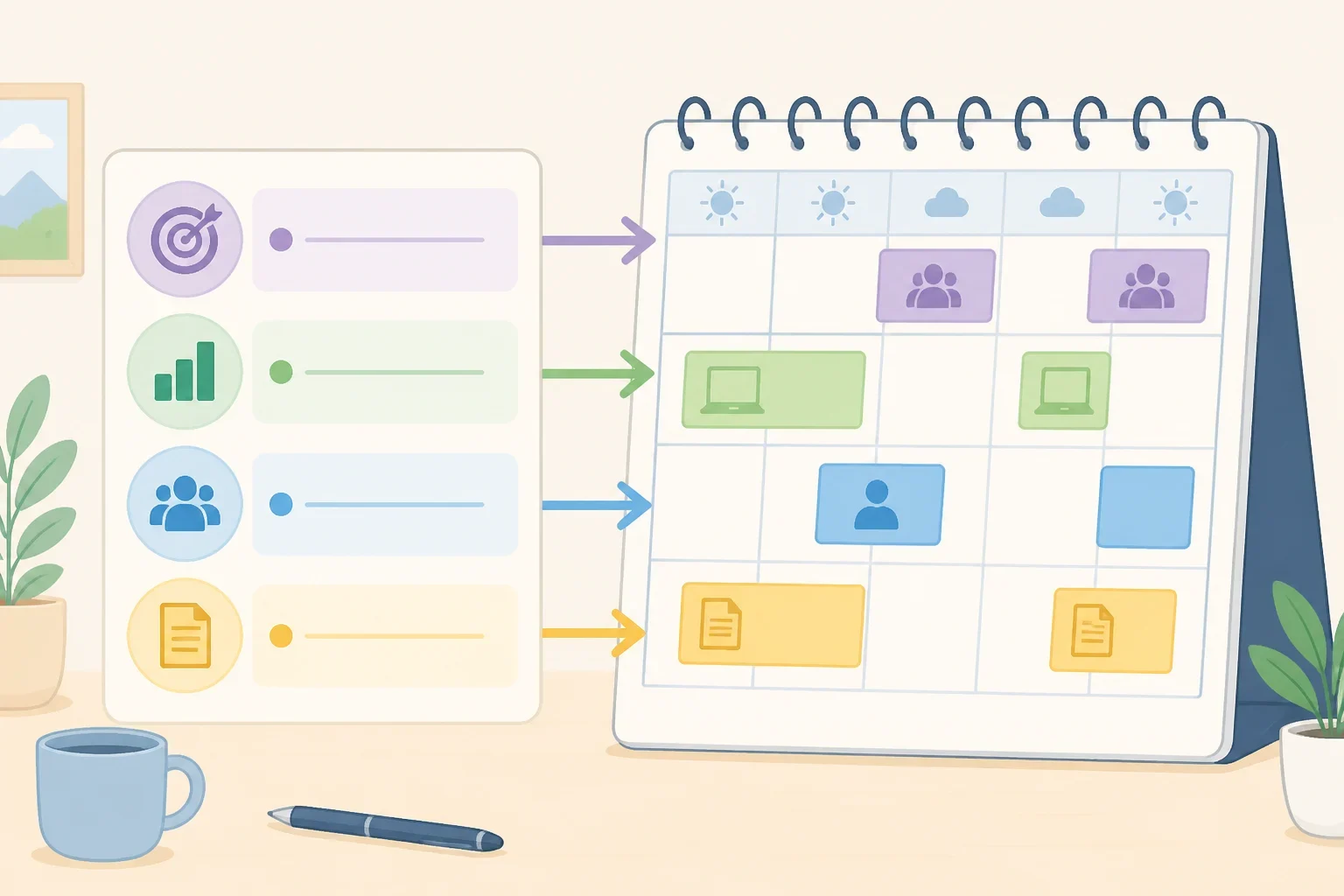
A priority with no time attached to it remains an intention. Once the week’s outcomes and immediate priorities are clear, place realistic work blocks on the calendar.
A useful block names both the task and the expected result. Instead of reserving “project time,” schedule “draft the first section of the client report” or “review and approve the three open budget items.” Leave room for meetings, messages, and work that cannot be predicted.
Task switching deserves attention when several projects compete. A study summarized in the 2025 review found that remote work and learning could remove external supports such as fixed schedules and face-to-face accountability. Research summarized there also reported difficulties with concentration, communication, motivation, stress, procrastination, and disengagement. Those findings support building structure deliberately, but they do not show that remote work alone caused every difficulty.
Apply the planning principle this way:
- Schedule focused work before filling every open period with meetings.
- Group similar administrative tasks when doing so fits the role.
- Avoid switching between unrelated projects during a short focus block.
- Leave buffer time for interruptions instead of pretending the week will be interruption-free.
- If adding another project appears to reduce output, ask which work should move.
Grouping email or status updates into one block is a practical extrapolation, not a directly tested intervention in the cited review. Use it when it reduces friction, and drop it when the role requires frequent responses.

4. Organize tasks in a system that makes starting easier
Planning tells you when to work. Organization reduces the effort required to decide what to do next.
Task organization was one of the four strategies identified as particularly beneficial in the 2025 review. The review examined 26 studies of time-management training, and those studies reported improved time-management effectiveness and strategy use. That suggests organizational habits can improve through training or practice. It does not prove that every habit is equally easy to learn.
Match the system to the work:
- For recurring operational work, use a task list with due dates and recurring items.
- For project work, connect tasks to milestones, dependencies, and owners.
- For collaborative teams, use a shared tracker showing status, next action, and deadline.
- For calendar-driven work, place the task and its expected result directly in the calendar block.
A payroll specialist might keep recurring deadlines in a task list, reserve calendar time for exception handling, and use a shared tracker for requests waiting on managers. A marketing team might organize work by campaign milestone rather than by a long list of unrelated tasks.
The goal is not to find a perfect app. It is to make the next action visible. Pick one workable system and test it for two weeks before replacing it. That is a habit-building recommendation, not a finding that two weeks is a scientifically established test period.
5. Review the gap between the plan and the work
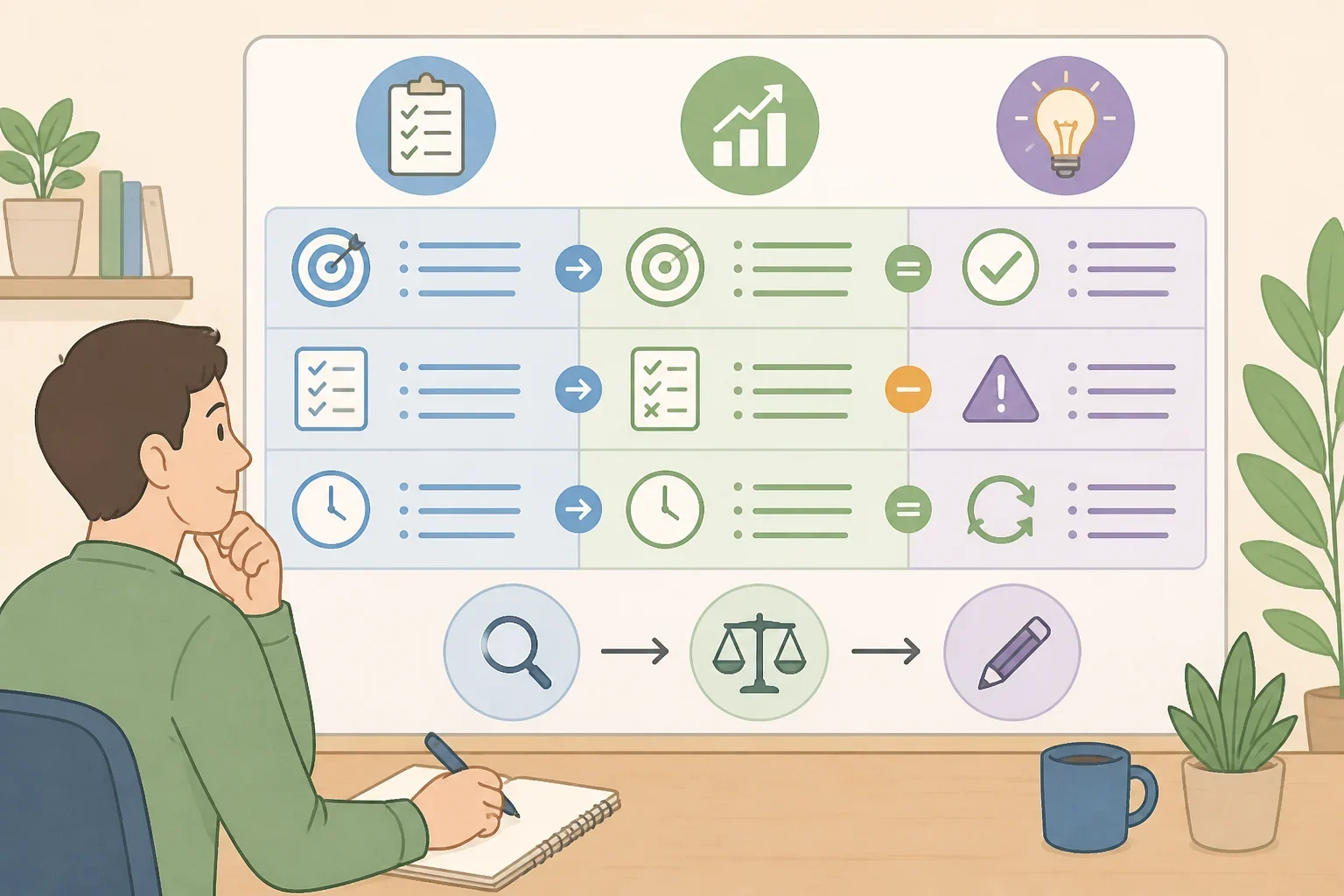
A plan becomes useful only when it can change. Set aside a short weekly review to compare intended priorities with actual work, then adjust the next week.
The 2025 review emphasizes organization, adaptation, and monitoring strategies as part of its definition of time management (Frontiers review). It presents review and adjustment as part of the broader process rather than as a separately tested technique.
Ask four questions:
- Which planned outcomes were completed?
- Which tasks took longer than expected?
- Which interruptions were necessary, and which could be reduced?
- What needs to be reordered, delegated, or discussed?
This step also helps separate a planning problem from a capacity problem. A protocol published two years ago describes work intensification and perceived time poverty as risks to employee health and wellbeing. It also summarizes earlier research connecting time pressure with work-family conflict, concentration, perceived work performance, and turnover intentions (PLOS ONE protocol).
The protocol is not a completed intervention review, so it cannot establish that a specific time-management program improves workplace wellbeing. It does provide a useful boundary: personal organization cannot fully offset a workload that exceeds available capacity.
In the European Union’s 2022 Occupational Safety and Health survey, nearly half of respondents reported that severe time pressure and work overload contributed to increased work stress, according to the PLOS ONE protocol. If a weekly review shows that recurring requests exceed available hours, raise the capacity issue directly:
“The highest-priority work is getting completed, but recurring requests are exceeding the available hours. Which deadline or task should move?”
That conversation may be more useful than adopting another personal productivity system.
A two-week implementation plan
Start with a small system that produces information about the work.
- Day 1: Write two or three outcomes for the week.
- Each workday: Identify the one or two tasks that advance those outcomes.
- During planning: Schedule protected blocks with a specific expected result.
- During execution: Group similar administrative work when appropriate, and record interruptions that materially change the plan.
- At the end of week one: Note where the plan was realistic and where work expanded.
- At the end of week two: Keep the practices that improved clarity, revise the ones that did not, and discuss recurring capacity problems with the manager.
The strongest starting point is not a particular app, matrix, or productivity ritual. It is a visible chain from outcome to priority, priority to scheduled work, and scheduled work to a review of what actually happened. That chain offers a practical way to improve time management at work while keeping the research, and its limits, in view.
