
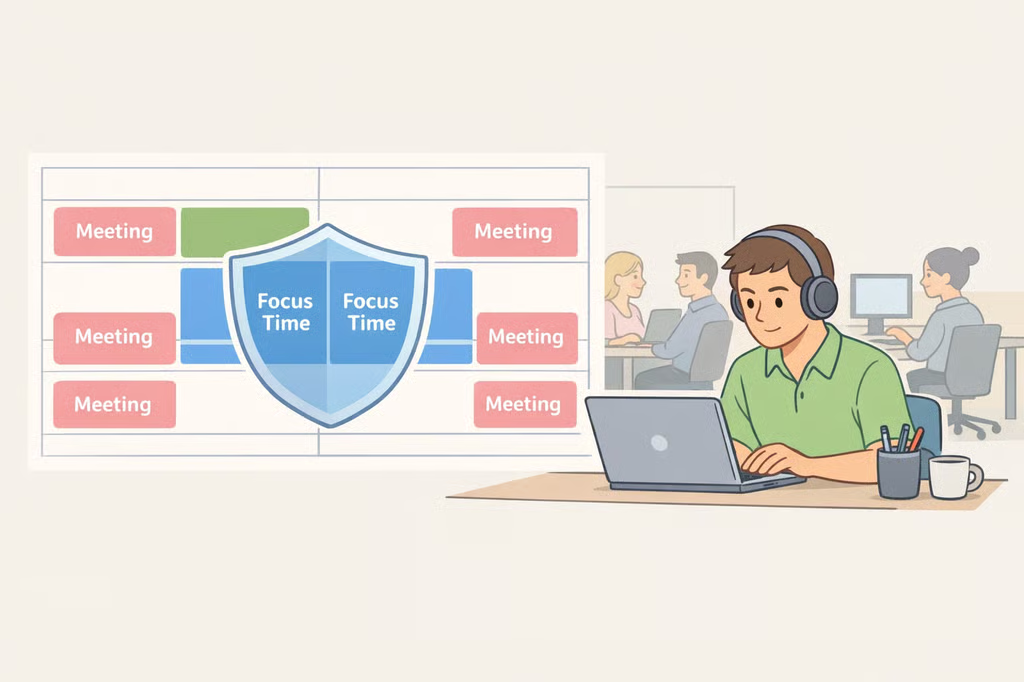
- How to Protect Focus Time at Work Without Hiding Your Calendar
- What the new research says about meetings and power
- Why self-initiated distraction matters as much as meetings
- How to protect focus time at work without hiding it
- Why the same request lands differently depending on your role
- How managers can reduce workplace interruptions and unnecessary meetings
- When to escalate beyond your own calendar
- What to do next
How to Protect Focus Time at Work Without Hiding Your Calendar
Most employees say they can't find enough uninterrupted time to do real work, and meetings are the main reason why. That shortage is also why some workers quietly relabel real project time as a fake meeting just to buy a few uninterrupted hours, though no study has actually measured how common that specific workaround is. It stays anecdotal, not documented.
Two studies published this year add context to why it's so hard to protect focus time at work. A 30-year synthesis of meeting research, published earlier this year in the Annual Review of Organizational Psychology and Organizational Behavior by Steven Rogelberg, Liana M. Kreamer, and Jon Gray, argues that meetings function as more than scheduling logistics. A related study from Harvard Business Review, published this summer and based on 27 employees, ties workplace culture to how often people get interrupted during meetings.
The underlying numbers behind the problem are older but better established. Microsoft research cited by Harvard Business Review two years ago found 68% of employees say they lack enough uninterrupted focus time during the workday, and inefficient meetings rank as the top barrier to productivity. That same reporting estimated up to a third of meetings may be unnecessary.
Meetings aren't the only culprit. A one-day diary study of 492 full-time office workers in Germany, conducted in 2022, found participants were interrupted roughly 25 times over a workday, including about 12 times by email and 7 times by phone, according to research published on PMC/NIH. The study's authors describe interruptions as one of the most common workplace stressors.
What the new research says about meetings and power
The Annual Review paper sorts three decades of meeting research into five recurring themes: meetings as stressors, as a communication tool tied to performance, as a platform for employee voice and inclusion, as a stage for power dynamics, and as an expression of company culture. Rogelberg, Kreamer, and Gray close the review by outlining a research agenda for what still needs testing.
That framing matters for anyone thinking about skipping a call. If meetings double as a venue for voice and influence, a request to opt out isn't purely a scheduling question. It can also touch on who gets heard on a team, which is one reason the same request lands differently depending on who's asking.
The HBR study published this summer adds a narrower point drawn from its 27-employee sample: workplace culture forms less from mission statements or engagement initiatives than from everyday interaction patterns, especially interruptions during meetings. With a group that small, it reads as a signal worth testing on a specific team rather than a conclusion that applies everywhere.
Neither study suggests one person's calendar habits can fix an interruption-heavy culture on their own. Both point to team-level patterns, which is why the practical steps below separate what an individual employee can try from what actually requires a manager.
Why self-initiated distraction matters as much as meetings
A smaller, separate study points to a different source of lost focus, one that has nothing to do with other people's meetings. Researchers video-recorded 15 knowledge workers during hour-long sessions last year and found that self-initiated interruptions, such as switching to another task on their own, accounted for nearly 60% of their off-task time, compared with 39.6% from external sources like messages or colleagues. With only 15 participants, the findings are exploratory.
The researchers found no significant link between how often someone switched away from a task and either their total off-task time or their self-reported productivity. Spending a larger share of a session off-task did correlate with lower perceived productivity, and tiredness was linked to more off-task time, while working later in the day was linked to less of it.
That distinction matters for diagnosing your own workday. A scheduling fix is built for interruptions that come from outside a person's own choices, the kind captured in the meeting and diary research above. It won't touch the self-initiated drift the smaller study ties to intrinsic motivation and personal obligations.
How to protect focus time at work without hiding it
None of the research above tests calendar-labeling tactics directly, but it points toward a few low-risk practices worth trying instead of a workaround. Naming a block accurately and setting terms around it creates a record a manager or teammate can see and question, rather than something that unravels once someone notices the pattern.
Two examples worth adapting:
- A calendar entry that reads: "Focus time, [project name], back online at 2 p.m., message if urgent."
- A direct question to a meeting organizer: "Do you need me for the full agenda, or just item two, and could I get an update async instead?"
The second question tests whether attendance is actually required rather than defaulting to full attendance or an outright decline. HBR's 2024 reporting found that many meetings knowledge workers attend simply aren't a good use of their time, which supports asking the question directly instead of guessing.
Participants in the 15-person study reported trying tactics like Windows 11's built-in Focus mode, restricting communication to email only, and working in Pomodoro-style blocks. The study documents what those participants tried, not proof that any single tactic works for everyone. Testing one for a few days, rather than committing indefinitely, is a reasonable way to check the fit.
Why the same request lands differently depending on your role
Latitude to decline or reschedule a meeting isn't equal across a team. The Annual Review's framing of meetings as a venue for voice, participation, and power helps explain why the same request to skip a call can read differently depending on someone's standing.
None of the research reviewed here tests whether junior employees, customer-facing staff, or workers in highly collaborative roles have the same ability to protect a focus block as more senior colleagues. That's a gap in the evidence, not a settled finding. Readers in those positions might test the norm on a single meeting before assuming broader flexibility.
Focus blocks also need to fit around existing obligations, not replace them. Protecting time for concentrated project work is different from becoming unavailable for customer response times or urgent team needs, so scheduling a block where those responsibilities are already covered avoids trading one problem for another.
How managers can reduce workplace interruptions and unnecessary meetings
The HBR study published this summer points to a manager-relevant lever: culture forms around everyday interaction patterns, particularly interruptions during meetings, more than around formal statements. For managers, that shifts the starting point from writing a new policy to reviewing how their own meetings actually run.
A few practical steps follow from that logic:
- Audit recurring meetings against the one-third-unnecessary estimate from HBR's 2024 reporting instead of defaulting to full calendars because canceling feels disruptive.
- Require a stated purpose before scheduling a meeting.
- Set shared meeting-free windows.
- Extend permission to decline or shorten non-essential invites to every team member, not only senior staff.
The Annual Review lists meeting performance as one of five recurring research areas, alongside stress, inclusion, power, and culture. Reviewing necessity and length, not just frequency, follows that framing when a team reports being short on focus time.
When to escalate beyond your own calendar
If interruptions continue after individual changes have been tested, a specific request tends to move further with a manager than a general complaint about being busy. Logging meeting counts and interruptions for a few days, then bringing one defined ask, such as a shorter standing meeting, rotating attendance, or a default async update for routine status checks, gives a manager something concrete to act on.
Raising the issue doesn't guarantee a manager will change team norms, and outcomes will vary by employer, industry, and role. It's a reasonable next step for employees who don't set those norms themselves, and it puts the decision in front of someone who does.
What to do next
Track where focus time actually goes for two or three days before trying any new tactic. If most of it traces to meetings and messages, the calendar and communication changes above are the more direct fix. If it traces to self-initiated drift, checking messages or switching tasks without an external prompt, those same changes won't help much on their own.
Either way, the fix starts with a specific record, not a general sense of being interrupted too often. That record is what makes a calendar change worth proposing, and it's what turns a vague complaint into a request a manager can actually act on.
