

What checking your phone during meetings says about you
Checking your phone during meetings can cost more than a few seconds of attention. In a controlled experiment, participants who watched a staged group discussion rated a phone-checking speaker's interpersonal trust at 0.93 on average, compared with 1.15 for speakers who never touched a device, a statistically significant gap (SAGE Open).
The finding comes from a study called "A Bird's-Eye View of Phubbing," which recruited 331 U.S. adults through Amazon Mechanical Turk and had them watch a three-minute staged video online. Participants weren't judging a coworker with an established reputation; they were rating a speaker who picked up a phone five times during a four-person conversation, disengaging for roughly 3 to 5 seconds each time (SAGE Open).
Separate workplace research adds a longer-term angle. A study published last year on Swedish electricians found that being ignored for a coworker's phone, a behavior researchers call phubbing, was associated with weaker perceived support, sense of community, trust, and organizational commitment, though that evidence comes from work breaks rather than formal meetings (Scandinavian Journal of Psychology).
Taken together, the research draws a line worth knowing before assuming every device in a meeting reads the same way: unexplained phone checking tracked with lower observer ratings, while device use tied to the meeting itself, like chat or a shared document, has been studied as something closer to a participation tool.
Checking your phone during meetings vs. meeting-related device use
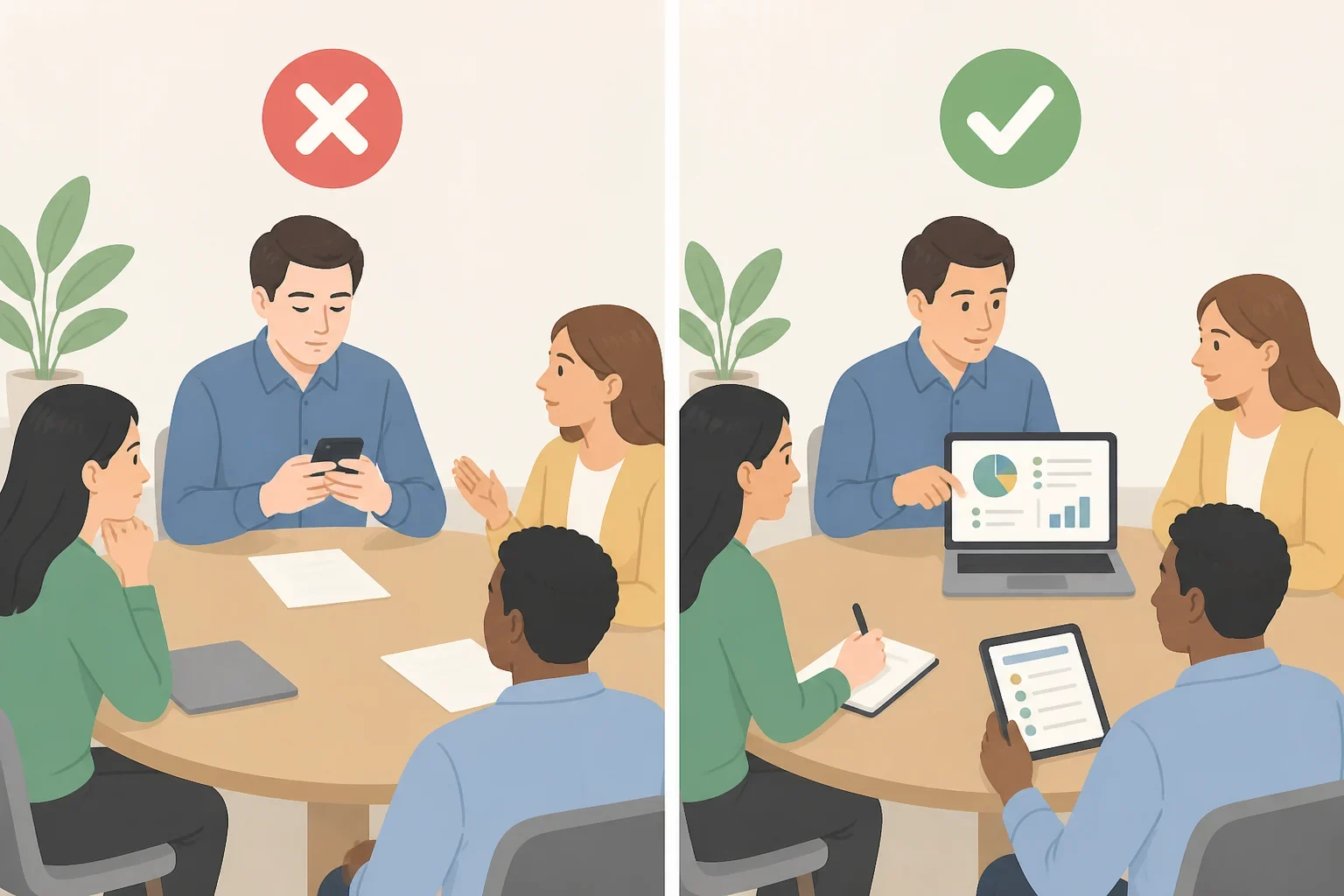
Researchers define phubbing as ignoring a physically present person to pay attention to a phone, a term that blends "phone" and "snubbing" (Scandinavian Journal of Psychology). A 2024 qualitative study interviewed 25 Swedish employees, 13 in the electrical trade and 12 in health care, and found that none of their workplaces had formal policies governing phone use during breaks, leaving employees to work out appropriateness on their own (Scandinavian Journal of Psychology).
Meeting-related device use looks different in the research. An eight-week field study led by Matin Yarmand and colleagues followed 332 employees at a single large technology company that runs meetings on Microsoft Teams. When in-person attendees connected to hybrid meetings on their own laptops, remote colleagues used chat features more often, a median of 12.6 active chat actions compared with 6.8 in fully remote meetings, and interviewees recommended in-person attendees bring devices specifically to "even the playing field" for remote coworkers, a view held by 32 of the 45 people interviewed (ACM CSCW, "Format Matters").
The staged-video experiment didn't test that distinction. It showed a speaker disengaging from a conversation to look at a phone, without establishing whether the check was personal, work-related, or tied to the meeting in any way (SAGE Open). Whether using your phone at work meetings reads as engaged or distracted seems to hinge on that visible purpose, not just whether a device is out.
What the smartphone distraction experiment found

The SAGE Open study ran on Mechanical Turk between November 16 and November 30, 2020, and required participants to be U.S. adults with a 95% platform completion rating. Each of the 331 participants watched one of four 180-second videos showing four speakers seated around a table, with one speaker in every version picking up a phone five times during the conversation (SAGE Open).
Across nearly every pairwise comparison, the phone-using speaker came out worse, with Bonferroni-adjusted significance below .0001 (SAGE Open). The effect showed up in both epistemic trust, meaning how much knowledge participants attributed to a speaker, and interpersonal trust, meaning how much they trusted the speaker socially, with the drop larger for interpersonal trust.
Not every observer judged the behavior the same way. Participants who reported using their own phones more often during group interactions rated the video's phone user more leniently, and female participants reported lower interpersonal trust in the phone user than male participants did (SAGE Open). Both findings suggest the same brief phone checks can land differently depending on who's watching and their own habits.
Because the sample watched a staged video rather than a live meeting, the study documents a general perception pattern among online observers, not proof that a specific glance in a real meeting will register with coworkers the same way.
How phone checking affects coworkers beyond the meeting room
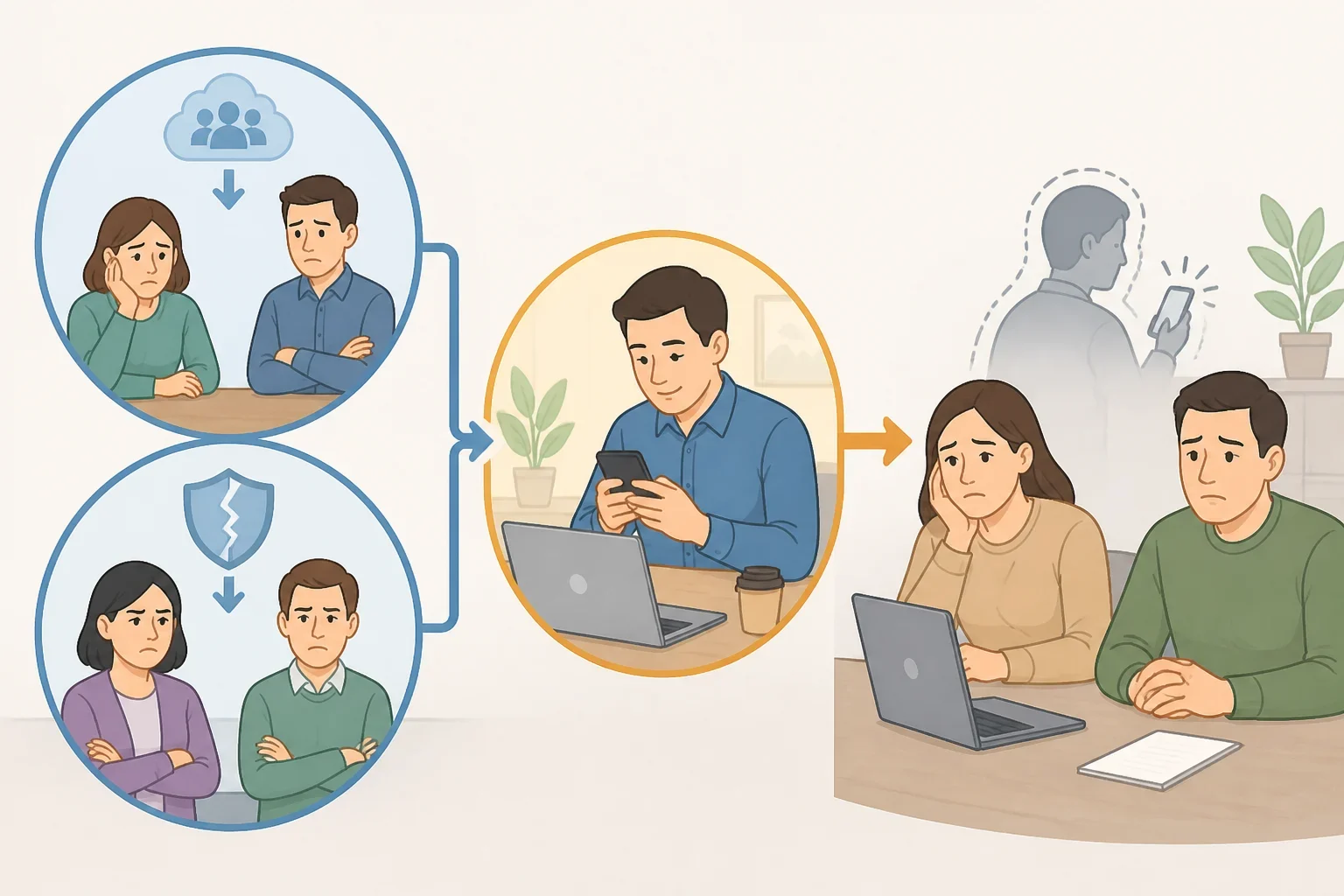
That 2025 survey of Swedish electricians split its sample into 250 younger workers, ages 18 to 34, and 557 older workers, age 35 and up, and examined associations between coworker phubbing during breaks and four measures of workplace connection: social support, sense of community, horizontal trust, and organizational commitment. Being phubbed by coworkers was negatively associated with all four, and the association grew stronger for more overt, "active" phubbing behaviors (Scandinavian Journal of Psychology).
One detail stands out: participants' own phubbing habits were generally not associated with those same measures. Exposure to coworker phubbing tracked with weaker support and trust; doing the phubbing did not carry the same measurable cost for the person checking their phone (Scandinavian Journal of Psychology).
A separate study on workplace multitasking adds a related thread. Employees who witnessed a coworker engaging in irrelevant multitasking tended to judge that coworker as ruder or less communal, and perceived intent behind the multitasking played the largest role in predicting workplace conflict and turnover intentions (PLOS One).
Both studies center on informal moments, breaks and general multitasking, not agenda-driven meetings, so neither one proves that a single glance at a phone during a meeting damages a career. But the mechanism they describe, visible disengagement wearing down a colleague's sense of trust and belonging, is a reasonable basis for caution in any shared work setting, meetings included.
What varies: meeting format, generations, and workplace norms
Not every workplace or every meeting treats phone use the same way, and the research reflects that. In the qualitative Swedish study, younger employees were both more likely to phub and more tolerant of the behavior in others than older colleagues, meaning identical phone use might draw different reactions depending on a team's age mix (Scandinavian Journal of Psychology).
Because none of the workplaces studied had explicit phone-use policies for breaks, researchers suggested that directly discussing expectations could reduce friction where norms are unclear (Scandinavian Journal of Psychology). That suggestion came from break-time behavior, not a tested meeting policy, but it points to a reasonable starting point for teams working out their own norms.
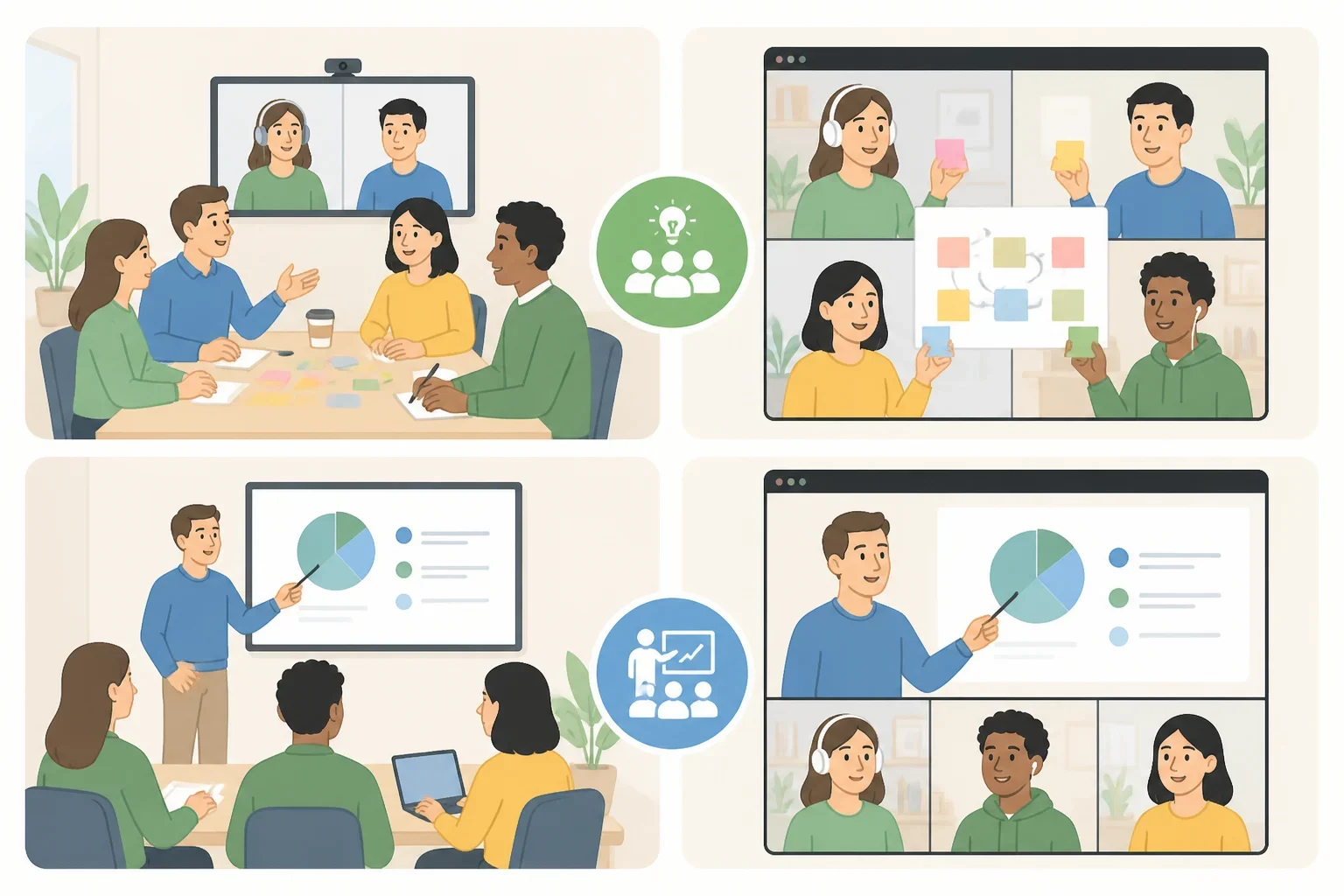
Meeting format also shaped how device access got interpreted at the technology company Yarmand and colleagues studied. Employees favored hybrid setups for brainstorming and planning sessions but preferred fully remote formats for presentations and stand-up meetings, and a majority of interviewees said hybrid meetings with a moderator instead of personal devices for in-person attendees were the least effective configuration they experienced (ACM CSCW, "Format Matters"). Those preferences concerned laptop access to a shared meeting platform at one employer, not phone checking generally, so they shouldn't be read as a universal ranking of meeting formats.
For employees, the practical question is whether a device is visibly serving the meeting or appears unrelated to it. Noting aloud that a phone check is "the shared doc" or "the meeting chat" follows from evidence that perceived intent shapes judgment, but that specific practice hasn't been tested as an intervention (PLOS One). The research doesn't establish a universal rule for when phone use in a meeting damages a worker's reputation, but it does point to a workable habit: keep any device use visibly tied to the discussion, and if it's still unclear which behaviors read as engaged versus distracted, raise the question with a manager or team before the next recurring meeting rather than guessing.
