
- Retail vs Warehouse Seasonal Jobs: What Target's Posting Reveals
- What Target's seasonal warehouse job shifts show
- Retail vs warehouse seasonal jobs: what the available evidence shows
- Why recovery capacity factors into the comparison
- Comparing a retail or warehouse job for seasonal work
- What the available evidence can and cannot tell job seekers
Retail vs Warehouse Seasonal Jobs: What Target's Posting Reveals
Target posted a seasonal warehouse listing on September 10, 2026, built around three 12-hour shifts or four 10-hour shifts rather than five listed workdays (Target). For job seekers weighing retail vs warehouse seasonal jobs this hiring season, the posting provides exact shift windows, pay ranges, and physical requirements, details that are useful to compare against any retail offer under consideration (Target, posted last month).
The listing covers Seasonal Warehouse Associate and Seasonal Warehouse Worker openings and includes start times, pay bands, and lifting requirements (Target, posted last month). The sources reviewed for this article do not provide comparable shift-level detail for seasonal retail jobs, which limits how closely the two can be measured against each other.
What Target's seasonal warehouse job shifts show
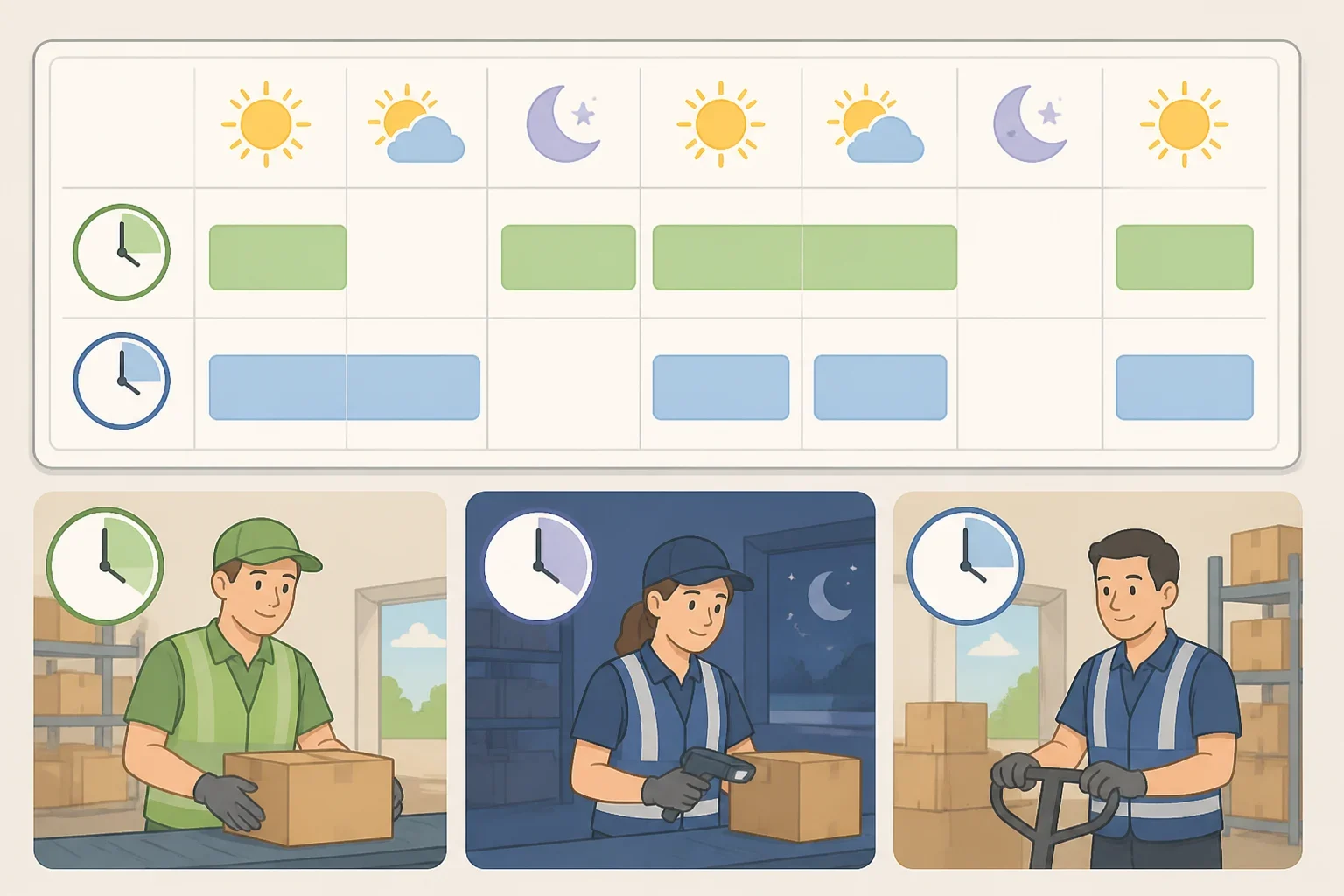
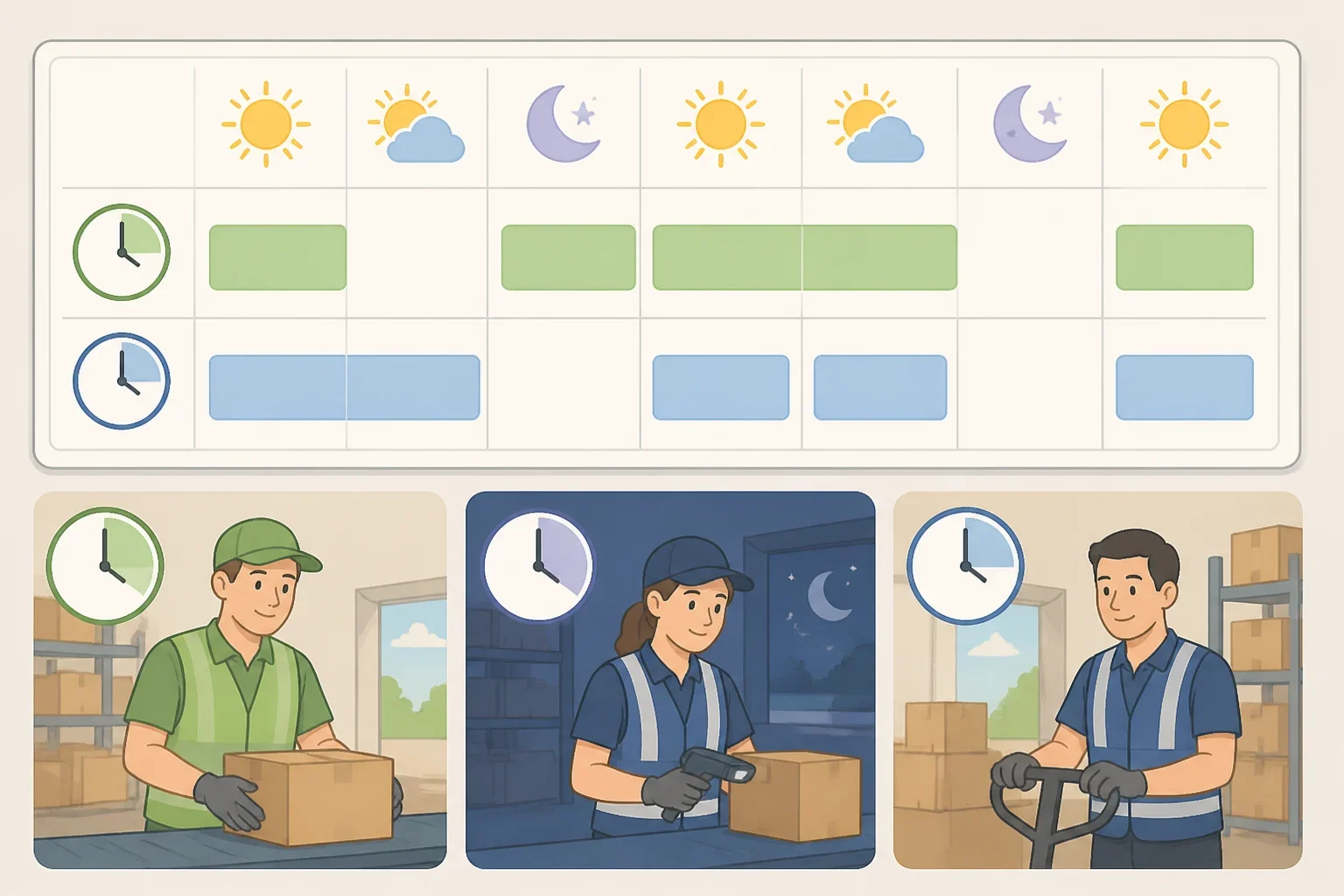
The posting lists two shift structures. One covers Sunday, Monday, and Saturday in 12-hour blocks, starting at 6 a.m., 5:30 a.m., or overnight at 6 p.m. The other covers Tuesday through Friday in 10-hour blocks, starting at 6 a.m. or 4 p.m. (Target, posted last month). The listing doesn't specify whether an applicant can choose between the two blocks.
Target asks applicants to apply with "as much open availability as possible," language that suggests the company, not the new hire, may have significant say over which block gets assigned (Target, posted last month). That's worth confirming directly with a recruiter rather than assuming from the posting alone.
Pay starts at $21.00 an hour for the Warehouse Associate role, topping out at $24.71, and $22.60 an hour for Warehouse Worker, up to $25.45. A shift differential of $2.00 to $3.50 an hour is available based on eligibility, though the posting doesn't say which shifts qualify (Target, posted last month).
Both roles require frequent lifting of 35 to 50 pounds, occasional lifts up to 60 pounds, and standing, walking, pushing, pulling, squatting, bending, and reaching during a shift (Target, posted last month). The Warehouse Worker listing adds equipment and height requirements where applicable, including operating forklifts, pallet riders, or scissor lifts, and working at heights up to 40 feet. At food distribution sites, the posting says workers must be able to work in refrigerated or freezer conditions for most of a shift.
Retail vs warehouse seasonal jobs: what the available evidence shows

Retail is one of several sectors that typically add seasonal workers, alongside warehousing and fulfillment, package delivery, food service, and hospitality, according to a 2024 analysis of seasonal hiring (Graham Law, late 2024). That analysis doesn't break down typical retail shift length or scheduling structure the way the Target posting does for warehouse work, so seasonal retail job schedules can't be measured against it with equivalent precision right now.
Seasonal retail hiring also isn't confined to the winter holidays. The same analysis points to tax season from January through April, spring and Easter in March and April, and back-to-school hiring from July through September as separate waves of demand, with scheduling needs that can vary by season and store type (Graham Law, late 2024).
On safety, 2023 Bureau of Labor Statistics data cited in that report found a higher injury rate per 100,000 full-time retail workers than in transportation and warehousing, manufacturing, or construction (Graham Law, late 2024). Shorter shifts, where a retail employer offers them, don't necessarily mean lighter physical demands; that's a question to raise with a specific employer rather than an assumption to carry into an offer.
Why recovery capacity factors into the comparison

A study using OSHA's Injury Tracking Application data examined California's General Warehousing and Storage establishments, a category defined by NAICS code 493110, and found total injury rates peaked at 5.87 per 100 workers in 2021 (California warehouse injury-rate study, late 2024). The same analysis found injuries requiring job transfer or restriction, a measure known as DJTR, stayed elevated in 2023 compared with 2018: 3.21 per 100 workers versus 1.84 (California warehouse injury-rate study, late 2024). Those figures describe one state's general warehousing sector, not warehouse or retail work nationally.
The study also found California's general warehousing sector expanded quickly over this period: annual average employment rose from roughly 132,802 workers in 2018 to about 242,196 in 2022 (California warehouse injury-rate study, late 2024). The researchers note that growth coincides with the injury trends but stop short of saying one caused the other.
A separate study of Illinois workers' compensation claims from 2018 through 2021 found statistically significant seasonal spikes in monthly injury claims only at e-commerce warehouses, not traditional ones (Illinois warehouse ergonomics study, 2024). The same research links e-commerce growth to faster, more repetitive, more variable warehouse work, without pinning the seasonal spike on any single cause. The findings suggest that anyone applying to an e-commerce warehouse this season has reason to ask how workloads are managed once volume peaks, rather than assuming the opening schedule holds steady through the busiest weeks.
California also has a specific rule worth factoring in for warehouse applications there: the state's AB 701 law applies to many warehouse distribution centers and requires covered employers to provide workers with quota information on request, according to the California injury study's review of the legislation (California warehouse injury-rate study, late 2024). Whether a specific site is covered, and what quotas apply, is something to confirm with the employer or a state agency rather than assume from this research.
Comparing a retail or warehouse job for seasonal work
Choosing between a retail or warehouse job for seasonal work comes down to comparing specific terms employer by employer, not comparing job titles. These fields are worth requesting from any posting or recruiter conversation, in writing where possible:
What to compare Why it matters Exact start and end times Shows the real daily time commitment, not just the posted shift length Required days per week A compressed schedule concentrates hours into fewer days; confirm how that affects total weekly hours How shifts get assigned Target's posting suggests the employer may control which block a new hire lands on; ask whether that's negotiable Shift-differential eligibility Confirmed for Target's posted range; ask directly for any other employer (Target, posted last month) Overtime policy during peak weeks Mandatory overtime changes the real schedule commitment Guaranteed weekly hours Not established in available research for either sector; ask the employer directly rather than assume Physical and environmental requirements Lifting limits, equipment certification, cold storage, or extended standing vary by role Commute time For example, a 12-hour shift plus a one-hour commute each way adds significantly to the time a job takes, beyond the posted hours Expected end date Seasonal roles end on different timelines depending on employer and department
Target's posted pay range shows how a shift differential, not hourly base pay alone, can change the total weekly picture; confirming eligibility for that differential before accepting an offer is a reasonable step no matter which sector a seasonal job falls under (Target, posted last month).
What the available evidence can and cannot tell job seekers
Target's September posting is unusually specific about warehouse shift structure, pay, and physical requirements for a single employer. That level of detail isn't matched in the retail sources reviewed for this article, which describe general injury rates and hiring-volume trends but not shift length or scheduling structure.
That gap doesn't mean retail schedules are shorter, more flexible, or more predictable than warehouse schedules. It means the comparison has to be built case by case rather than assumed from a sector's reputation. Before applying this season, request the exact schedule, pay and differential eligibility, physical requirements, and expected end date in writing from any employer under consideration, warehouse or retail, and treat the job title as a starting point for questions, not an answer on its own.
