

- How to Make a Personal Skills Inventory From Experience
- How to make a personal skills inventory: what belongs in each entry
- How to identify your skills from work experience: a three-step method
- Personal skills inventory examples: from raw experience to resume bullet
- Deciding which entries deserve a spot on a resume
- Using your career skills and accomplishments list: resume tailoring vs. career exploration
- Before anything goes on a resume
How to Make a Personal Skills Inventory From Experience
To make a personal skills inventory, start with one shift in habit: build a single running document where every skill gets paired with real evidence, instead of rebuilding a resume from scratch every time a promising opening shows up. Most job seekers end up digging through old email and half-remembered numbers for each new application. A work skills inventory built once can give you a reusable starting point for future resumes, cover letters, and interview answers, rather than a guarantee of saved time.
The approach adapts resume guidance already used by university career centers, though each one emphasizes a different piece of it. Harvard's career center pushes for fact-based, specific language over vague adjectives like "hardworking" or "detail-oriented." MIT's career advising office frames strong bullets around an action, a project, and a measurable result. Western Governors University builds accomplishment statements around situation, action, and result, the same STAR structure used in interviews.
This method works whether the experience on paper came from a job title, an internship, a club office, a research project, a season on a sports team, or responsibilities that never carried a title at all. What follows is what belongs in a skills inventory, a three-step method for building one, two worked examples that move from raw memory to finished resume bullet, a way to decide which entries deserve a spot on an actual resume, and how to put the finished document to work with O*NET OnLine.
How to make a personal skills inventory: what belongs in each entry

A resume only ever shows a slice of someone's experience. Harvard's career center advises tailoring a resume to the specific position being sought, which means most accomplishments never make it onto any single page. A personal skills inventory is where the rest of that experience lives: a private, ongoing record kept separately from any one application, built for reuse rather than written once and discarded.
Each entry works best with a consistent set of fields, modeled on the accomplishment-statement formula career centers already recommend: an action verb, the situation or task, the action taken, and the result, answering who, what, where, why, when, how, and how many along the way (WGU). Translated into a working table, that becomes six columns: experience or source, situation or challenge, action taken, result or evidence, skill or skills demonstrated, and relevance to a target role.
Experience/source Situation or task Action Result/evidence Skill(s) Relevance Math team captain (MIT example) Team needed structured practice ahead of states Organized review sessions for 15 participants, scored practice tests Led team to top-five finishes in Arizona's State Math League Leadership, coaching, organization Any role requiring team leadership or training Family caregiving (illustrative example, not drawn from a published source) Coordinating medical appointments and daily logistics for a family member while working Scheduled appointments, tracked a monthly care budget, communicated with providers Maintained an organized appointment and expense-tracking system Organization, budgeting, communication Roles requiring scheduling, coordination, or budget tracking
UCLA's career center recommends drawing from work experience, internships, volunteer activities, clubs, organizations, research projects, and sports when building this kind of list. Beyond that list, responsibilities like managing a household move or coordinating care for a family member can demonstrate comparable skills, though that's the article's own extension rather than something UCLA's list covers directly. Include experiences like these only when the situation, action, and result can be described as clearly as any paid role.
Before writing a single row, set up a simple spreadsheet or table using these six fields as column headers. That table becomes the working document for everything else in this process.
How to identify your skills from work experience: a three-step method

List. Start by listing every experience worth mining, not just the ones that sound impressive. Paid work, internships, volunteer roles, clubs, research, and sports all count as raw material (UCLA). The goal at this stage is a long list, not a polished one.
Capture. Turn each raw memory into a structured note using STAR or PAR. WGU's STAR format (situation and task, action, result) and MIT's PAR format (action verb, project, result) both do the same job: giving a vague memory a clear beginning, middle, and end (WGU; MIT). WGU's expanded version pushes writers to answer who, what, where, why, when, how, and how many for each entry, which doubles as a checklist while filling out the table.
Label. Attach a skill label only when the story actually demonstrates that skill in action. A single experience can sometimes support more than one label; organizing a fundraiser, for instance, might show both project management and budgeting depending on which part of the story gets emphasized, though that pairing is an illustration rather than a fixed rule. Resist labeling a story with a skill it doesn't actually show. Harvard's career center specifically warns against resume language that reads as general rather than specific, and the same standard applies here before anything reaches a resume.
Complete one full row per experience before worrying about formatting or trimming anything down. Completeness matters more than brevity at this stage; cutting comes later.
Personal skills inventory examples: from raw experience to resume bullet
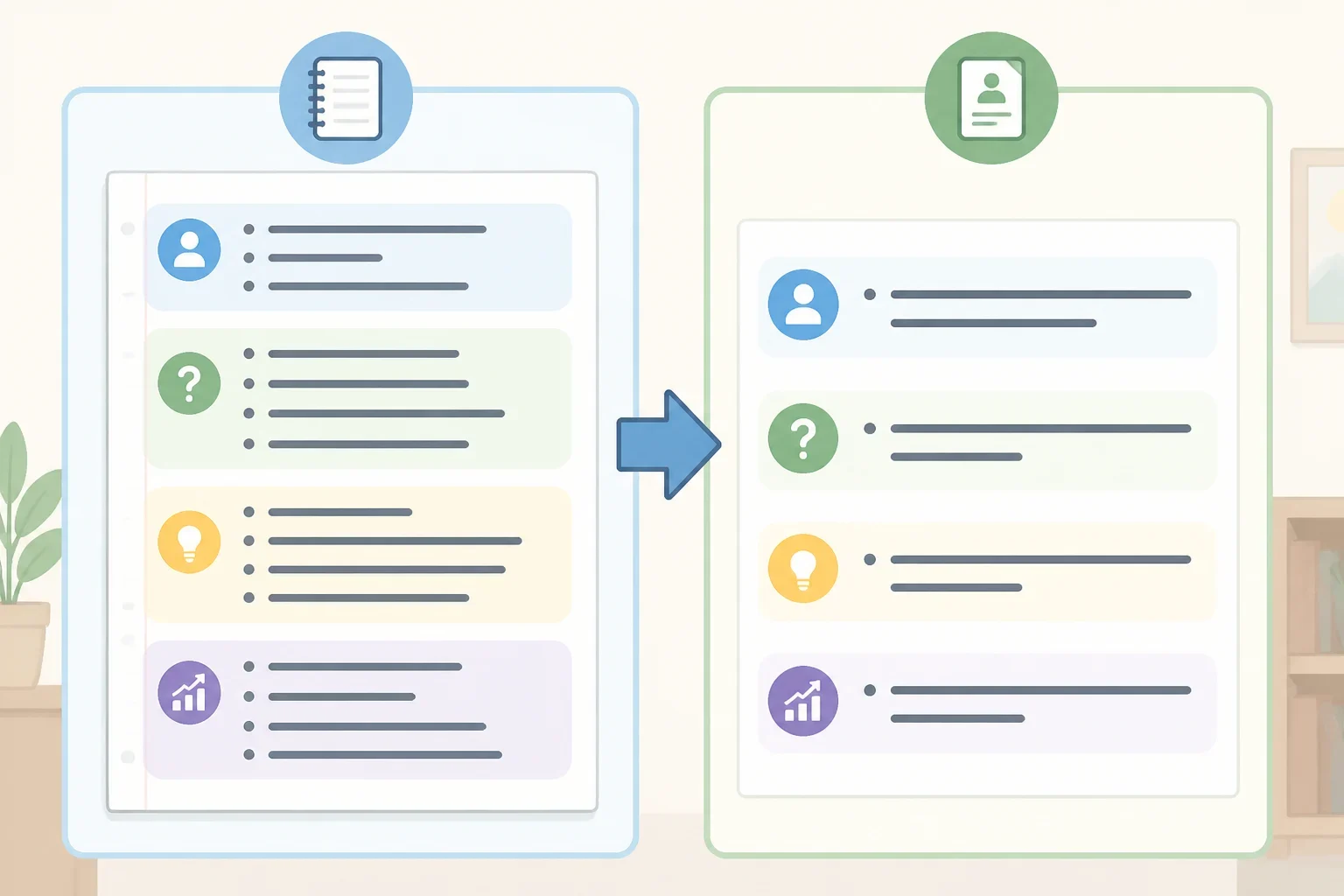
Two examples from MIT's career advising office show how this plays out in practice.
Example 1: math team captain. The raw experience was leading review sessions. Captured in PAR format, that becomes: organized review sessions for 15 participants, scored practice tests, and led the team to top-five finishes in Arizona's state math league (MIT). From that note, the skills demonstrated are leadership, coaching, and organization. The inventory entry captures all of it; the resume bullet keeps only the strongest line: "Organized review sessions for 15 participants, leading team to top five finishes in Arizona's State Math League."
Example 2: Radio Shack assistant manager. The raw experience was daily customer interaction on the sales floor. In PAR format: communicated product details and provided customer service to 50-plus people per day, and was promoted from cashier to assistant manager after four months (MIT). The skills most directly demonstrated are customer service and communication; the promotion itself hints at reliability, though that's an inference rather than something the raw story states outright. The condensed bullet keeps the scope and the promotion, both of which give the reader more specific evidence without needing a percentage attached.
Not every accomplishment comes with a dollar figure or a clean percentage, and inventing one isn't the answer. UCLA's own example shows the principle at work: a flat statement like "organized all sorority philanthropic events" becomes stronger once a concrete detail gets added, in that case a dollar total raised (UCLA). Beyond a specific dollar figure, other kinds of concrete detail worth considering include scope, frequency, team size, a completed deliverable, documented feedback, or a promotion. None of those require a spreadsheet to calculate, but all of them give the reader more specific evidence to point to instead of a vague claim.
Pick two or three personal entries and run them through this same sequence before attempting a full resume rewrite.
Deciding which entries deserve a spot on a resume
A finished inventory will likely hold more entries than any one resume can use. Before pulling rows onto an actual application, run each one through a short filter:
- Relevance to the target posting. Does the skill label match language the employer actually used?
- Recency or continuing use. Is this still something practiced regularly, or a one-time story from years back?
- Strength of evidence. Does the result section hold up on its own, or does it lean on a vague claim?
- Level of responsibility. Did the experience involve leading, deciding, or just participating?
- Relevance to an interview story. Can the entry be expanded into a full STAR answer if a hiring manager asks a follow-up question?
Entries that clear most of these filters are the ones worth condensing into bullets. Entries that don't clear them stay in the inventory for a different posting, not in the trash.
Using your career skills and accomplishments list: resume tailoring vs. career exploration

The full inventory stays private. What gets shared depends on what the reader is trying to do next.
Tailoring a resume to a specific posting. Scan the posting's language, then pull only the inventory rows that passed the filter above and whose skill labels match it. Condense each into a one- or two-line bullet, since an employer is only scanning a resume for a few seconds, per MIT's career advising office. Resume content should also be written for people and systems that scan quickly rather than read closely, per Harvard's career center. Anything from the inventory that doesn't match the posting's language stays in reserve for the next application.
Exploring career paths without a specific job in mind. O*NET OnLine's Soft Skills Custom List is built to help someone use their existing skill set to identify occupations worth exploring. The tool lets users select social and thinking skills, interpersonal abilities like negotiation and persuasion, and see how those skills map to specific occupations. Selecting a small group of soft skills from the inventory returns a "Skills Covered" percentage, showing how many of an occupation's high-level soft skills matched the selection, and a "My Matches" score, indicating how strongly the selected skills align with the occupation's ratings; a higher "My Matches" number makes it more likely the occupation will make full use of those skills (O*NET OnLine).
That comparison only runs on selected soft skills, so it's a limited lens, not a full read on technical skills, overall experience, or job fit. Treat whatever occupations surface as a list worth researching, not a verdict on fit.
Before anything goes on a resume
Run each entry through one more check before it leaves the inventory for good: Can the action be explained in an interview without hesitation? Does the result hold up if a hiring manager asks a follow-up question? Does the skill label match what actually happened, not what sounds good? Harvard's guidance on fact-based, specific resume language applies just as much here as it does to the final bullet.
AI tools have a role in this process, but a limited one. They can help reword a bullet or match language from a job posting, but Harvard's career center specifically cautions against letting generative AI write the underlying accomplishment itself, since the output tends to read as generic (Harvard). The accomplishment has to come from the actual experience; a tool can only help polish what's already true.
A manageable starting point is to list five experiences from the past few years and draft one STAR or PAR entry for each using the table above. That single sitting won't finish the inventory, but it gives whatever comes next, a resume, a cover letter, an interview answer, something real to draw from instead of a blank page.
