

What is skills-based hiring? Adoption rises, outcomes lag
Skills-based hiring means evaluating candidates by what they can demonstrably do, not screening them out over a missing degree or a low GPA. NACE's Job Outlook 2026 survey, published earlier this year, found that 70% of surveyed employers reported using skills-based hiring practices, up from 65% the year before (NACE). Among that group, 71% said they use the approach at least half the time, according to the same survey.
The survey drew from a fairly small pool: 183 total respondents, 170 of them NACE employer members, representing about 23% of eligible members contacted (NACE). NACE collected the underlying data between August and September last year, so the numbers reflect a snapshot of member-employer sentiment, not the full U.S. labor market.
The direction still lines up with other reported developments. More than 20 U.S. governors have committed to eliminating degree requirements for public-sector jobs (Brookings, last year), and a coalition of major employers led by the Burning Glass Institute expanded standardized skills profiles to 30 roles covering more than 35 million U.S. jobs last year (Burning Glass Institute). Separately, a 2024 analysis from Harvard Business School and the Burning Glass Institute found that most companies announcing dropped degree requirements hadn't actually changed who they hire (HBS/Burning Glass Institute).
Those three data points describe different things: reported employer intent, coordinated industry infrastructure, and measured hiring behavior. Job seekers evaluating a "skills over degrees" posting need to know which one they're actually looking at.
What skills-based hiring actually means

NACE defines skills-based hiring as a strategic approach that aligns recruitment with the skills a role actually requires, weighing what a candidate has done over the credential attached to their name, rather than defaulting to degrees or GPA as the primary screening signal (NACE). That's the core idea behind skills-based recruitment generally: matching who gets hired to what the job demands, rather than to a proxy for it.
Among surveyed employers, the practice shows up most heavily at two points in the hiring process. Eighty-seven percent report using skills-based practices during interviewing, and 65% during initial screening (NACE). Job descriptions are another common entry point: 81% of surveyed employers said they build them around skills, and 58% use skills-based criteria for interview rubrics, per the same survey.
GPA screening has fallen off substantially among this group. In 2019, 73% of surveyed employers screened candidates by GPA; in the most recent survey, only 42% did (NACE). That drop doesn't mean competency checks vanished. Among employers who no longer screen by GPA, 73% still weigh demonstrated proficiency in key competencies when deciding who to hire, and even among employers who still use GPA, 67% do the same, according to NACE.
Why employers are moving away from degree screening
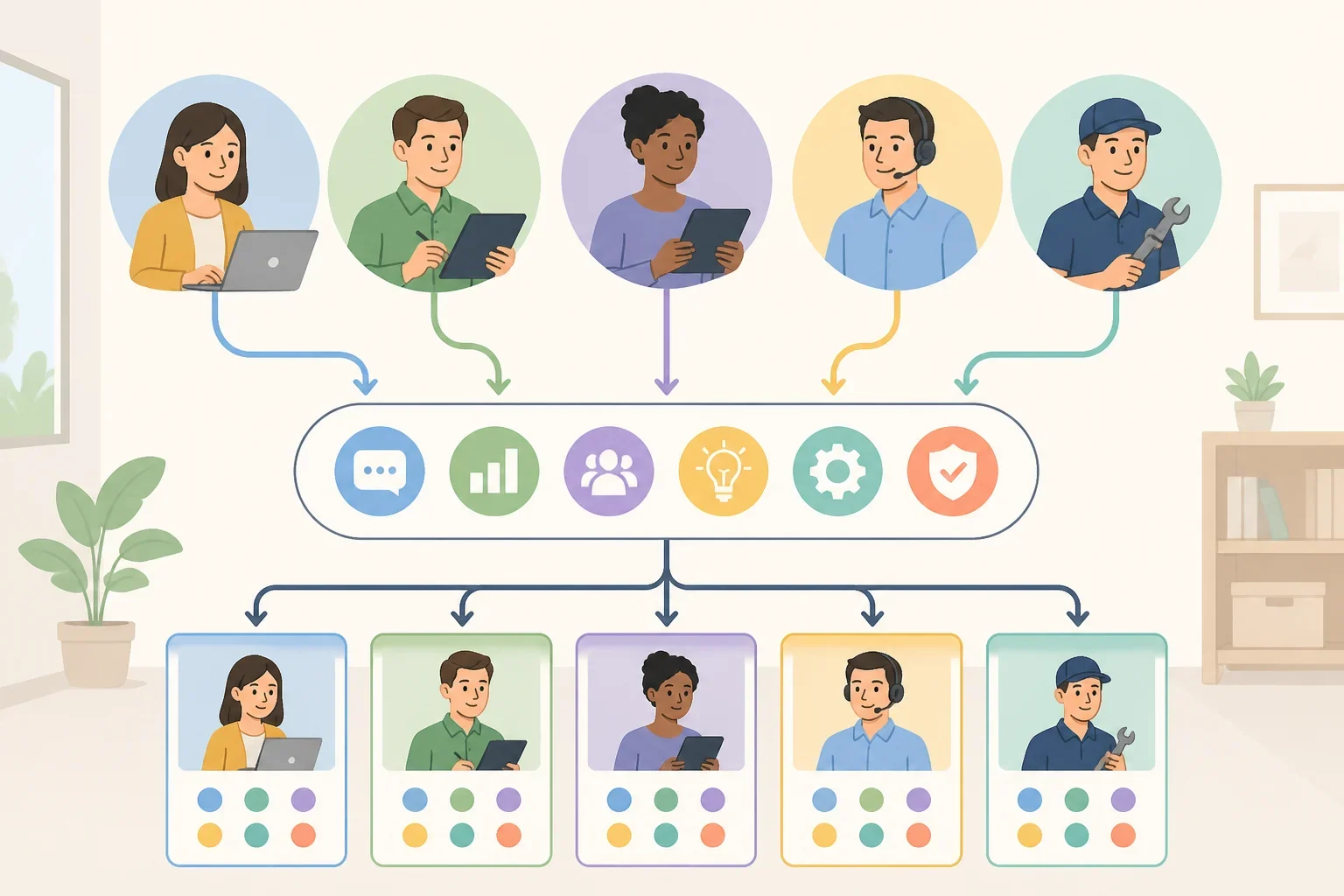
Brookings researchers point to scale as the main driver behind the shift. Adults without a four-year degree make up roughly two-thirds of the U.S. population over age 25, a large pool that degree-only filters may be screening out unnecessarily (Brookings, last year).
The Skills-First Working Initiative, convened by Walmart and led by the Burning Glass Institute, is one of the more concrete efforts built around that reasoning. Last year, the coalition expanded its shared skills taxonomies from nine initial roles to 30, spanning jobs from truck drivers and cashiers to cybersecurity analysts and project managers, covering an estimated 25% of the U.S. private-sector workforce (Burning Glass Institute). The group reports that some participating employers have piloted hires using skills-first criteria, which it describes as early evidence the approach can shape real hiring decisions, though it stops short of claiming outcome data at scale.
State governments have moved on a parallel track, though Brookings characterizes the governors' degree-requirement pledges as an opening move rather than a full overhaul (Brookings).
Where the evidence gets thinner: practice vs. outcome
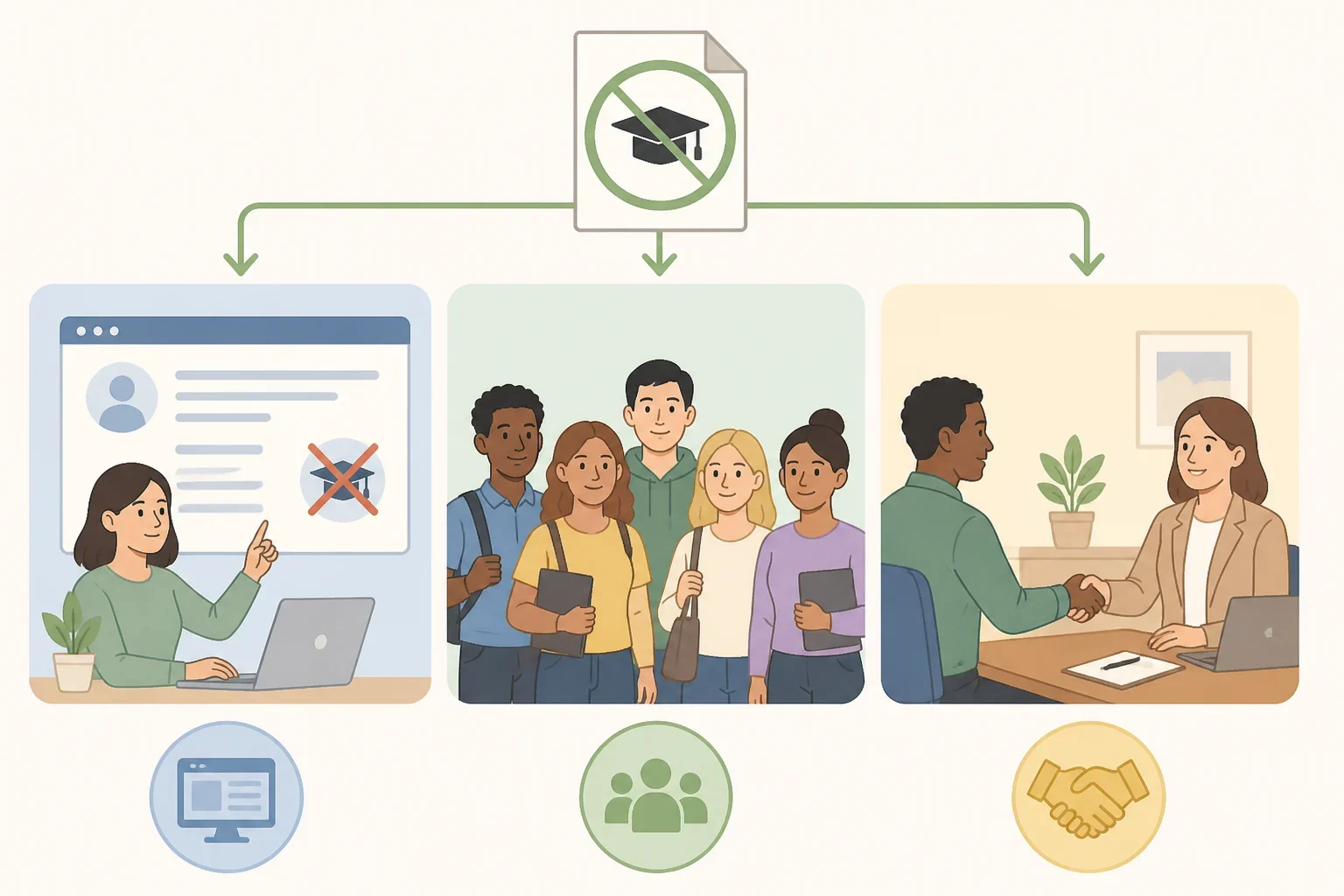
This is where the three developments start to pull apart. Removing a degree requirement from a job posting is a policy change. Whether it changes who actually gets hired is a separate question, and the research on that question is less encouraging than the adoption numbers alone would suggest.
A 2024 analysis from Harvard Business School's Project on Managing the Future of Work and the Burning Glass Institute tracked what happened after companies announced they were dropping degree requirements. It found that the increased hiring opportunity these announcements promised showed up in fewer than 1 in 700 hires during the study period (HBS/Burning Glass Institute).
The researchers sorted the firms they studied into three groups. About 45% changed their job postings with no meaningful difference in actual hiring behavior afterward. Roughly one-fifth made short-term gains in hiring workers without a bachelor's degree, but the gains didn't hold, and some of these firms ended up hiring an even smaller share of non-degreed workers over time. A smaller group the researchers labeled "Skills-Based Hiring Leaders" increased their share of non-degreed hires in the roles analyzed by nearly 20% (HBS/Burning Glass Institute). Nearly all the measurable change across the full study traced back to the 37% of firms that actually followed through in practice, not just in job-ad language, according to the researchers.
Where firms did follow through, the payoff was measurable. At Skills-Based Hiring Leader firms, non-degreed workers hired into roles that had formerly required a degree had retention rates 10 percentage points higher than their degree-holding colleagues (HBS/Burning Glass Institute). Across the firms studied, non-degreed workers hired into upgraded roles also saw an average 25% salary increase, per the same analysis.
None of that means skills-based hiring failed. It means deleting a degree line and actually redesigning how a company screens candidates are two different projects, and most firms in the study only completed the first one.
What's slowing broader adoption
Brookings researchers argue that degree requirements became standard in the first place because they gave hiring managers an efficient, if blunt, way to narrow a large applicant pool (Brookings). Replacing that filter requires something equally efficient, and most employers don't have it built yet.
Part of the gap is technical. Brookings reported that the applicant tracking systems most employers rely on generally don't have a way to capture digital records of learning or work experience, so skills evidence outside a traditional resume often goes unused by the very systems meant to screen for it (Brookings).
Part of it is definitional. The Burning Glass Institute points to a longstanding lack of shared language around skills: employers describe the same roles differently, workers lack a consistent way to prove what they know, and training providers struggle to figure out what to teach (Burning Glass Institute). Closing that gap, one role at a time, is what the Skills-First Working Initiative's shared taxonomies are actually built to do.
What this means for job seekers

Taken together, the reported data points to a gap between stated practice and demonstrated outcome. Surveyed employer adoption of skills-based language is climbing, and industry infrastructure to support it is expanding, but the strongest available research on actual hiring behavior found meaningful change concentrated in well under half of the firms studied.
That gap suggests a posting without a degree requirement doesn't automatically reflect a redesigned screening process. In the HBS/Burning Glass analysis, the difference between firms that changed outcomes and firms that didn't came down to whether skills-based language matched real changes in interview structure, screening rubrics, and hiring criteria, not whether a line was deleted from a job ad.
Before assuming a "no degree required" posting reflects that kind of overhaul, ask hiring managers directly how they evaluate qualifications for the role. Come prepared with work samples, certifications, or specific project outcomes that speak to the job's stated skills, rather than leaning on a resume alone to make the case.
