
36Kr gaming pay decline: limits of the 13% claim
A report attributed to 36Kr claims that gaming salaries declined 13% over four years and that 46% of workers who found new jobs after a layoff accepted lower pay. Those figures could point to real pressure in part of the labor market. They cannot establish a universal salary trend without basic information about who was surveyed, where they worked, which jobs were included, and how compensation was measured.
The available summary does not provide the original report’s methodology. Its publication timing, geography, sample size, occupations, employment categories, salary definition, and treatment of inflation remain unclear. The figures should therefore be treated as reported claims, not as a salary target or forecast.
That distinction matters for people deciding whether to accept a return offer after a layoff, as well as students, career changers, and active applicants considering gaming as a field. The useful response is not to dismiss the figures or treat them as a verdict. It is to test the evidence, compare like with like, and examine the full terms of a specific job offer.
What the reported figures establish

The two claims are straightforward as presented by 36Kr:
- Gaming salaries declined 13% over a four-year period.
- Among workers who found new jobs after a layoff, 46% earned less than before.
The available link leads to the outlet rather than the original article or an underlying dataset. Without the report itself, readers cannot determine whether the figures describe one country, a particular city, or a broader population. They also cannot tell whether “gaming salaries” refers to average pay, median pay, advertised salary ranges, or the earnings of a particular group.
Those distinctions change the meaning of the result. A four-year comparison could use nominal pay, which does not account for changes in purchasing power, or an inflation-adjusted measure. A salary figure covering programmers would not necessarily describe artists, producers, quality-assurance workers, localization staff, or business employees.
The 46% figure has another ambiguity. “Found new jobs after a layoff” does not explain whether the workers moved into full-time employment, fixed-term contracts, freelance assignments, part-time work, or another arrangement. A reduction in annual income could result from a lower salary, fewer hours, a shorter contract, or a change in employment status.
That does not make the report false. It limits what can responsibly be inferred from it. Until the original methodology is available, the figures show that 36Kr reported a concerning pattern. They do not show that every gaming worker is facing the same decline.
Why a second source must match the job

A second compensation source can help test the report, but only if it measures a comparable population. Readers should look for data that matches as closely as possible on:
- country or region
- job title and seniority
- employee, contract, freelance, or part-time status
- base pay versus total compensation
- reporting period
- median, average, or advertised salary measure
The Game Developer site is identified as a place to look for a Game Developer or GDC salary survey. The available material does not identify the exact survey, year, participating population, or measures, so it should not be presented as confirmation of the 36Kr figures without further checking.
The same caution applies to layoff information. Layoffs.fyi can provide a way to examine reported technology and gaming job cuts, while GamesIndustry.biz has covered studio closures and restructuring. A record of jobs eliminated does not measure the number of qualified workers competing for each opening, the pay attached to current vacancies, or the compensation of a specific occupation.
Those sources can establish context around layoffs and company changes. They cannot, by themselves, prove an industry-wide salary decline. A reader comparing a software engineering role in one region with a global figure covering multiple job families would be comparing different populations.
Before using the report in a negotiation, find a second source that covers the same kind of work and employment arrangement. If an exact match is unavailable, label the comparison as context rather than confirmation.
Three possible explanations for pay pressure
Several explanations could fit a reported decline in gaming pay. None can be established from the available 36Kr summary alone.
One possibility is increased competition after layoffs. When qualified workers are seeking fewer openings, employers may have more room to set compensation within a lower range. Layoff records can show that jobs were eliminated, but they do not reveal the balance between available workers and open positions. This makes increased competition a plausible labor-market mechanism, not a demonstrated cause of the reported figures.
A second possibility is a change in studio spending and hiring priorities after a period of rapid expansion. Industry reporting about closures or restructuring may indicate that particular companies changed their operations. It does not establish that every studio, region, or job family is responding in the same way. Without specific investment, hiring, or company-level data, this explanation should remain a possibility for investigation.
A third possibility concerns changing job responsibilities and the use of artificial intelligence tools. Quality assurance, localization, and asset production are sometimes discussed in connection with changing workflows, but the available material does not provide a named employer statement, survey, or role-level compensation analysis linking AI adoption to lower gaming salaries.
That evidence gap matters. A company may introduce a tool without reducing pay. It may expect employees to learn a new workflow, produce more, or take on different responsibilities. Another employer may not use the same tools at all. AI should therefore be treated as an employer-specific question, not as a catch-all explanation for a disappointing offer.
Candidates can ask:
- Has the role’s scope changed in the past two years?
- Is the position newly created or replacing someone who left?
- Which responsibilities will be handled by tools, vendors, or other teams?
- What work will remain with the person hired?
- Are output expectations different from those attached to the previous version of the role?
The answers will not settle the industry-wide debate, but they can clarify the job in front of the applicant.
Compare the complete offer
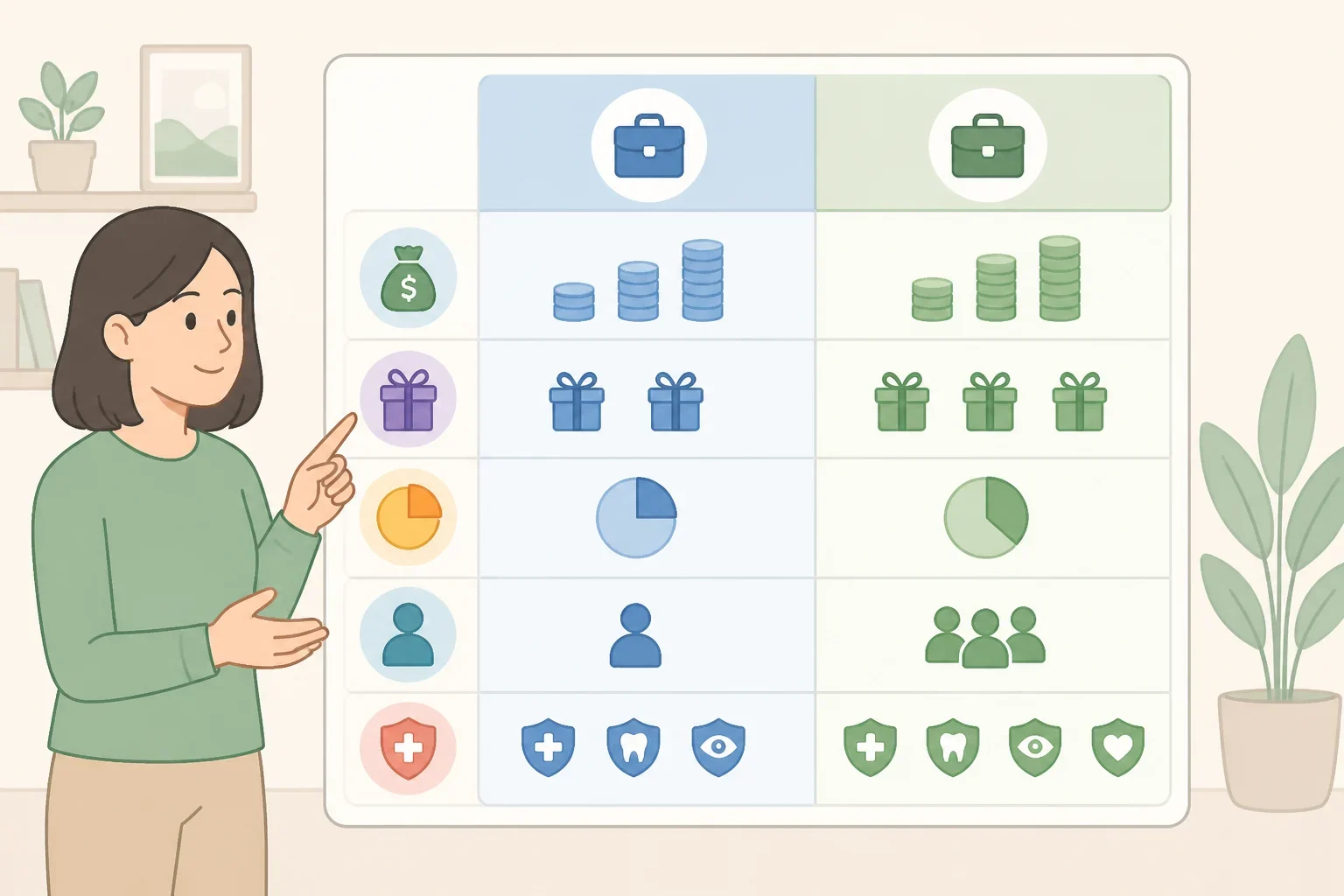
A salary percentage is a poor substitute for an offer comparison. A lower base salary may come with different hours, benefits, employment status, responsibilities, or workload. A higher base salary may also reflect heavier release-period demands or a less stable team.
Review each offer across these categories:
Offer element What to check Why it changes the comparison Base salary The stated range, placement within it, and review schedule Shows the guaranteed wage component and whether there is room to negotiate Bonus or profit share Whether it is guaranteed, discretionary, or tied to specific results Variable compensation should not be treated as guaranteed income Equity Type of award, vesting terms, and whether it is included in advertised total compensation A projected value is not the same as cash compensation available now Employment status Employee, fixed-term contract, freelance, or another arrangement The arrangement can affect benefits, continuity, and the practical value of the offer Location and pay band Whether compensation depends on residence or office location A remote role may still use a location-based salary band Benefits Health coverage, leave, retirement contributions, and other listed benefits Two offers with the same base salary can have different overall value Workload Expected hours, deadlines, travel, and release-period demands A higher salary may come with materially different time expectations Team stability Recent reorganizations, the reason the role is open, and how the team is funded The offer exists within a business context, not just a job description
Some offers include bonuses or profit-sharing, but the employer should explain how those payments are calculated and how often they have been paid. Treating a variable payment as guaranteed can make an offer appear stronger than it is.
The same principle applies to equity. Ask what type of award is being offered, when it vests, and whether the stated value is an estimate or a current cash benefit. Keep those details separate from base pay when comparing offers.
Employment status also deserves attention. Applicants should ask the employer to explain the arrangement in writing, especially when a position is described as contract work or when benefits are unclear. This article does not provide tax or legal guidance. A qualified professional can help if the classification or its consequences are unclear.
Location can create another misleading comparison. A remote position is not necessarily location-neutral. The employer may use a salary band based on the worker’s residence, an office location, or another internal policy. Ask which band applies before comparing the offer with a posting from another city or country.
The decision differs by career stage
A worker returning after a layoff has a prior salary that may provide useful context, but it should not be the only benchmark. Compare the new role with current postings for the same title, seniority, and location. Then check whether the responsibilities, employment status, workload, and benefits are genuinely comparable.
A lower offer may reflect a weaker market, a narrower role, a different location band, or a move from employment to contract work. Those possibilities call for different responses. The applicant may choose to negotiate, continue searching, or accept the role for reasons that go beyond pay. The reported 13% figure cannot make that decision without data matched to the worker’s situation.
Students and career changers face a different question. They are not comparing a return offer with a previous salary. They are deciding which job families to research and what preparation may be worthwhile.
“Gaming” covers multiple kinds of work. A broad industry figure may hide differences among live operations, engine programming, narrative design, art, production, and other roles. Those examples should be treated as different job families, not as proof that one area pays more or offers greater stability than another.
Start with the actual work described in postings. Identify the skills employers request, compare compensation information for the same title and region, and examine whether the role is full-time, contract, or freelance. This approach produces a more useful picture than treating the industry label as a single labor market.
The job’s core duties should guide any comparison with broader occupational data. Someone writing software for a game may belong to a different occupational category from someone creating visual assets, testing builds, coordinating production, or developing narrative content. Map the role by its primary work rather than assuming every employee at a game company belongs to one category.
Questions to ask before deciding

The reported figures are most useful when they lead to specific verification. Before using them in a negotiation or career decision, ask the employer:
- Is this role newly created or a backfill?
- What salary band applies, and how is placement within that band decided?
- Is the position full-time employment, fixed-term contract, freelance, or another arrangement?
- How has the team changed since the role was opened?
- What workload is expected during major deadlines or releases?
- Are bonuses, profit sharing, or equity guaranteed, discretionary, or conditional?
- How are location and remote-work policies reflected in the pay band?
- Have the responsibilities or output expectations changed because of new tools or workflows?
Also verify the report itself. Look for the original 36Kr article and confirm its geography, sample, occupations, employment types, salary measure, and treatment of inflation. Then compare it with compensation information that covers the same role and location. If those details cannot be matched, describe the comparison as limited rather than using it to set a precise expectation.
The practical conclusion is narrow. A reported salary decline may be a reason to investigate the market, but it is not evidence of what every gaming worker should earn. Candidates will make better decisions by comparing like with like, checking the full offer, and asking whether the job has changed since the role or team was previously staffed.
For the next recruiter or hiring-manager conversation, prepare three questions: Is the role new or a backfill? How has the team changed? How do tools and workflow changes affect the position’s responsibilities? Those answers will tell an applicant more about a specific offer than an unverified industry percentage can.
