
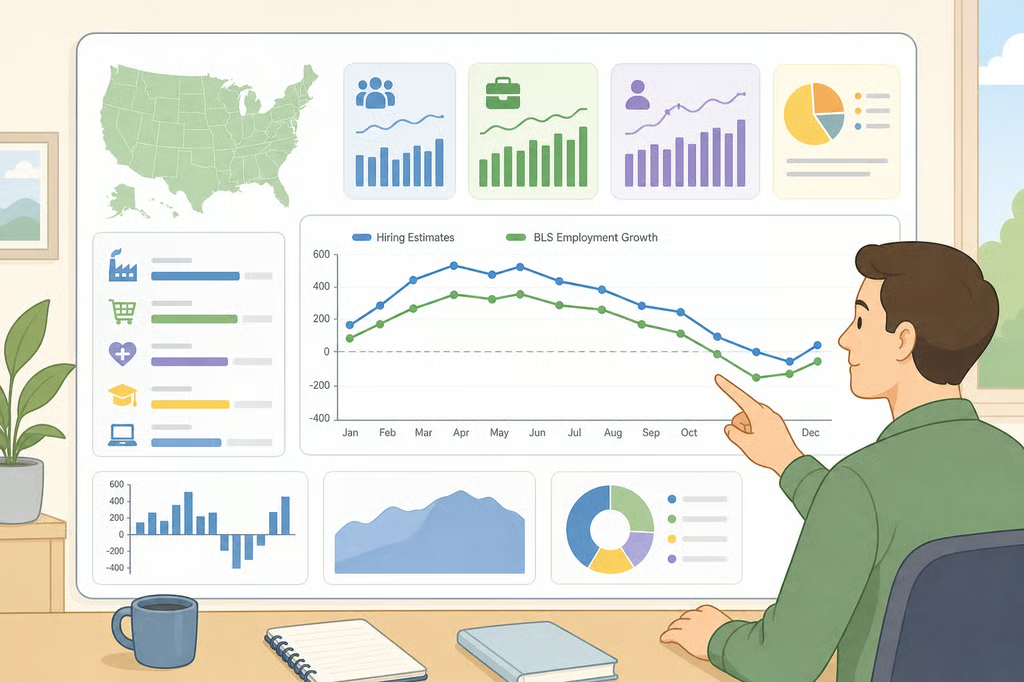
ADP private-sector hiring slows, but BLS shows an uneven labor market
ADP private-sector hiring slows is the headline implied by a reported weekly hiring figure, but the available evidence does not establish that conclusion. No original ADP release, reporting period, methodology, sample description, or definition of “hiring” accompanies the figure in the supplied research.
The stronger evidence shows a cooler labor market, not a confirmed collapse in hiring. Total nonfarm payroll employment rose by 29,000 in September, below the prior 12-month average monthly gain of 45,000, while unemployment held at 4.2% and has stayed between 4.1% and 4.3% since March, according to BLS.
That distinction matters for people applying now. Payroll change measures the net result of jobs added and jobs lost. It does not show how many employers are actively recruiting, how many workers are replacing people who leave, or whether a particular opening remains funded.
Why the ADP hiring figure needs verification
The reported ADP number should remain an early signal rather than the basis for abandoning a target industry or sharply changing an application strategy. Without documentation showing what the figure measures, it cannot be compared reliably with the monthly BLS payroll report.
A weekly private-sector estimate would also cover a different period from the monthly Employment Situation report. Even if both reports use the word “hiring,” they could describe different populations, methods, or outcomes. One might count new hires, while another reports net employment change.
The BLS payroll series itself shows why early employment figures require caution. July’s payroll change was revised from an increase of 21,000 to a decline of 10,000, and August’s increase was revised from 162,000 to 133,000, BLS reported. The two most recent months remain preliminary, so the September picture can still change.
The next major checkpoint is the October Employment Situation report, scheduled for November 6 at 8:30 a.m. Eastern Time, according to BLS. That release will offer a fuller government view of employment after the reported ADP figure, although it will remain a separate measure rather than a direct confirmation of an unpublished estimate.
For now, job seekers should treat both weekly and monthly indicators as directional. A single report can help identify what to investigate, but it should not determine where every application goes.
US private-sector job growth is uneven by industry
September’s payroll results do not show a uniform private-sector retreat. Private service-providing industries added 28,000 jobs and goods-producing industries added 18,000, while government employment declined by 17,000, BLS data shows.
Private employers were therefore still adding jobs in net terms, even though overall payroll growth was limited. National figures provide context, not a forecast for a particular employer, location, or job opening.
Health care continued to add jobs, but its September increase of 17,000 was below its average monthly gain of 33,000 over the prior 12 months, BLS reported. Applicants targeting hospitals, clinics, and related organizations may still find openings, but continued sector growth does not guarantee that a specific employer is hiring.
Financial activities showed a weaker pattern. The industry lost 7,000 jobs in September and was down 129,000 jobs from its recent peak in May 2025, with most of the decline concentrated in insurance carriers and related activities, BLS data shows.
Manufacturing and construction were steadier by comparison. Manufacturing employment increased by 9,000 in September and was up 72,000 jobs from a recent low in December 2025. Construction added 11,000 jobs, compared with an average monthly gain of 10,000 over the prior 12 months, BLS reported.
Those differences give applicants a useful starting point. Someone searching in finance may want to examine adjacent roles or employers more carefully, while someone considering manufacturing or construction may find a different set of conditions. Neither pattern says whether an individual applicant will receive an offer.
What JOLTS hiring data adds
The Job Openings and Labor Turnover Survey provides a different view of US labor market hiring trends. Payroll employment reports the net change in jobs, while JOLTS separately tracks job openings, hires, and total separations by industry, BLS JOLTS data shows.
The latest published release, issued last month, covers August. Its tables provide seasonally adjusted levels and rates for private-sector openings, hires, and separations, with preliminary figures identified in the release, according to BLS JOLTS.
The difference is practical. An employer can add workers while also hiring replacements for people who leave. Another employer can keep its payroll roughly unchanged while making very few new hires. Net payroll change alone cannot show which pattern is taking place.
JOLTS does not answer every applicant’s question either. An industry hiring rate cannot show whether a specific vacancy is active, whether a manager is still reviewing applications, or whether an organization has paused recruiting. Those details require checking the listing and asking the employer or recruiter.
Applicants comparing industries should therefore examine payroll trends alongside JOLTS openings and hires measures. The surveys cover different periods and use different methods, but together they provide more context than either measure alone.
How to use the hiring data in a job search
Start with national data to understand the direction of a target industry. Then compare that picture with the actual opportunities available in the applicant’s location. A sector showing sustained declines may deserve a broader search, but one weak monthly result should not automatically eliminate it.
Review each posting for details that suggest whether it reflects an active search:
- the posting date
- the work location
- the schedule or shift
- the stated qualifications
- whether the role appears newly listed or repeatedly reposted
A repeated listing could reflect turnover, difficulty filling the role, or an outdated advertisement. The posting alone does not establish which explanation applies.
Questions to recruiters or hiring managers can add useful context. Applicants can ask whether the position is newly created or replaces a departing employee, whether the team has hired recently, and whether the hiring timeline remains active. The answers may clarify whether national conditions are relevant to that opening.
Transferable skills can widen the search without requiring an immediate career change. Someone with insurance operations experience, for example, might compare health care administration or manufacturing support roles if the duties and qualifications overlap. That possibility should be tested against individual job descriptions rather than assumed from industry labels.
Workers who already have jobs should also avoid turning national data into a prediction about a raise, promotion, or layoff. Average hourly earnings for private nonfarm payroll employees rose by 5 cents to $37.81 in September, while the average workweek remained at 34.4 hours, BLS reported. Those broad measures do not predict what a particular employer will do.
What to check before the next jobs report
Before narrowing a job search, take three steps:
- Check the October Employment Situation report when it is released on November 6.
- Review the latest JOLTS openings and hires measures for the target industry.
- Compare both with current local postings and conversations with recruiters.
The reported ADP figure may deserve follow-up if an original release becomes available. Until then, the verified evidence supports a measured conclusion: employment growth has cooled, private-sector conditions differ sharply by industry, and no single hiring indicator can establish what a particular job seeker should do next.
