

What Is Stability Stacking? Guarding Against Layoffs, AI
A new Glassdoor report has a name for something a lot of millennial workers already seem to be doing: building skills, income, and professional relationships outside a single job so no one employer holds all the use over their financial security. Glassdoor calls the pattern "stability stacking," a strategy meant to guard careers against layoffs and disruption, according to a Glassdoor report Future Party covered last week.
The numbers behind the term are stark. More than three in four millennial workers, 76%, say they're actively questioning their career path, and 68% say career uncertainty has delayed a major life milestone, based on separate Glassdoor Community polls of more than 1,800 and 2,400 U.S. professionals conducted over the summer of 2026 (Glassdoor).
Glassdoor doesn't report what share of millennials are actually stability stacking. The report describes a pattern and coins a term rather than measuring how widespread the practice is. What it does establish is scale: millennials make up 33% of U.S. workers and have outnumbered every other generation in the labor force since October 2021 (Glassdoor), which turns this from a fringe habit into something showing up broadly during what should be a generation's peak-earning years.
What follows is what stability stacking actually involves, why Glassdoor says it's showing up now, what it appears to cost the workers doing it, and the one distinction that matters most before anyone tries it: stability stacking is not the same as quietly holding down two full-time jobs at once.
What is stability stacking as a career strategy?

Glassdoor defines stability stacking as layering multiple sources of security, including skills, options, income, and networks, so that no single job, boss, or industry disruption can derail a career (Glassdoor).
In practice, Glassdoor frames this as an "Employee+" model. Workers keep a primary job for benefits and stability, then diversify around the edges of it through skills training, networking in adjacent industries, or supplemental income, rather than leaving traditional employment altogether (Glassdoor).
Glassdoor separates this from what it calls "income stacking." Income stacking protects a bank account. Stability stacking, in Glassdoor's framing, aims at something broader: long-term career longevity and a sense of psychological security (Glassdoor). Future Party frames the same idea more plainly, describing stability stacking as something closer to an insurance policy against an uncertain and changing job market (Future Party).
For readers weighing whether this fits their situation, the practical starting point is figuring out which layer is actually missing, a portable skill, an outside network, or a backup income source, rather than assuming all three need to be built at once.
Why millennials are stability stacking now
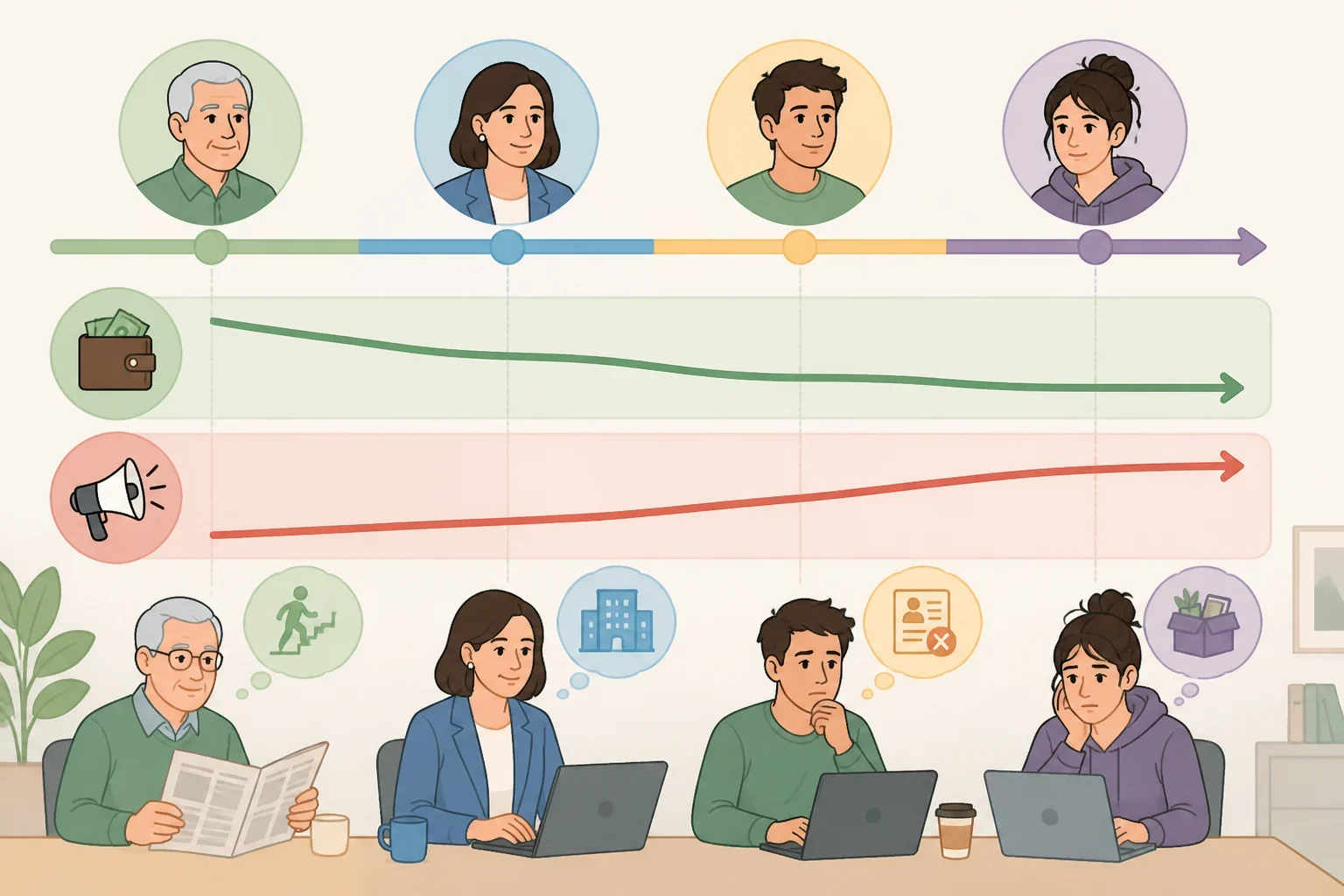
Glassdoor ties the pattern to where millennials sit generationally. The youngest members of the generation turn 30 this year, and wages typically slow through a worker's 30s; elder millennials' real earnings growth has already flattened to nothing, according to the report (Glassdoor).
That backdrop lines up with how millennials describe their jobs. Glassdoor's review of workplace feedback from January through June 2026 found millennials were more likely than other generations to mention job insecurity, at a 47% higher rate, and layoffs, at a 54% higher rate (Glassdoor).
Glassdoor positions the strategy explicitly as a hedge against what it calls "forever layoffs" and an advancement path the report says AI has rewritten, framing stability stacking as a way to "AI-proof" a career (Glassdoor). Future Party makes a similar point, tying the trend to workers burned by economic crises and AI disruption who are taking on extra work as a form of employment insurance (Future Party). Business Insider reported last week that the people building these safety nets increasingly include well-educated, middle-class earners, not just workers already in visible financial distress, a sign the instability is reaching millennials during what should be their prime working years.
Gen X still holds a slightly larger share of management and executive roles than millennials do, but millennials have already surpassed baby boomers in both categories, and more than one in four executives are now millennials (Glassdoor).
Anyone deciding whether this applies to them is better off checking their own exposure, industry volatility, how AI-adjacent their role is, how recently their employer has cut staff, than adopting the strategy simply because it's trending.
The trade-offs: benefits, burnout, and where stacking becomes something riskier

Glassdoor senior economist Chris Martin frames the core benefit as optionality. Building "a network that's adjacent to your career or in a different field altogether" gives a worker a place to turn for information, referrals, or leads if a primary industry contracts, he told Future Party last week.
The cost shows up in the same data. Glassdoor found millennials mentioned burnout 44% more often than other generations in workplace reviews, and millennial women mentioned it 76% more often, a gap the report flags as significant without fully explaining it (Glassdoor). Future Party notes that building multiple jobs, networks, and skills at once takes real effort, and that effort appears to be landing hardest on the generation already reporting the most exhaustion (Future Party).
That's where the distinction matters most. Stability stacking, as Glassdoor defines it, means adding skills, options, and networks around one primary job. It is not the same as "job stacking," a separately documented practice involving two or more full-time positions held at once, often without either employer's knowledge, according to an Innovative Human Capital overview published earlier this year.
That overview describes job stackers as often working 70- to 80-hour weeks to keep both roles running. It also cites separate research finding that sustained workweeks beyond 55 hours correlate with deteriorating physical health, reduced life satisfaction, and elevated mental health risk, a finding about overwork generally rather than a measurement specific to job stacking (Innovative Human Capital).
What varies by employer
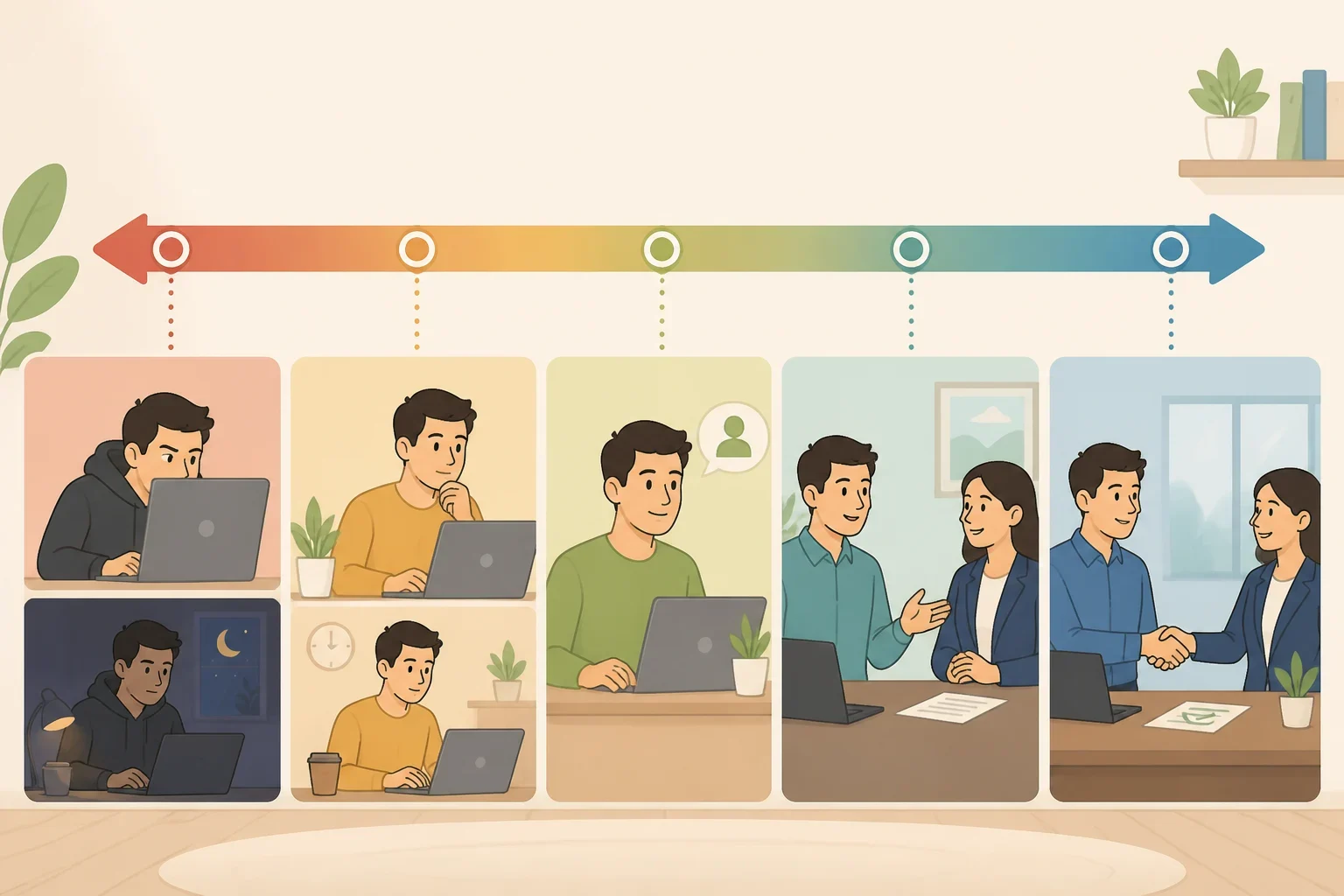
Where a given worker's arrangement falls on that spectrum matters, because employer tolerance varies. The Innovative Human Capital overview describes a range: fully covert double employment at one end, contract work that quietly approaches full-time hours without disclosure in the middle, and openly negotiated multiple-employer arrangements at the transparent end (Innovative Human Capital).
By Glassdoor's description, stability stacking sits closer to the transparent end by design. It keeps one disclosed primary job and builds resilience around it through skills, networking, or supplemental income, rather than concealing a second full-time role (Glassdoor). Whether a specific outside activity, a side certification or freelance work, crosses into conflict-of-interest or moonlighting territory still depends on the individual employer's policies, something neither source addresses in detail.
What workers can check next
Glassdoor's report doesn't measure whether stability stacking actually reduces layoff risk, shortens time spent unemployed, or raises long-term earnings. It documents a pattern and the sentiment behind it, not a proven outcome.
Martin's own example, an adjacent-industry network built through informational conversations or professional groups, is one low-conflict place to start (Future Party). A documented backup skill or certification is another, though credentials vary in how portable they are across employers, industries, and licensing jurisdictions, so it's worth checking what a specific credential actually transfers before paying for it.
Anyone considering paid work on the side has a more concrete step available first: checking an employer's outside-work, moonlighting, confidentiality, and conflict-of-interest policies, since neither source establishes a universal line between what's acceptable and what isn't. Given how the burnout numbers already look, the most realistic first move is picking one layer, a certification, a networking effort, or a skill, tracking how many hours it actually takes over a few weeks, and deciding from there whether adding paid work on top of it is worth it.
