
- How much do drone pilots make? Salary ranges explained
- Why published drone pilot salary estimates disagree
- How much do commercial drone pilots make by role
- What employers may ask for beyond Part 107
- What pushes pay higher: industry and location
- Employed pay versus freelance drone work
- How to estimate your local earning potential
How much do drone pilots make? Salary ranges explained
If you're asking how much do drone pilots make before committing time or money to Part 107 training, the honest answer is: it depends on which job you mean. Drone U's own estimates for drone pilot pay span from $35,000 a year for entry-level operators up to $215,663 for aerospace and defense roles (Drone U). Both figures come from the same source, but they describe very different workers.
"Drone pilot" isn't one job title with one paycheck attached to it. An entry-level visual operator, a salaried mapping technician, a freelance videographer, and a cleared contractor doing inspection work for a defense client could all list "drone pilot" on a resume, and each would be comparing against a different realistic commercial drone pilot salary. Treat any single average with caution until you know which of these roles it's actually describing.
This guide walks through why the published numbers disagree, what pay looks like across common role types, what employers tend to ask for beyond a basic certificate, and how to check a specific offer or freelance rate against something more useful than a headline average.
Why published drone pilot salary estimates disagree

Different sources measure different slices of the same job title, and that alone explains most of the spread in cited figures.
Drone U cites two separate Salary.com figures: an average of $48,102 a year in one part of its reporting and approximately $49,657 in another, both describing general operator roles across all experience levels (Drone U, citing Salary.com). Glassdoor's figure, also cited by Drone U, lands much higher at around $94,699, based on self-reported pay from people already employed as pilots (Drone U, citing Glassdoor). ZipRecruiter's estimate goes higher still, around $130,000, which Drone U attributes to the inclusion of defense and aerospace contractor roles that require security clearances (Drone U, citing ZipRecruiter).
None of these figures come with a published sample size or collection date, so read them as directional estimates rather than precise benchmarks. Government wage data doesn't close that gap, either. The Bureau of Labor Statistics doesn't track civilian drone pilots as their own occupation; the closest comparable government figures cover manned aircraft crews. Airline pilots, copilots, and flight engineers had a mean annual wage of $250,050 in wage data reported in 2023 (BLS). That number describes conventional aviation work, not remote drone operation, so treat it as rough background rather than a stand-in for UAV pay.
Before comparing any job offer or freelance rate to "the average," check what job title, experience level, and employer type the cited number actually describes.
How much do commercial drone pilots make by role
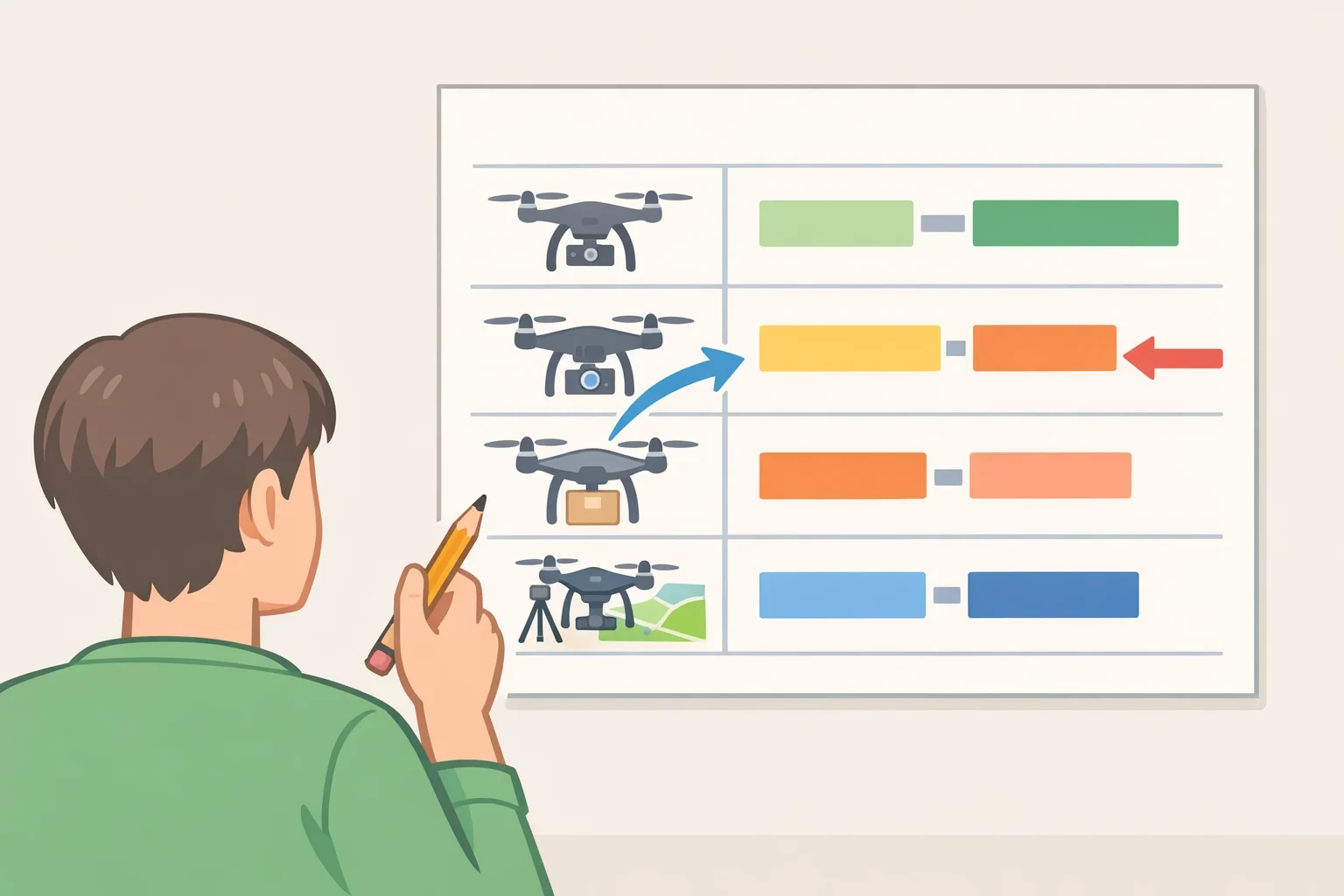
Rather than one average, published estimates cluster around distinct role types. Find the one that matches the job actually on the table.
Role Cited pay range Source Entry-level operator $35,000–$50,000/year (~$29–$35/hr) Drone U estimate Entry-level UAV pilot $48,000–$65,000/year UAVSphere Mid-career Part 107 commercial pilot (2–4 yrs) $57,000–$95,000/year Drone U estimate Mid-level UAV operator $70,000–$95,000/year UAVSphere Senior specialist (mapping, thermal, infrastructure) $100,000 or more Drone U estimate Senior UAV pilot $100,000–$145,000/year UAVSphere Specialized BVLOS pilot $130,000–$180,000 or more UAVSphere Search-and-rescue pilot $68,000–$90,000/year Drone U estimate Real estate drone photographer $62,338/year (~$30/hr) Drone U estimate
These estimates mix annual salary, hourly wage, and freelance billing rate, and each row comes from a single source's methodology. They aren't directly comparable to one another, and none is a confirmed occupational median. Use the table as a starting reference point, not a pay scale.
This year's UAVSphere survey ties its top bracket to highly specialized operators in defense contracting, LiDAR mapping, offshore inspections, or beyond-visual-line-of-sight (BVLOS) work, not to every job that happens to land in that dollar range (UAVSphere). BVLOS refers to flying beyond what the operator can see unaided. Requirements for that kind of flying go beyond a standard Part 107 certificate, so confirm current authorization rules directly with the FAA before assuming the higher figures apply once basic training is finished.
What employers may ask for beyond Part 107

A Part 107 certificate shows up across Drone U's estimates as the baseline credential behind most of the commercial pay figures above, but a certificate alone doesn't explain why one job pays $50,000 and a similar-sounding one pays $95,000. Job postings tend to layer additional expectations on top of it.
- Regulatory requirements. Part 107 covers standard commercial operations. BVLOS flying and some other missions require separate FAA authorization; confirm what a specific role actually requires directly with the FAA rather than assuming certification alone.
- Employer preferences. Postings for the mid-career pay tier often specify a couple of years of hands-on experience rather than certification alone, which lines up with how Drone U frames its $57,000–$95,000 estimate for pilots with two to four years in the field.
- Role-specific technical skills. Mapping, thermal inspection, and infrastructure work sit at the top of Drone U's senior-specialist tier, and UAVSphere's highest bracket names LiDAR mapping and offshore inspection specifically. If a posting mentions LiDAR, check whether it wants hands-on experience with the sensor or a formal credential in processing that data. Those aren't automatically the same thing, and the posting should say which one applies.
- Employer-specific conditions. Security-clearance eligibility is the factor Drone U points to for ZipRecruiter's higher defense and aerospace figures. If a listing mentions clearance, travel, or irregular field schedules, those conditions belong in the job description itself, not assumed from the salary number alone.
A reader targeting mapping work, for example, should compare postings for data-processing and GIS requirements rather than buying a high-end camera drone based on a senior-tier salary figure that may describe an entirely different skill set.
What pushes pay higher: industry and location
Two factors move pay more than the job title on a resume: industry and location.
Drone U's industry breakdown lists mapping and surveying at $95,966 a year and construction at $95,168, compared with film and video work at $69,107, the lowest figure in its dataset. Real estate comes in at $84,459, environmental services at $83,856, transportation at $85,715, and a catch-all "all other industries" category at $89,264 (Drone U). Aerospace and defense sits far above everything else at $215,663. Drone U's source doesn't provide job-scope detail behind that number, so don't treat it as typical pay for the field.
Location adds another layer. The cited ZipRecruiter estimates put Seattle at $148,986, Washington, D.C., at $148,275, and New York City at $143,227, well above Huntington, West Virginia, at $101,351, or Little Rock, Arkansas, at $108,255 (Drone U, citing ZipRecruiter). The source doesn't explain what drives that gap. Compare any offer against current listings in your own city or state rather than a national figure.
Employed pay versus freelance drone work

Freelance and salaried drone work get quoted in dollars per hour and dollars per year interchangeably, and sorting that out matters before comparing numbers.
Drone U cites freelance hourly rates ranging from $15 to $132, with a $48 median (Drone U). A freelance billing rate is not take-home income. It has to cover equipment, insurance, software subscriptions, travel, marketing, and unpaid hours spent editing and communicating with clients before anything close to that amount reaches a bank account.
Separately, Drone U cites Salary.com hourly figures that look more modest: an average of $23 an hour, with a typical range of $29 to $48, breaking down further into roughly $29 for entry-level work, $40 for experienced pilots, and $56 for senior-level work, all from the same Salary.com data (Drone U, citing Salary.com). Drone U also cites a much higher figure for full-time employed pilots, averaging $80 to $120 an hour with a $95 median (Drone U). The available data doesn't explain why these hourly figures differ so widely, which is exactly why hourly numbers from different sources shouldn't be averaged into a single figure.
Before comparing a salaried offer against a freelance rate, ask whether the salaried role includes benefits, predictable scheduling, and employer-provided equipment; freelance contracts may leave more of those costs with the pilot. As a matter of practical planning rather than a sourced salary figure, it helps to estimate realistic billable hours for a full year, subtract equipment, insurance, software, and tax costs, and compare that net number, not the raw hourly rate, against a salaried position's listed pay.
How to estimate your local earning potential
Once a target role and industry are identified, run any real offer or rate through a short checklist instead of measuring it against a single published average:
- Job title and actual duties. Visual operator, data processor, and mapping technician are different jobs even when a posting says "drone pilot."
- Employment classification. Confirm whether the role is employee-based or independent-contractor work, since that changes tax treatment, benefits, and who covers equipment costs.
- Expected hours. Ask how many billable or working hours per week or per project the pay figure assumes.
- Cost responsibilities. Find out who covers equipment, software, insurance, and travel. These costs eat into freelance rates fastest.
- Certification and clearance requirements. Note whether the role requires a security clearance or a specific technical credential, and whether hands-on experience with a tool like LiDAR is enough or a formal certification is expected.
- Location and cost of living. A salary that looks strong nationally may not stretch as far in a high-cost metro area, and vice versa.
From there, pull three to five current job postings for one specific target role, whether that's mapping, construction inspection, aerial media, or public-safety work, in your own local market. Calculate the midpoint of the listed pay only for postings that describe genuinely comparable work, and record the specific skills, certifications, and employment terms each one asks for. Then verify any licensing or authorization requirements for that role directly with the FAA before spending money on additional training, equipment, or certification exams tied to a higher-paying specialty.
