
- Personal trainer job requirements: what to verify before you enroll
- Do you need certification to be a personal trainer?
- What separates one personal trainer certification from another
- Personal trainer, athletic trainer, or exercise physiologist: choosing the right path
- How to check what employers in your area actually require
Personal trainer job requirements: what to verify before you enroll
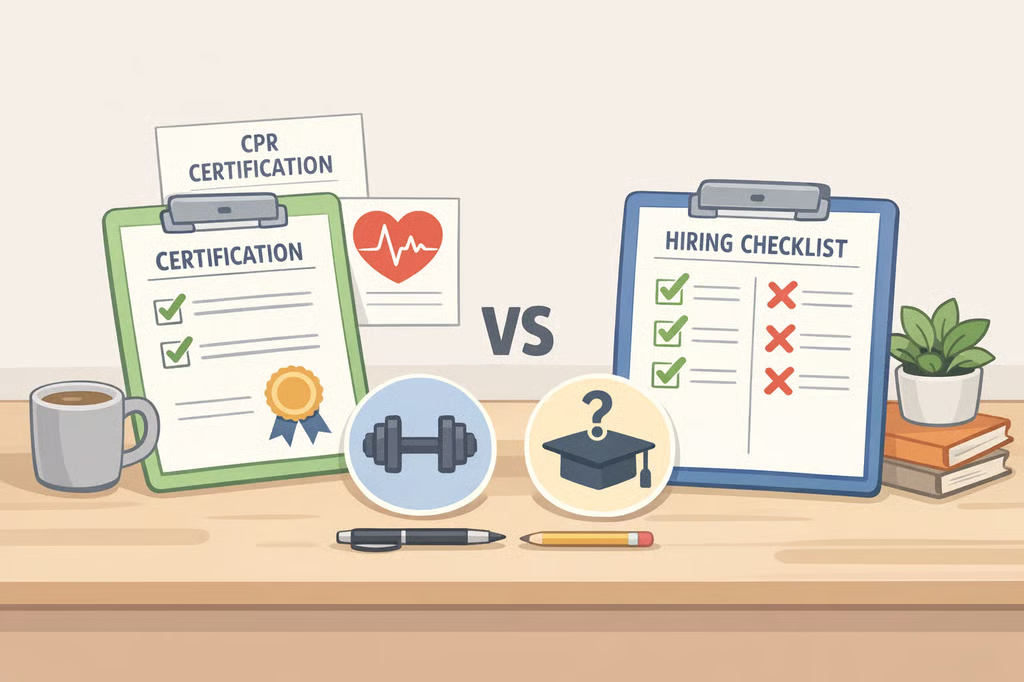
No law requires a personal trainer to hold a certification. Almost every gym, studio, and insurer expects one anyway, according to NASM, a certification provider whose guidance on the topic went up last month (NASM). That gap between the legal requirement and the practical one sits at the center of personal trainer job requirements, and it determines whether a specific certification program is worth paying for.
Demand for the broader role keeps climbing. The Bureau of Labor Statistics projects 12% growth for the fitness trainers and instructors occupation from 2024 to 2034, adding roughly 44,100 jobs and creating about 74,200 average annual openings, a category that covers personal trainers along with group instructors and other specialty coaches (BLS). Median pay across that occupation was $46,180 in 2024, and it already employs about 370,100 people nationwide (BLS).
This article separates what's legally required from what employers and insurers actually enforce, breaks down what distinguishes one certification from another, and lays out how to confirm local hiring expectations before enrolling in a program.
Do you need certification to be a personal trainer?
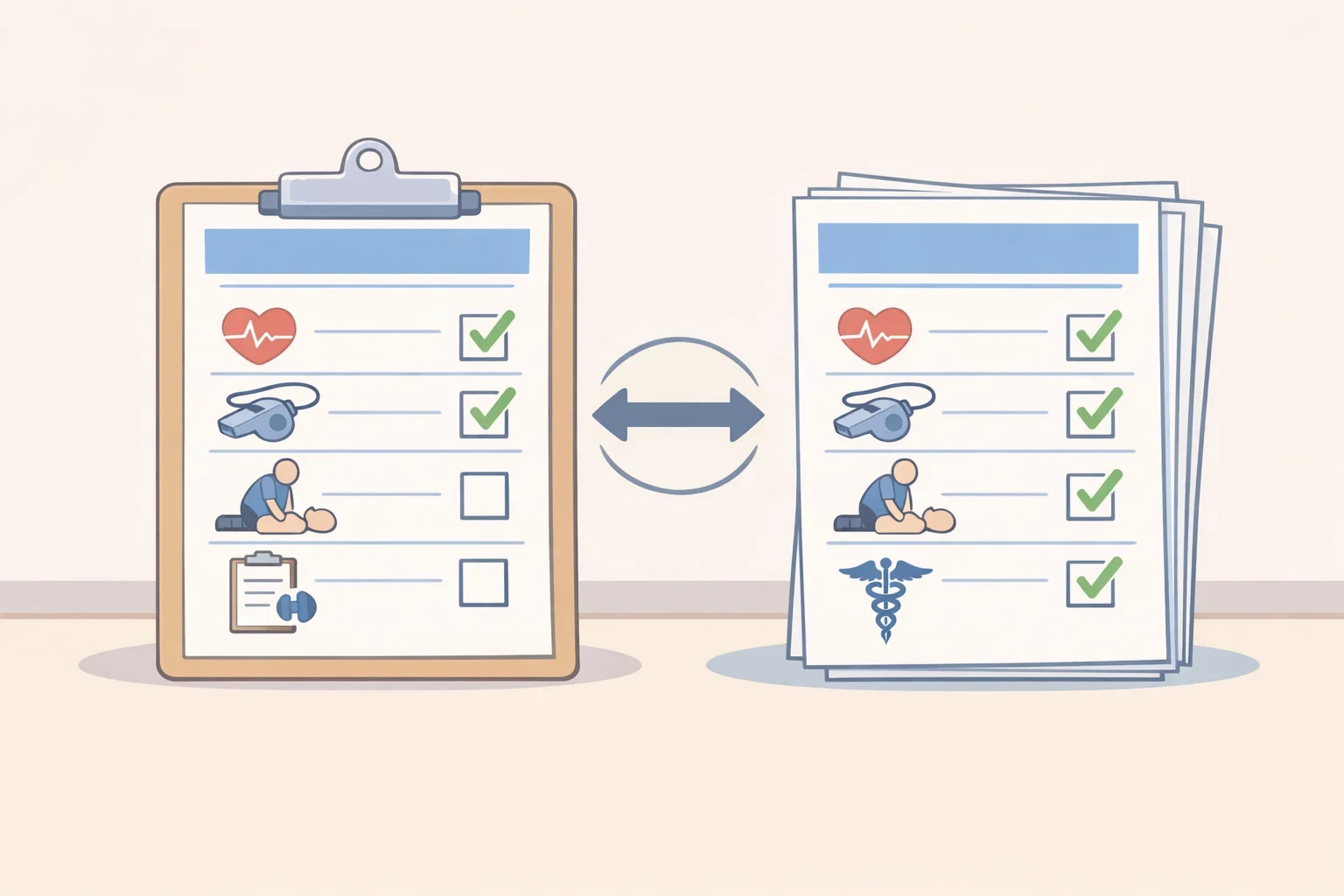
No federal or state law requires a personal trainer to hold a certification, according to NASM (NASM). Personal training remains unregulated at both levels of government, so there's no license to earn or lose in the legal sense.
BLS describes a narrower reality: personal trainers "usually must be certified" before working with clients or gym members, a standard set by employers rather than statute (BLS). NASM frames the same pattern more strongly, saying certification functions as a requirement "in nearly every practical sense": gyms and studios expect it, liability insurers ask for proof of it, and clients treat it as a baseline credential (NASM).
In practice, a lack of certification affects two things: whether a facility will hire someone, and whether an insurer will write a policy. NASM says many fitness insurance providers require proof of a current, NCCA-accredited certification before issuing coverage (NASM). Anyone planning to carry independent liability insurance should confirm accepted credentials with the insurer directly rather than assume a given certification will qualify.
BLS also notes that certification and hiring expectations vary by facility, so no single employer's practice should be read as an industry-wide rule (BLS).
What separates one personal trainer certification from another

Understanding personal trainer certification requirements starts with knowing who issues them. Commonly accepted organizations include the National Academy of Sports Medicine (NASM), the American College of Sports Medicine (ACSM), the American Council on Exercise (ACE), and the National Strength and Conditioning Association (NSCA), though this isn't a complete list (NASM). Most trainers hold a credential tied to their specific specialty rather than one universal certificate (BLS).
NASM says facilities with corporate hiring policies commonly require an NCCA-accredited credential as a condition of employment (NASM). Confirm a program's accreditation status directly with the certifying body rather than trusting the program's own marketing page.
As one example of how a program is structured, NASM's Certified Personal Trainer (CPT) credential requires only a high school diploma or GED plus a current CPR/AED certification, with no college coursework needed (NASM). Most candidates finish in 10 to 15 weeks studying at their own pace, though some finish in as little as four (NASM). Treat that timeline as one certifier's pace, not an industry standard, since scheduling and format vary across NASM, ACSM, ACE, and NSCA.
NASM's own guidance points to CEU requirements, exam pass rates, and program rigor as factors worth comparing between certifiers (NASM), though it doesn't spell out how each organization actually differs on those points. Treat them as questions to ask each certifier directly, alongside accreditation status, total cost, and available specialty tracks, rather than settled facts.
Earnings claims deserve the same scrutiny. NASM cites its 2026 State of the Personal Trainer Survey, which included 1,133 active personal trainers and found that NASM-certified trainers reported earning 22% more than the industry average and 65% more than peers within their first three years in the field (NASM). That's a certifier's survey of its own certified trainers, not independent labor-market data. Weigh it against local job listings and BLS wage figures before treating it as a pay guarantee.
Personal trainer, athletic trainer, or exercise physiologist: choosing the right path
BLS lists a high school diploma or equivalent as the typical education for the broader fitness trainers and instructors occupation, with certification expectations set by individual employers rather than a licensing board (BLS).
Athletic trainers sit in a different, regulated category. BLS describes the role as specializing in preventing, diagnosing, and treating muscle and bone injuries, typically requiring a master's degree; nearly all states require a license or certification, with specific rules varying by state (BLS).
Exercise physiologists follow a different path again. BLS says they typically need at least a bachelor's degree, and their work involves reviewing a client's medical history, running endurance and stress tests with medical equipment, and building exercise programs from that clinical data (BLS).
Those duties belong to occupations with different education and regulatory expectations than personal training. Anyone interested in injury treatment or clinical exercise programming should look into those specific paths rather than assume a personal trainer certification is an advanced version of the same work.
How to check what employers in your area actually require
National data can't say what a specific gym, studio, or franchise expects, since certification and specialty requirements vary by facility (BLS). Checking active listings is the more reliable way to see what employers look for in personal trainers in a given market.
Before enrolling in a program, pull three to five active personal trainer job postings in the target area and build a simple comparison table with columns for:
- Accepted certifications
- CPR/AED timing (required before hiring or within a set window after)
- Experience required versus preferred
- Employment classification, employee or independent contractor
- Liability insurance requirements
- Pay structure, hourly, commission, or session-based
- Specialty focus, such as strength training, older-adult fitness, or group coaching
Filling in that table across five postings usually surfaces a pattern, such as most listings accepting NASM or ACE credentials, or most requiring CPR/AED before the first day on the job. When postings disagree, weight the employers actually being considered over the rest of the sample.
Liability insurance requirements matter most for anyone planning to work as a contractor. If a posting requires independent coverage, contact the insurer directly to confirm which certifications qualify before paying for a specific program.
One employer's posting doesn't set an industry standard. Five of them, compared side by side, turn a national hiring pattern into a decision that fits an actual local job market, which is a sturdier basis for choosing a certification than a provider's own claims about earnings or job placement. Start there before enrolling, and confirm each program's accreditation status directly with its certifying body rather than the program's marketing page.
