
Job losses in German industry: where cuts hit auto suppliers
Job losses in German industry continued through the first quarter of 2026, even as industrial revenue finally turned upward. Employment at German industrial companies fell by 127,300 jobs, or 2.3%, from a year earlier, while revenue rose 1.7%, the first increase after 10 consecutive quarters of decline, according to EY five months ago.
The decline reaches beyond one quarter. Germany has lost 341,500 industrial jobs since 2019, roughly one in every 17 positions in the sector, EY reported five months ago. That affects current manufacturing workers, automotive employees, engineering graduates, and job seekers considering companies connected to German supply chains. Revenue growth, so far, has not brought comparable hiring stability.
What the industrial employment figures show

The figures follow a difficult 2025. Industrial companies cut 124,100 jobs during that year, a decline of 2.3%, according to EY eight months ago. The same report counted 1,483 industrial insolvency proceedings between January and November 2025, 11% more than during the same period a year earlier and the highest level since 2013.
The early 2026 revenue increase also depended heavily on metals. Metals revenue grew 18% in the first quarter, supported by a 28% increase in exports, while metals employment remained 15% below its 2019 level, EY found five months ago. Automotive revenue rose 2.1%, and electrical-industry revenue increased 1.4%, according to the same analysis.
Those figures show why a stronger quarter does not automatically signal a broad hiring recovery. Growth may be concentrated in one product group or export market, while other production lines continue to shrink. Workers assessing an employer should look beyond earnings headlines and ask about order trends, production plans, planned headcount, and exposure to specific markets.
EY’s barometer analyzes revenue and employment trends across German industry and selected key sectors. Its underlying data comes from raw figures published by Germany’s Federal Statistical Office, according to EY five months ago. The measure describes the industrial companies covered by that statistical data, not every manufacturing-related job or every business connected to production.
German industrial job cuts are concentrated among automotive suppliers
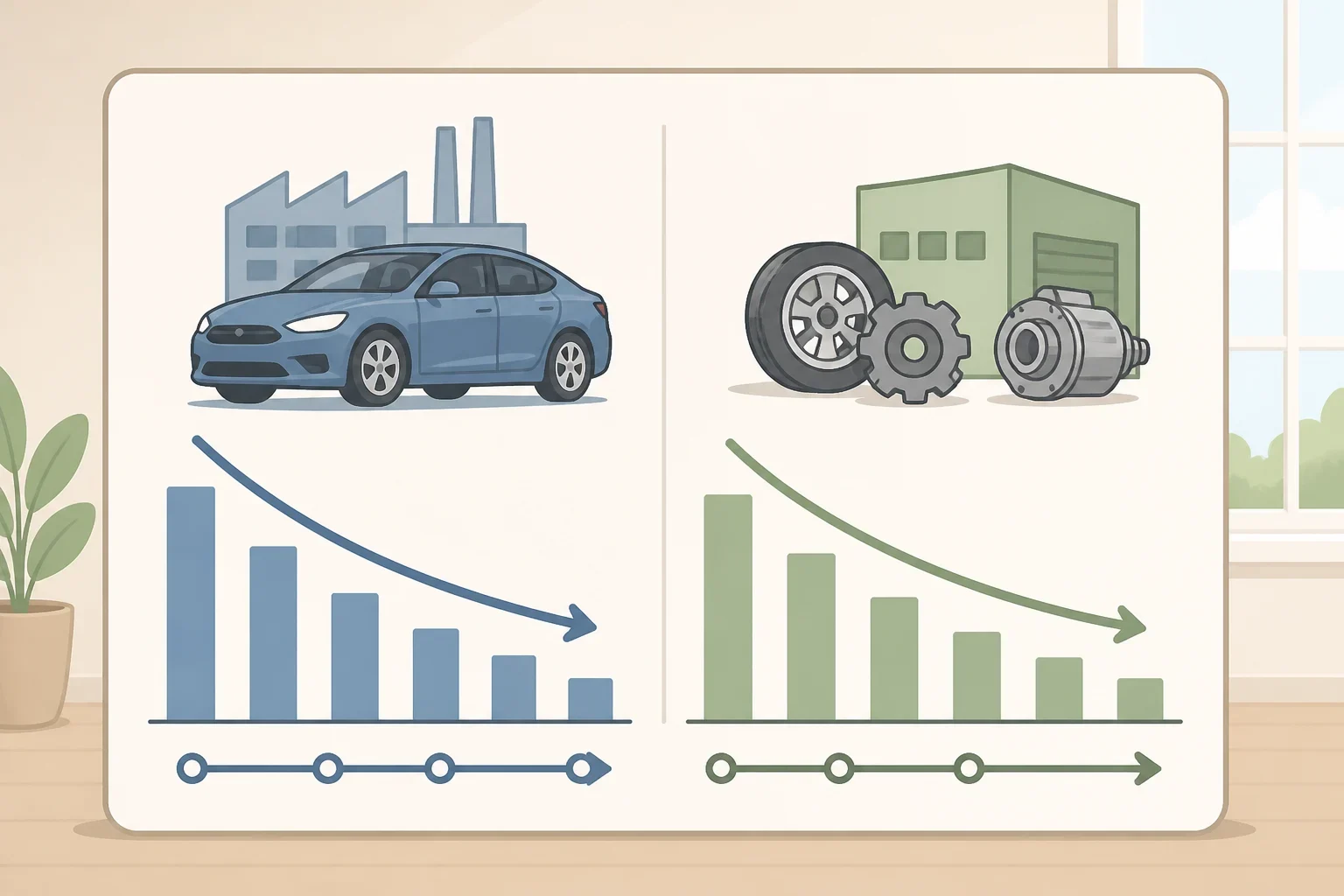
Automotive employment has fallen particularly sharply. The sector lost 32,000 jobs in the 12 months covered by EY’s first-quarter analysis and about 125,800 jobs since 2019, a 15% decline, EY reported five months ago.
The pressure is greater among suppliers than vehicle manufacturers. Supplier employment fell 11% in the year covered by the March analysis, compared with a 3.6% decline among manufacturers. Since 2019, supplier employment has fallen 23%, representing about 73,000 jobs, EY’s automotive analysis found seven months ago.
The insolvency figures point in the same direction, although filings do not equal total employment losses. Automotive companies recorded 39 insolvency filings between January and November 2025, compared with 29 during the same period in 2024 and 21 in 2023, EY reported seven months ago.
Manufacturers still had financial buffers and were reluctant to close entire plants, while site closures had become commonplace among suppliers, EY commentator Gall said, according to the March analysis. A vehicle manufacturer, a large parts supplier, and a smaller company dependent on one production contract can therefore present very different employment risks.
For employees and graduates, the supplier’s position in the chain deserves close attention. A role at a tier 1 supplier may not carry the same risk as work at a smaller tier 2 or tier 3 company, particularly when the business depends heavily on one automaker or production program. Before accepting an offer, ask how diversified the customer base is and whether the company is adding or reducing shifts.
Export shifts and strategic pressure
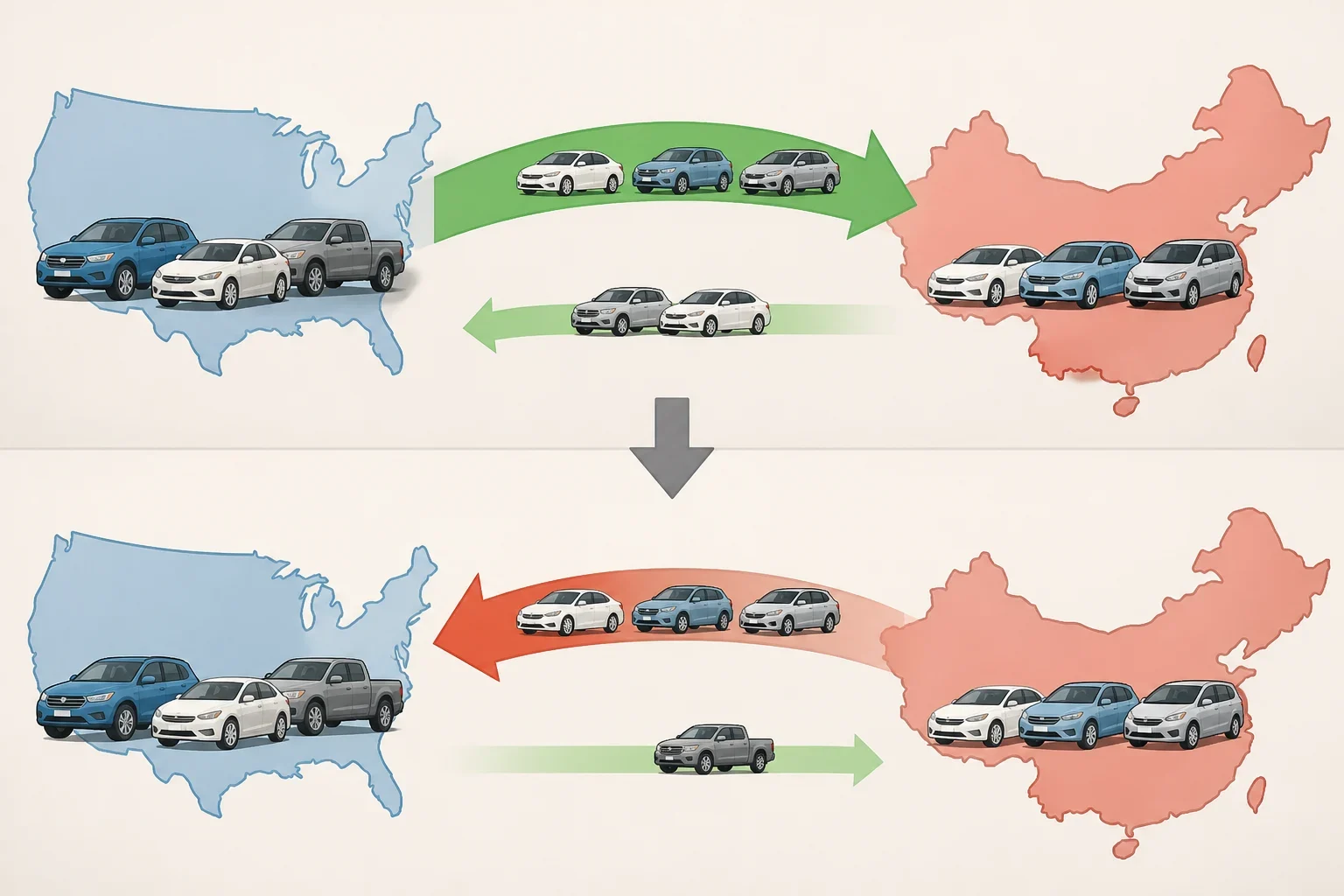
EY points to several pressures behind the industrial decline rather than one single cause. German industrial exports to the United States fell 16% year over year in the third quarter of 2025, while exports to China fell 8%. China, Germany’s second-largest export market in 2020, ranked eighth by late 2025, EY reported ten months ago.
The automotive trade figures show how much the competitive position has shifted at the European level. The European Union’s automotive trade surplus with China fell from €23 billion in 2019 to a €6 billion deficit in 2025. EU vehicle exports to China dropped 34% to €16 billion, while imports of Chinese vehicles and parts reached a record €22 billion, according to EY’s automotive analysis seven months ago.
Those are EU-wide figures, not Germany-only figures. They still provide relevant context for German manufacturers and suppliers whose production and investment decisions depend on international markets.
EY’s analysis also identifies high energy and labor costs, regulation, weak investment, limited confidence in an economic recovery, and sluggish domestic demand as pressures on German industry, as EY reported eight months ago. The automotive analysis adds that production is becoming more localized in important sales markets, which can reduce the need to supply those markets from Germany.
The electric-vehicle transition adds another layer. EY says many companies invested heavily in electric mobility expecting faster sales growth, but the expected volumes did not materialize. Its analysis describes manufacturers shifting back toward combustion-engine production, requiring further investment and write-downs, according to EY seven months ago.
For workers, the practical point is straightforward: current revenue may not reveal how a company’s production model is changing. Export dependence, vehicle technology, investment plans, and the company’s place in the supply chain can affect employment separately from short-term sales.
What job seekers and workers should check next
The available figures do not show that every industrial employer is reducing headcount, nor do they establish that technical skills transfer directly into another occupation. They do show that industry-wide and company-level conditions can diverge sharply.
Workers and job seekers can make their assessment more specific by checking:
- whether the employer is a vehicle manufacturer or a supplier
- how many customers and production programs support the business
- whether sales depend heavily on China, the United States, or another export market
- whether the company is investing in electric, combustion-engine, or other production capabilities
- whether headcount, shifts, or site plans have changed
- which technical skills can be documented for roles outside automotive manufacturing
Experience in production, quality, mechanical systems, electrical work, and industrial automation may be worth highlighting when comparing adjacent roles. The target employer may still require different equipment knowledge, credentials, or training, so those requirements should be checked before assuming a direct move.
EY’s automotive assessment is that job cuts will continue and that a full recovery remains distant, the March analysis reported seven months ago. It does not establish a precise timetable for further reductions.
For anyone working in or near Germany’s manufacturing and auto supply chains, the next step is to review the employer’s order book, customer concentration, export exposure, and production plans. Then update the resume to show transferable technical skills and compare realistic training options before a layoff notice forces the decision.
