


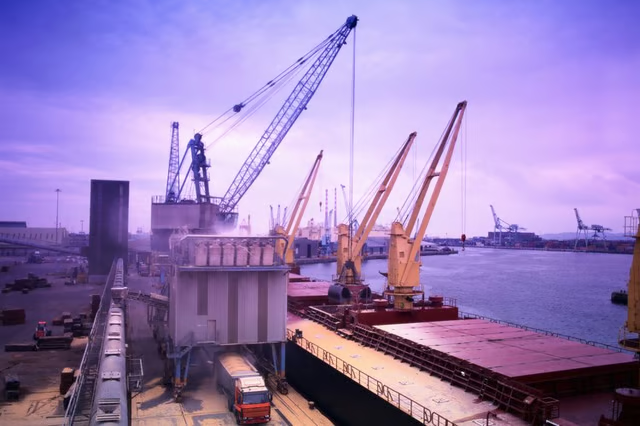
Freight forwarders are also known as cargo agents or freight agents. The U.S. Bureau of Labor Statistics claims that freight forwarders “facilitate incoming and outgoing shipments” by putting shippers together with shipping companies. Those who work with surface freight -- trucks and railroads -- and ocean freight require federal licenses. Ocean freight forwarders, called ocean transportation intermediaries, must have ocean-freight experience. Airfreight agents don’t require a license or experience, but must complete industry training.
Ocean Transportation Intermediaries
You must have three years of documented experience working for a firm licensed as an ocean transportation intermediary in U.S. foreign commerce before you can get a license as an ocean transportation intermediary. You must file a Form FMC-18, “Application for License as an Ocean Transportation Intermediary,” with the Federal Maritime Commission. The fee, $825 as of July 2013, must accompany the application. You will receive notice of the commission’s licensing decision in approximately 45 days. The commission will issue your license when you provide proof of financial responsibility in the form of a bond or insurance.
Trucking Freight Forwarders
It helps to have some experience working with a truck broker or freight forwarder, but it isn’t required for licensing.You can complete the application, Form OP-1(FF), online or through the mail. What are the steps in getting an operating authority? When you pay the $300 filing fee, you receive the “FF” number you’ll use in all future transactions with the FMCSA. As soon as possible, apply for cargo insurance in the amount of $5,000 for property loss or damage for any one vehicle and $10,000 for damage at any one time or place. Next, file a Form BOC-3 with the FMCSA for each state within which you will do business to designate a person or company to receive legal service on your behalf.
Airfreight Freight Forwarders
The International Air Transport Association is the industry association to which all airlines belong. The airlines, both cargo and freight, maintain administrative control of the industry through membership – if the IATA has no record of your having taken the IATA-provided courses, you can’t access the forms data or electronic systems necessary to function within the industry. This applies to airfreight forwarders, as well. You must take the IATA Cargo Introductory Course, delivered online. According to the IATA website, the $310 course requires 160 to 200 hours to complete and covers waybills, IATA operations manuals, operation of freight forwarders and airline cargo units and cargo operations. The IATA offers the 3.5-hour examination four times yearly, in March, June, September and December.
Intermodal Freight
Intermodal freight moves by more than one mode of transportation. It’s often loaded into a truck first, but the trailer with the freight may move across the country behind a tractor or on a rail car, to be loaded onto a ship or into an airplane. There’s no single license for all intermodal freight. There’s no railroad freight-broker license, because when the freight is delivered to a railhead, the receiving railroad arranges for rail transportation going forward to the terminal rail destination. To complete an intermodal move, a freight forwarder may require an FMCSA license, as well as an ocean transportation intermediary license, if the shipment requires ocean shipping, or an IATA certification if it’s to move by air.
